



Four years ago, I wrote in Public Square Magazine about imagining a mental health system “centered on learning and growth” as part of a series on the worsening mental health crisis in America. With wise counsel from my wife, Monique, I’m considering here what this same broader paradigm shift could specifically mean for maternal mental health in the U.S.
Few events in recent memory have drawn as much attention to maternal mental health as the heartbreaking Lindsay Clancy case — with many people weighing in on what the larger take-away should be. For instance, Nicole Kumi, a postpartum mental-health expert, told CBS News: “the duty is on the system to revamp, and I feel like this case is going to put the system in a place where they have to act. Changes have to occur.”
Sounds good, but what changes? And how exactly does the system need to be revamped?
Much of the commentary I saw focused on proposals to make the existing system more efficient and encourage people to trust it more.1 Two examples:
Psychiatrist Jennifer Payne told the Boston Globe, “The reality is, these gaps exist in the entire health system” (referring to limited supervision by Clancy’s doctors after making a prescription). She then added, “Anybody who’s prescribing a medication should follow up with that patient,” but patients can seek care elsewhere, “and nobody’s tracking that.”
Veerle Bergink, director of the Women’s Mental Health Center at Mount Sinai Hospital in New York, tells The Guardian that the primary problem is a lack of formal understanding about “postpartum psychosis” which does not yet exist in diagnostic classification systems. “We’re really in the middle ages here.”
The same article emphasizes how “treatable” postpartum psychosis is, stating: “Response to treatment with lithium and electroconvulsive therapy ‘is excellent.’”
Better follow-up and more accurate diagnostics could surely make a difference. But is this really what Lindsay Clancy lacked — a better diagnosis, another prescription for lithium and maybe some electroconvulsive therapy?
What these commentaries seem to miss is that Lindsay Clancy had no shortage of psychiatric treatment (30 prescriptions involving 13 medications), diagnoses (five, not counting postpartum psychosis)2 or supervising doctors (six providers in the months before the tragedy).
Are we to honestly believe that more diagnoses, more medications and more attention from additional providers were the missing ingredients in her failed care?
No mother in her right mind would do what Lindsay did

A photograph of Lindsay Clancy and her children circulated during the trial.
Listening to mothers themselves
Rather than asking only professionals within the existing system to direct needed changes, this is an especially important time to listen to mothers themselves. Over the past decade, some researchers have interviewed mothers about what they need to thrive, while others have collected first-person accounts of women navigating postpartum depression and anxiety. For instance:
In 2014, British researchers interviewed 17 women who had experienced emotional difficulties during the first year after childbirth to explore how they understood their distress and what they needed. In addition to the shock of adjusting to motherhood and unmet needs for support, many women described feeling ignored or rushed by healthcare professionals. Others expressed appreciation for a compassionate provider who listened without judgment.
A 2015 British interview study found that most of the 17 women did not identify with the concept of postnatal depression. They described forms of distress that they felt the healthcare system failed to recognize. One takeaway was an appeal to recognize a broader range of emotional experiences, rather than relying on depression-focused screening alone.
One particularly valuable study, published in 2020, involved interviews with 30 new mothers. The researchers began by noting that previous literature had “identified a gap between what experts recommend and what mothers desire during the postpartum period.”
Social support came up over and over: “I think someone to talk to is the biggest one. Because I just―I don’t know. I had so many doubts and whether I was doing the right thing or not or trying to figure out the right thing to do for a lot of different scenarios. So yeah, just helped me to be able to talk about that to somebody.”
One mother described the value of having more realistic expectations about infant crying: “I think me being calm and knowing that he’s okay and if he cries, just going through the checklist. Did he eat, did he sleep, did he poop? If he had all his things, then maybe he needs one extra feed or a little bit more sleep or whatever. But … if he did everything today, then he is good.”
One mother who felt exhausted by being constantly around her baby said: “I’m like her favorite person right now, so that is difficult when I’m like, ‘Just take the baby.’ And then in the morning, [my husband will] bring her downstairs, and she just wants to come back to be with me. I’m like, ‘I love you so much, but go away. I need like an hour, or like five minutes, or a breath.’”
The study identified a wide range of factors influencing mothers’ well-being:
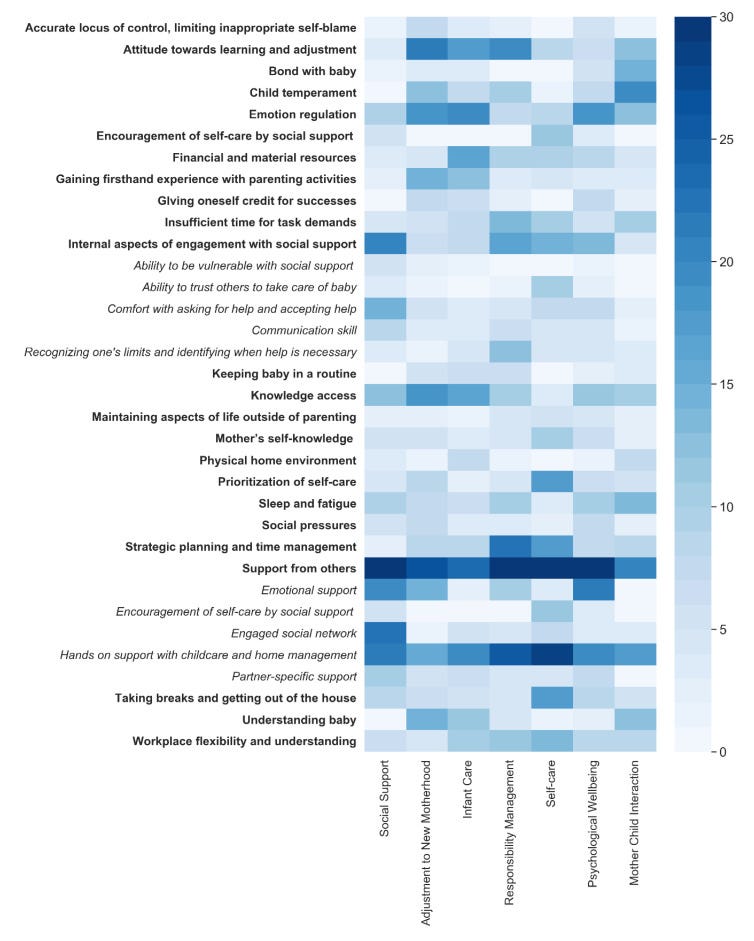
Mothers are clearly navigating a broad range of factors that can affect their postpartum well-being.
Our usual approach to maternal mental health
Listening more closely to mothers could change a great deal, especially because their accounts suggest that they need something beyond treatment as usual.
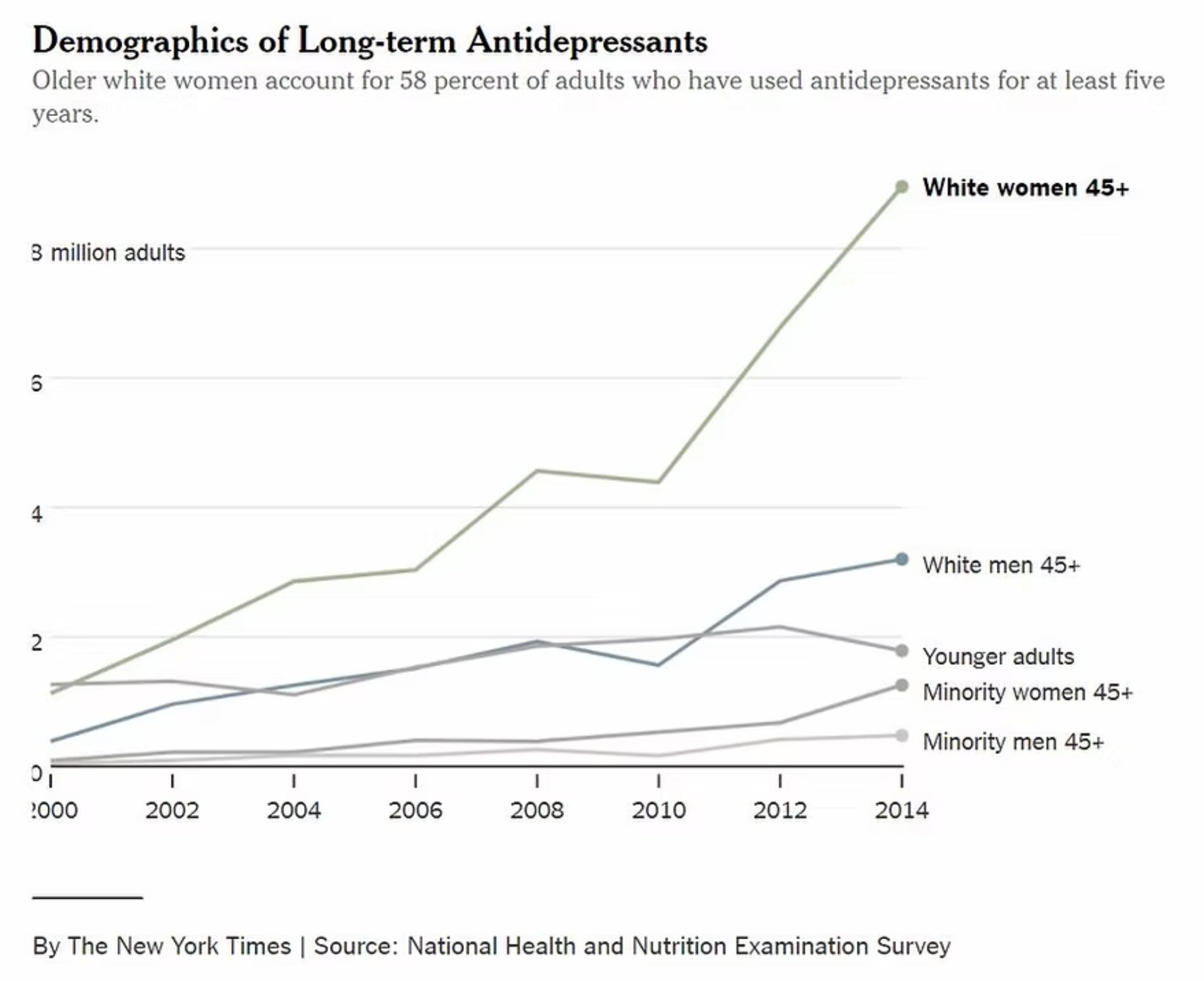
Over the past three decades, psychiatric treatment—particularly antidepressant use—has increased substantially across a wide range of demographic groups in the United States. But few groups of people take more antidepressants than women.
By 2002, women’s antidepressant use had tripled compared with 15 years earlier. Over the following two decades, it doubled again — with women consistently using antidepressants at roughly twice the rate of men, with these medications prescribed to nearly one in four women over age 60.
That increase is evident in young women:
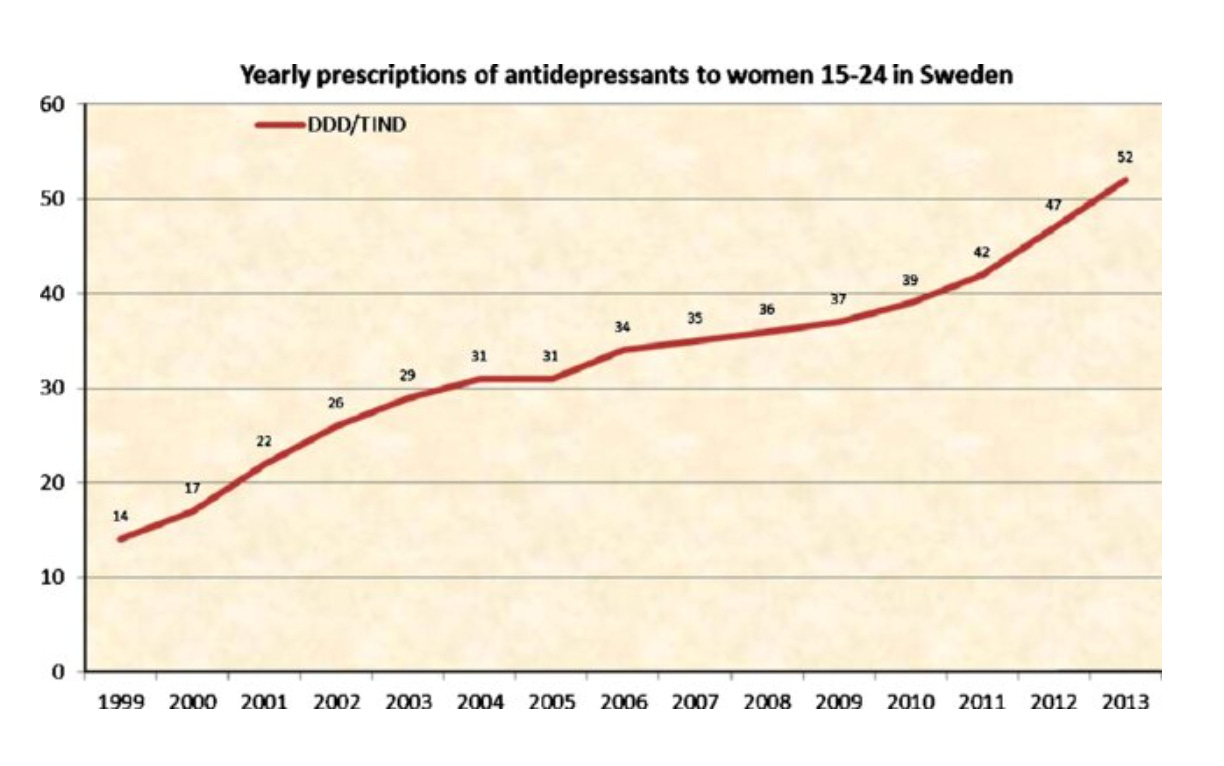
(In this analysis from 1999-2013, antidepressant use among Swedish women ages 15–24 nearly quadrupled across these 14 years, rising from about 14 daily users per 1,000 women to 52 per 1,000.)
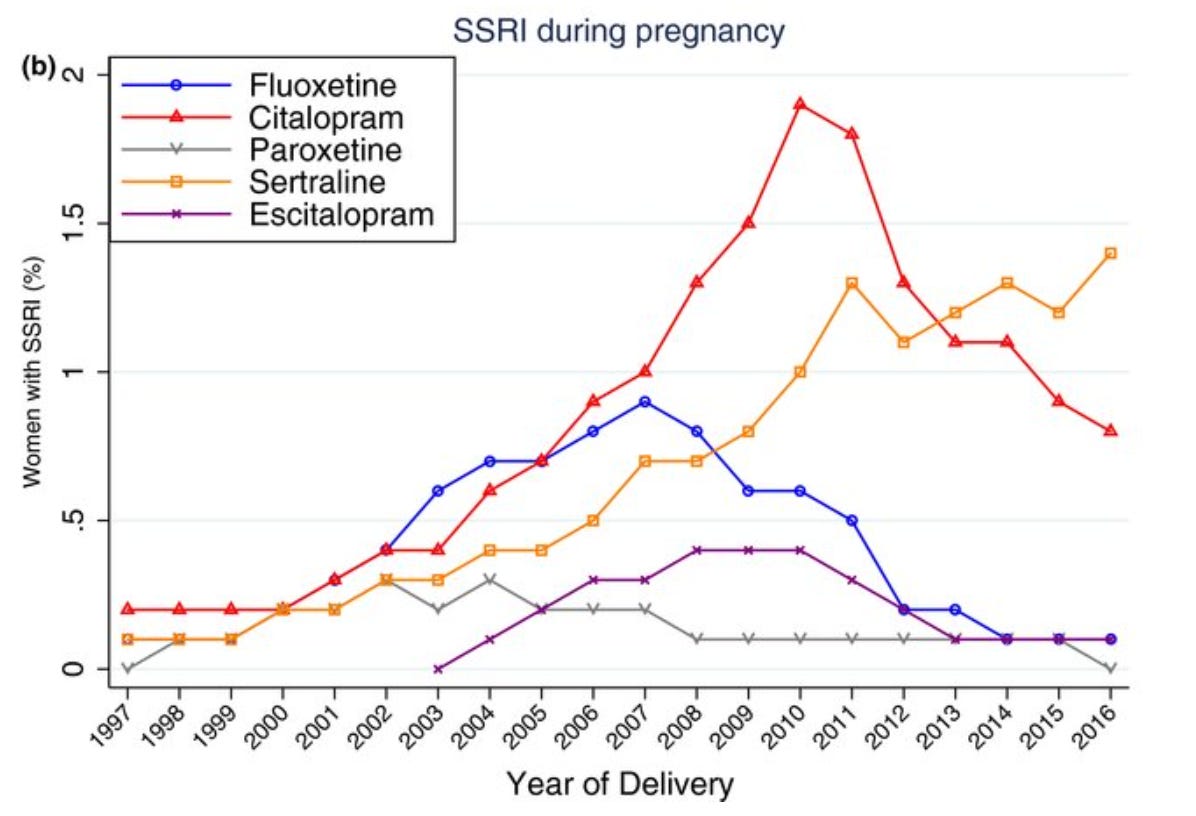
The increase also includes pregnant mothers:
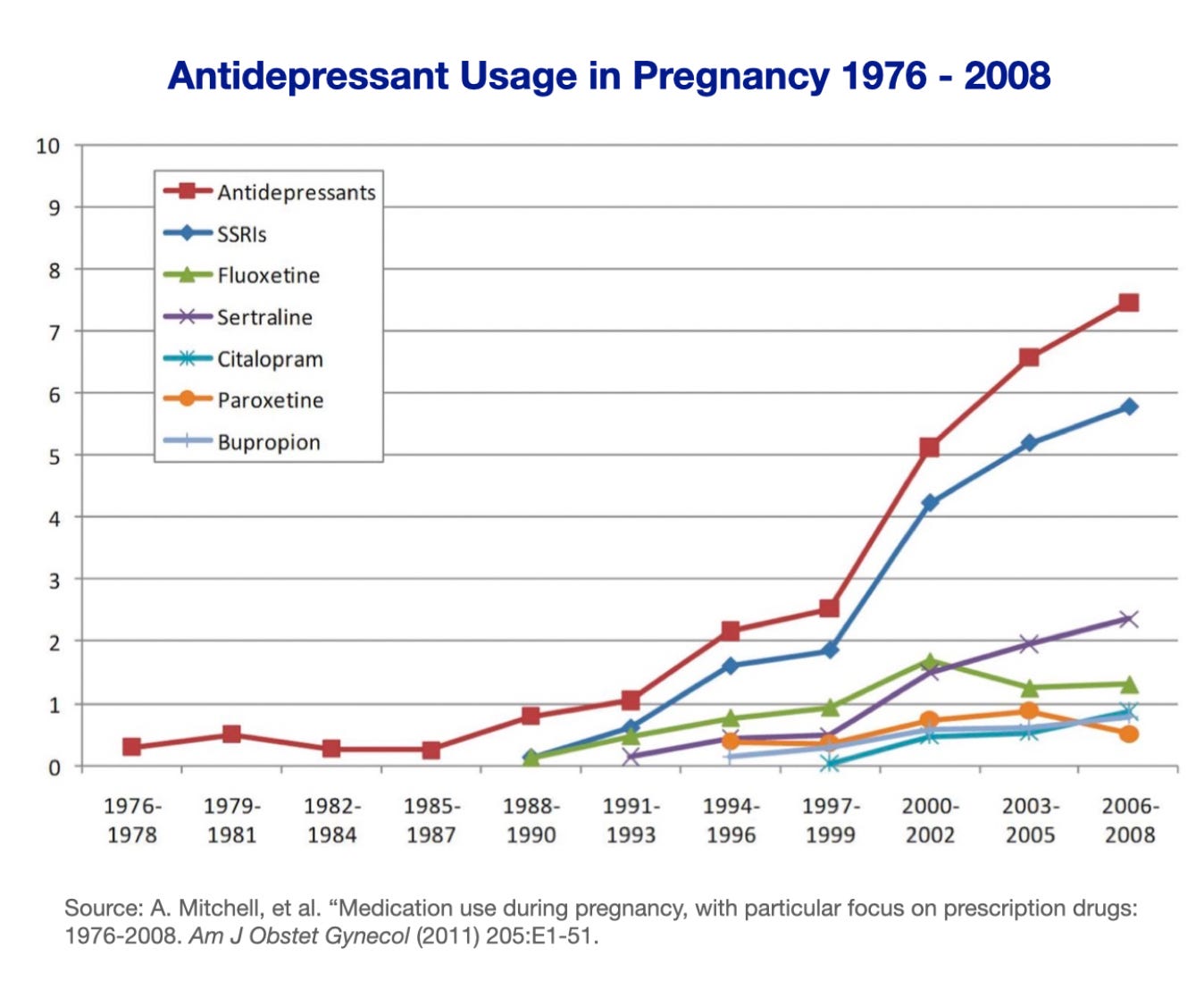
(Note: Antidepressant exposure during pregnancy continued to rise after 2008. By 2014–2018, about 6% of women reported taking a medication for depression or anxiety during the first trimester, compared with 3.7% in 1997–2001. The changing patterns of antidepressant use during pregnancy are also evident in this graphic).3
By the way, virtually no one, myself included, disputes the potential stabilizing value of antidepressants in some cases, for a certain period of time.4 Whether the risks of doing so in pregnancy are outweighed by the benefits, however, remains a sharply contested question.
What’s less contested, however, is this: we as a society have turned to these medications as a first and primary source of relief for most people facing depression, including pregnant women, even though we know there are other things that could likely be emotionally relieving.
Given that, we all know what usually happens when women speak with a mental health or medical professional about feeling anxious or down. They walk away with a prescription, often without receiving adequate support for the other factors affecting their well-being.

Another approach to maternal mental health
Imagine if psychiatric treatment were not the automatic first step. Instead, pregnant women could be offered a range of supportive interventions that target the wide array of mental health risk factors connected to bringing a baby into the world.
Years ago, after developing a general inventory of depression risk factors, I began work on a similar inventory focused on postpartum depression. It was Cheryl Tatano Beck at the School of Nursing, University of Connecticut who first developed in 2002 a Postpartum Depression Predictors Inventory, which identifies 13 general areas that can set up a pregnant woman to struggle with depression:
Marital/relationship status
Socioeconomic status
Self-esteem
Depression during pregnancy
Anxiety during pregnancy
Unplanned/unwanted pregnancy
Previous history of depression
Social support
Marital/partner satisfaction
Major life stress
(After delivery, three additional domains were added):
Child-care stress
Infant temperament
Maternity blues
Beck did amazing work, although her inventory was based on research from the 1990s. By 2026, approximately 2,500 scholarly articles had explored risk factors for postpartum depression. Although subsequent studies found Beck’s inventory impressively predictive of later depression, more recent research highlights other areas of vulnerability that could strengthen this inventory, including intimate partner violence and sleep struggles. As most women know, simply not being able to sleep after a baby is born can be a psychic shock.
In addition, there are several protective factors that help women guard against postpartum depression. These include: parenting interventions, doula support, breastfeeding support, physical activity and overall nutrition and diet.
The larger point is to establish a broader foundation for a lifestyle-oriented approach to maternal mental health — one centered on learning and growth.
To focus on learning and growth means acknowledging fundamental wholeness and potential, which sharply contrasts with how many feel in our mental health system today.

A different first step
Imagine if mothers experiencing emotional distress were first invited to explore these 20 areas,5 identifying both their existing strengths (“you’re lucky to have a supportive partner and lots of social support”) and the circumstances that might be making things harder (“all this financial burden isn’t helping you” — neither is your history of poor sleep and little physical activity”).
Based on conversations like this, any woman could be supported in crafting a custom-designed emotional wellness action plan for her pregnancy. Rather than centering the plan on a single intervention, this approach would draw on a range of research-informed strategies, including:
Strengthening connection with your partner
Creating safety in your relationships
Building confidence and self-worth
Learning from your emotional history
Developing skills for managing anxiety
Working through difficult pregnancy feelings
Finding ways to ease financial stress
Lightening an overwhelming daily load
Building a strong support network
Reconnecting with meaning and purpose
Making space for rest and renewal
Preparing emotionally for postpartum changes
Preparing for birth and recovery
Building confidence in parenting skills
Learning to respond to your baby
Getting support with breastfeeding challenges
Protecting sleep and nighttime rest
Keeping your body safely active
Nourishing yourself with healthy food
Building skills for difficult emotions
Two confirmatory lists
These practical growth options for a personalized emotional-wellness plan correspond nicely to the many actionable influences on mothers’ well-being identified in that 2020 interviewing study, including:
Accurate locus of control and limiting inappropriate self-blame
Attitude toward learning and adjustment
Bond with baby
Child temperament
Emotion regulation
Financial and material resources
Gaining firsthand experience with parenting activities
Giving oneself credit for successes
Insufficient time for task demands
Internal aspects of engagement with social support
Keeping baby in a routine
Knowledge access
Maintaining aspects of life outside of parenting
Mother’s self-knowledge
Physical home environment
Prioritization of self-care
Sleep and fatigue
Social pressures
Strategic planning and time management
Support from others
Understanding baby
Workplace flexibility and understanding
This range of action steps also maps onto many of the areas identified in the innovative “Barkin Index of Maternal Functioning,” pictured below.
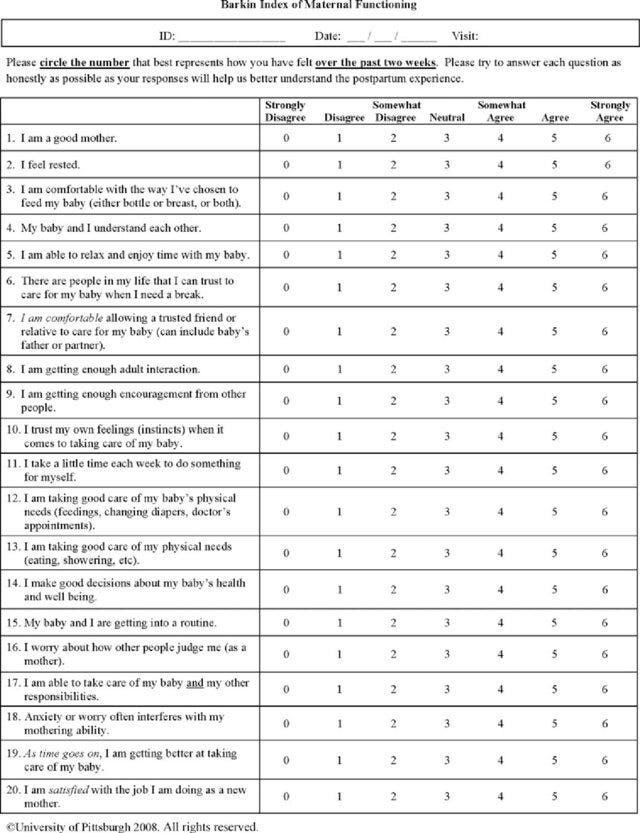
Consider how much more reassuring and helpful this comprehensive approach could be than hearing, “Well, it looks like you meet the criteria for depression. Let’s start you on something and hope it works!”
Certainly, each of these areas of learning and growth has a cost: effort, time, and investment. But none of these approaches has the same range of possible side effects associated with antidepressants, some potentially serious (especially for the babies).
Learning and growth as an engine for healing
What might this broader approach mean for women like Lindsay Clancy — and for the many other mothers who struggle emotionally during pregnancy and after childbirth? We cannot know whether a different approach would have changed her story. But we can ask whether our current system is giving mothers the full range of support they need, especially when they bring histories of trauma and other vulnerabilities into pregnancy.
As psychiatrist Bessel van der Kolk argues in The Body Keeps the Score, medications can help people find their footing in the present, but they don’t necessarily teach the lasting skills of emotional self-regulation. That distinction matters. Medication can be essential, especially in severe distress. But relief from symptoms is not the same as learning how to navigate them.
After decades of expanding psychiatric treatment, we’re still hearing calls to do more of the same: identify more conditions, prescribe more medications, and supervise treatment more closely. These things matter. But they leave a larger question unanswered: Where are we helping mothers build the skills, relationships, and everyday conditions that make healing possible?
Imagine a maternal mental health system that does both: treats serious illness when needed while also helping women strengthen relationships, find support, protect their sleep, build parenting confidence, and learn to work with difficult emotions.

Mothers need more than treatment for what’s going wrong. They need support in building what helps life go right.
Let’s listen more closely to pregnant women, mothers, and anyone else struggling emotionally. They need more than medication and supervision alone: they need support that can help them find deeper healing, peace, and joy.
For more on this broader approach to mental health, check out my book with Clay Olsen published this fall: “Recovering Hope: Science-Based Tools for Long-Term Healing from Depression, Anxiety, and Addiction.”
Notes:
Many continue to argue for making sure people have “access to resources” and of course, “decreasing stigma” — a mental health campaign that first went mainstream in the 1990s with Eli Lilly depression-awareness and anti-stigma initiatives while marketing Prozac.
Generalized anxiety disorder was Clancy’s initial diagnosis in fall 2022, with multiple clinicians diagnosing subsequent major depressive episodes and associated insomnia as a major presenting problem. Later, postpartum depression/anxiety were raised by certain clinicians, along with bipolar disorder.
When it comes to long-term antidepressant treatment which has been rising, more concerns have been raised about the counterintuitive effects many women experience from antidepressants.
20 general domains of vulnerability for postpartum depression:
Partner relationship & stability
Relationship safety & violence
Self-worth & confidence
Depression history & current vulnerability
Anxiety during pregnancy
Pregnancy wantedness
Birth experience & postpartum transition
Restoration & renewal
Infant temperament & demands
Breastfeeding challenges
Caregiving stress & overload
Sleep disruption & deprivation
Physical activity & movement
Nutrition & physical health
Financial strain
Premenstrual mood sensitivity (PMS/PMDD)
Meaning & purpose
Social support & isolation
Parenting confidence & skills
Trauma history & difficult past experiences