


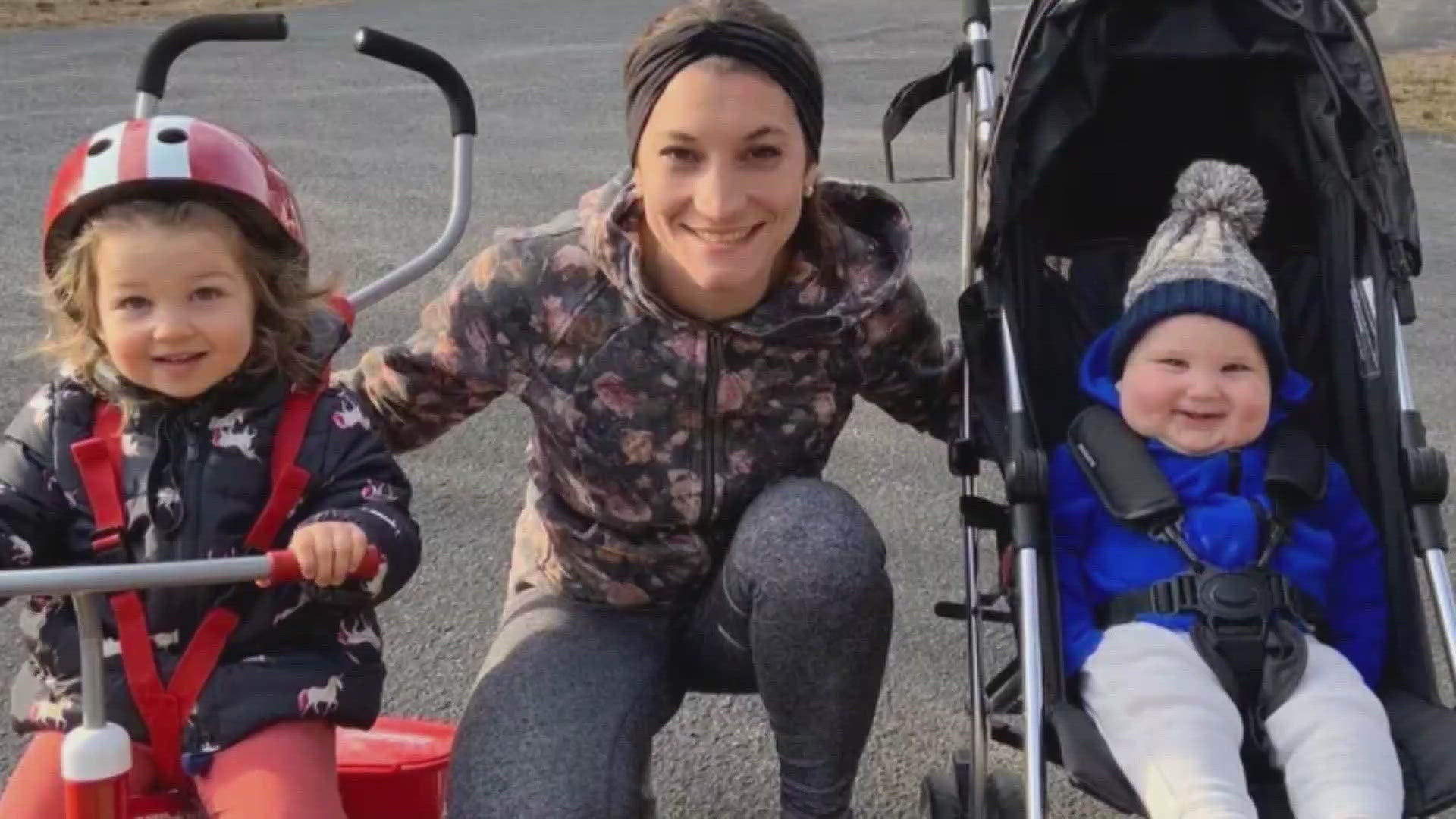
A photograph of Lindsay Clancy and her children circulated during the trial.
Lindsay Clancy, the mother who has been on trial for the murder of her children in Massachusetts, yearned to find healing and feel better: “I want help. I want to be well,” she wrote in her diary.
But instead of getting well, she got treatment. A lot of it.
Although it’s unclear how many medications the young mother was taking at the time, The Boston Globe noted that the court recorded prescriptions for 13 different psychiatric medications from six different providers during the five months before the tragic January 2023 deaths of her three small children.
That includes:
Sertraline (Zoloft)
Fluoxetine (Prozac)
Trazodone
Mirtazapine (Remeron)
Lorazepam (Ativan)
Clonazepam (Klonopin)
Diazepam (Valium)
Buspirone
Zolpidem (Ambien)
Diphenhydramine (Benadryl)
Lamotrigine (Lamictal)
Quetiapine (Seroquel)
The first four are classified as Antidepressants, the next four are used for anxiety — including three benzos — then two Sleep/Sedating Medications on top of that, one “mood stabilizer” and an antipsychotic.
Lindsay became increasingly reluctant and apprehensive about taking psychiatric medications, as the trial made clear, especially after experiencing troubling side effects that made her wonder whether the treatment was helping.
According to prosecutors, there was also a note in her phone days before the tragedy that said: “Medication stole my motherhood and my life … prescription medication stole me from my own body.”
Note: None of what I’m reviewing here constitutes medical advice about your own situation. If you or someone you love have been prescribed any of these medications, this should not change what you are doing. Remember, it can be dangerous to taper off a medication quickly, something that should only be done gradually and with support. Mental health and medical professionals can be a significant help in navigating these things. Talk with your doctor about any concerns you notice in your own treatment.
Listening to ‘intrusive thoughts’
As recounted by a psychiatrist in The Free Press, Lindsay Clancy began having suicidal ideation and experiencing “intrusive thoughts” and “auditory hallucinations” telling her that she was “damaged” and would “not be the same,” and that “the only option is to die.”
She acknowledged in December 2022 that she was experiencing thoughts of harming her children to both her husband and mother (each of whom testified to her being a wonderful mother previously). And a month later, as Clancy would recount later, a loud, demanding male voice told her over and over, “This is your last chance. You have to kill the kids so you can kill yourself.”
Clancy said she entered “a dreamlike state” and watched herself act, feeling as if she had “no choice.” Weeks after the crime, Clancy shared with a hospital chaplain that voice “told her that if she did not follow the command, neither she nor her children would be safe.”
According to psychiatrist Phillip Resnick, Clancy felt she had to “obey,” “She felt that her body was taken over by an external force, where she was in a dream state and did not have control of her own body,” Resnick told the jury. “It was almost like she was a puppet and someone else was pulling the strings.”
“Go to God, baby,” she allegedly told each child in the horrible moment. In the psychiatrist’s words, she was “acting on a deranged belief that her kids would suffer so greatly without her that they needed to die.”
Resnick said that Clancy genuinely believed she was protecting the children by taking them with her to heaven. Consistently, Clancy told the hospital chaplain a week after the killings: “I am so glad my children are safe.”
Other stories like Lindsay
Years ago, I encountered a group of parents who had banded together after similar experiences of someone in their family — a son, a daughter, a spouse — who had committed horrific and uncharacteristic acts of violence while taking some kind of psychotropic medication.
They created websites like this one, with close to a thousand stories of horrifying family violence across the U.S., Canada and England between 1990–2011 at the hands of someone taking an SSRI medication — including 232 stories where a child was the victim (and another 100 murder-suicide stories involving parents and children).1
Here are just two examples:
One father describes how his behavior changed dramatically in a short period: “Over a 3-week period, I changed completely from being a loving, caring and nurturing father of 2 beautiful children to taking the life of my beloved son Ian, in a calm, organized state of delirium-psychosis.”
Steindor Erlingsson likewise recounts how a few days after starting his SSRI antidepressant, “terrible thoughts came into my mind. I wanted to harm my wife and newborn son. Every time I saw a knife or thought about one an incredibly strong urge to injure them erupted.”
I’ll never forget a story of one father who killed his young daughters — especially because his wife was adamant during the legal process that this was completely opposite and uncharacteristic to his true nature.
This is, of course, a small subset of people who receive treatment. We don’t know why this happens. And the vast majority of people taking antidepressants and other psychiatric medication will not harm themselves or others.
But these stories seemed plausible to me because I had interviewed a close friend who told me that, after starting Prozac while struggling emotionally, he noticed his paranoia shoot up considerably. When he went back to the doctor to share concern with this shift, my friend described how the doctor recommended a higher dose. As his medication increased, my friend told me his paranoia increased to the point that he wrote out a “hit list” of people he wanted to knock out in a blaze of glory at work.
As alarming as this was for me to hear, thankfully it was alarming to him as well. He noticed what was happening and began tapering off. As soon as he did this, the paranoia went away — and so did the thoughts of harming other people.
What medications have been connected to acts of violence?
These are not secrets to our regulatory agencies or researchers either. Five different antidepressants were in the top 10 list of medications associated with violence, as the Massachusetts Nurses Association reported in 2011.
The authors of the original study concluded that their analysis provides “new evidence that acts of violence towards others are a genuine and serious adverse drug event that is associated with a relatively small group of drugs.” That includes one medication to help people stop smoking (Varenicline) and antidepressant SSRIs (selective serotonin reuptake inhibitors) which were “the most strongly and consistently implicated drugs.”
Swedish researchers later found in 2020 an “increased risk of violent crime during SSRI treatment in a small group of individuals” — a risk they found persisted during treatment and in a number of months afterwards.
British scientist David Healy is a prominent researcher on adverse drug effects like these. On his drug-safety website summarizing the research, it states, “Prescription drugs can cause violent or aggressive thoughts, acts, and behaviors, or can trigger behaviors like alcohol misuse or other substance abuse that ends up in violence, or can cause a disinhibition that leads to violence” — then says:
“It is important to find out if there is a connection between these thoughts and your prescription so that adjustments can be made.”
Dr. Dee Mangin, Data Based Medicine’s Chief Medical Officer and a professor in the Department of Family Medicine at McMaster University in Canada, is quoted as saying: “Violence has not traditionally been seen as a medical problem, but the range of drugs now linked to violence has grown, including drugs used in smoking cessation, dermatology, asthma, weight loss, insomnia, and behavior.”
Appealing for more study
It’s data and stories like these that have led parents to gather with professionals who have noticed the same concerning pattern. About 8 years ago, several of these supportive professionals wrote a public letter about “what appears to be strong evidence of a significant correlation, and in some instances, an actual causal relationship, between the use of prescribed psychoactive drugs and the commission of violent acts against oneself or others.”
To back up their concern, the letter-writers referenced individuals “who have a family member incarcerated for committing a violent act while under the influence of a prescribed psychotropic drug and persons who have survived their own suicide attempt” — along with “parents who took the lives of their own children while on psychiatric drugs and others who were plagued by thoughts of doing the same.”
But how will anyone pay attention to this, they wondered — given the deep trust vested in these medical professionals involved in prescriptions. They also noted that “little or no attention has been offered by major mainstream media to a possible connection between an ever-increasing use of prescribed psychoactive drugs and instances of mass violence and/or increasing suicide rates.”
Their big hope as an initiative was to encourage Benedict Carrey, a New York Times reporter, to write an article or series shining a light on these experiences and the perspectives of those involved — something that could amplify their “concern about the probability that there is a close relationship between ingesting prescribed psychoactive drugs and violence against oneself and others.”
This team of family members and scholars were also “advocating the need for a government-financed investigation of the reality, nature, and consequences of such a relationship undertaken by persons of integrity who are independent of the pharmaceutical/psychiatric complex.”
Little awareness, little action
So, did anything ever come of these efforts?
Carrey had reported in 2008 about a shooter at Northern Illinois University who was taking antidepressants, stating “Over the years, the antidepressant Prozac and its cousins, including Paxil and Zoloft, have been linked to suicide and violence in hundreds of patients.”
But I’ve never seen sustained reporting on the issue across other major news outlets. Nor was there a corresponding public cry for action or research or steps forward — as confirmed by two people I contacted who were involved.
I personally find the possibility of drug-induced violence a compassionate one for families who are left behind to pick up pieces — something to help them make sense of what can feel wholly senseless.
Lindsay’s fault — or something messing with Lindsay?
Returning to Lindsay, her defense attorney Kevin Reddington has argued that the prosecution’s portrayal of her as a calculated, cold-blooded killer ignores the profound mental deterioration that preceded the killings.
I agree. No one disputes how evil and cruel the killing of children is. But many of the social media influencers and cable news hosts screaming about how “evil” Lindsay is seem to also be laying aside the extensive evidence of her mental deterioration.2
Combined with abundant evidence that she was a good mother, as vouched by her own husband, it seems likely future juries would similarly be ready to mostly acquit (which almost happened here).
My friend who served as a public defender for people on death row worked to tell the “whole story” of someone leading up to a crime. I believe a loving God similarly accounts for all the factors, in a way that allows both justice and mercy.
I foresee a day in the eternal future when Lindsay embraces all of her children tenderly and say “I’m sorry! You know I really always did love you!”3
That’s when her full healing will come. In the meanwhile, I’m glad Lindsay has received so much support.4 She’s going to need it, as she will undoubtedly suffer terribly over what she did for the rest of her life. .
Shouldn’t it give us some compassion to understand the full severity of what someone was suffering at the time of a horrific act?
When young parishioner took his life in approximately 1527, Martin Luther insisted on digging the man’s grave within the church yard (when tradition stipulated he shouldn’t be buried there).
“Such persons do not die by free choice or by law,” he said, “they do not wish to kill themselves but are overcome by the power of the devil.”
“They are like a man who is murdered in the woods by a robber,” Luther analogized." “‘tis the devil who has put the cord round their necks, or the knife to their throats.”
One more story
Tatiana Morales writes about her own experience with a similar rollercoaster of symptoms during a period when she was prescribed around fifteen medications over a three-month period by five different doctors, including Klonopin, Ambien, Remeron, Trazodone, Buspar, Prozac, Lithium, Librium, Seroquel, Propranolol, and medical marijuana—many of which Lindsay Clancy was also prescribed.
And similar to Lindsay, Morales writes, “despite the medications, I didn’t get better—instead, I only got worse.”
Morales described insomnia as “the worst mental and physical torture I’d ever known” — explaining: “What people don’t understand about insomnia is that it isn’t just the occasional struggle to fall asleep at night. When you’ve struggled with severe insomnia, like Lindsay and I did—I’m talking one to four hours of sleep every night for days, weeks, even months on end—the way you interpret reality shifts.”
“The less sleep I got, the more distorted reality became,” she writes. “I felt so dizzy that the words I read on my computer seemed to float off the screen. The world around me felt dull and gray. I was irritable, pessimistic. I suffered from panic attacks daily. The bright lights from the TV were enough to throw me into a rage. I was angry, even violent—mostly towards myself, other times towards benign household objects.”
Yet concerns she was having got brushed off by one doctor as “psychosomatic.” The author asked, “Why are some psychiatrists so reluctant to believe that medications can, sometimes, cause serious damage?”
Morales acknowledges those who insist Lindsay’s problem wasn’t overmedication, but instead switching medications and not “giving them enough time to work.”
In her case, she said, “I came to the realization that no external medication was going to fix what was ultimately an internal problem. I had been on-and-off psychiatric medications since I was sixteen years old, but nothing had really changed. I had tried every big-name antidepressant, and yet, I was still depressed. I was still anxious. I had tried every sleep med, but I still wasn’t sleeping. What if it wasn’t psychiatric drugs that would fix me?”
From there, Morales embarked on what she called a “spiritual journey” — including learning to meditate. “It wasn’t easy—in the first few weeks, whenever I sat down to meditate, it was as if my brain was writhing around on the floor in pain—but after a while, with a lot of hard work, I managed to reset my nervous system.”
“But while I got better, Lindsay Clancy never did,” Morales notes. “Instead, on January 24th, 2023, she did the unthinkable.”
“While it’s easy for me to say I wouldn’t ever do what Lindsay did, the truth is, when I was most ill, I became someone very different, someone who was capable of flying into uncontrollable rage. And while I don’t know if Lindsay’s mistreated mental illness exonerates her from her actions, at the very least, it should be taken into heavy consideration.”
Notes:
There are 30 stories during this same period where the person was acquitted or cleared of charges when the judge concluded the medication played a significant role.
It’s perhaps not surprising to see so many people simply blaming Lindsay as “evil.” As Peter Breggin pointed out years ago, the natural bias at play in so many cases is that when good things happen, we attribute them to the medication; when bad things happen, it’s the person’s fault.
One reader called this line especially “heinous.” My response: Is this not simply amplifying the most beautiful verse in the Bible, “He will wipe away every tear from their eyes, and death shall be no more, neither shall there be mourning, nor crying, nor pain anymore, for the former things have passed away” (Rev 21:4)
Rather than dismissing the many women expressing support for her in bombastic political screeds, maybe online influencers could consider this as a reflection of how many other mothers may have grappled with similar despair (25-30% of whom are on antidepressants according to the latest data).
Jacob, you make so many good and valuable points here and handle this difficult subject with a tenderness, reflective of your intelligent mind, good heart and naturally compassionate nature. I admire your determination to waste and wear out your days in true Doctrine and Covenants Section 123 fashion and wish you the blessings of a passionately cheerful disposition, to both magnify and accompany, your other God given spiritual gifts. ☺️
As usual, Jacob, you provide a thoughtful, compassionate take on an exceedingly difficult situation.
A low dose SSRI & some intensive therapy (eventually spurred on by my mother's sudden death very early in my 2nd pregnancy) helped lift me out of the dark depression with which I had suffered for 2 years shortly after ceasing to nurse my oldest at 13 months.
I never wanted to harm my toddler, for which I am grateful. I never wanted to harm myself either, though there were many days I could barely get out of bed, wondered what the point of it all was, and despair was the emotion of the day. My joy and typical humor where missing, stolen by something- I didn't know what. There were no happy days.
Once I began to dig out of that hole- about 6 weeks after starting on 20 mg of Celexa, which I finally consented to try about 3 weeks after starting therapy, it took me 20 years to even ponder stopping it for fear of sinking back into the pitch.
My kind therapist was markedly more gentle at helping me to see the clinical depression I had not wanted to admit to for two years than was my first OB with pregnancy #2. She was a new doctor for me, & when I disclosed some of the feelings with which I had been plagued for 2 years, she was ready to whip out the prescription pad & write away- at my first visit no less! Whoa, Nellie!
After my therapist's coaxing, I did seek that prescription from the OB's nurse practitioner (who listened more than the dr), but very shortly thereafter I changed doctors. I needed one that was willing to take more time to know me that that- especially considering how fragile I was on the heels of my mother's death.
Around the same time as my girls were in pre-school, an acquaintance from church who had recently had twins...& if memory serves had a slightly older child, too- was struggling. A LOT. Bi-polar? Post-partum? No idea...but she still comes to mind every so often. I think she & her husband divorced & he took the kids....I really don't know what became of that situation, though I do recall the meds, the behaviors, the distress no one knew what to do with in the early 2000s.
There but for the grace of God, folks. If you've never seen the face of Hell inside your own head, you really should be more circumspect in casting stones. The woman, this mother, this child of God, will see justice on Earth- at least as good as we can mete out with our imperfect understanding. But most importantly, she will receive the justice after death that only God can give- and I have a feeling it will be much more merciful than any one of us could fathom. Aren't we happy that that applies to us all?