


Credit: The Book of Mormon Squad
Every student of psychology, social work and family science takes some kind of a human development class — a field that has long focused “almost exclusively” on the earliest changes of childhood.1 From Piaget’s cognitive stages to Harlow, Bowlby and Ainsworth’s attachment theories, those rapid changes between infancy and toddlerhood to adolescence have been an understandable preoccupation among scholars historically.
Less frequently, there have also been thoughtful examinations of middle and late adult development, such as Erik and Joan Erikson’s adult stages of “life cycle” development. In his “Lifelong Development Theory,” Paul Baltes also pushed back on the idea that “the five or six decades after adolescence yield little to no developmental change at all.”
According to Baltes, not only is development “not completed in adulthood, it encompasses the entire life span, from conception to death.” From this view, all stages of the life span contribute to human development, with no one period holding supremacy over another.
From lifelong development to eternal progression
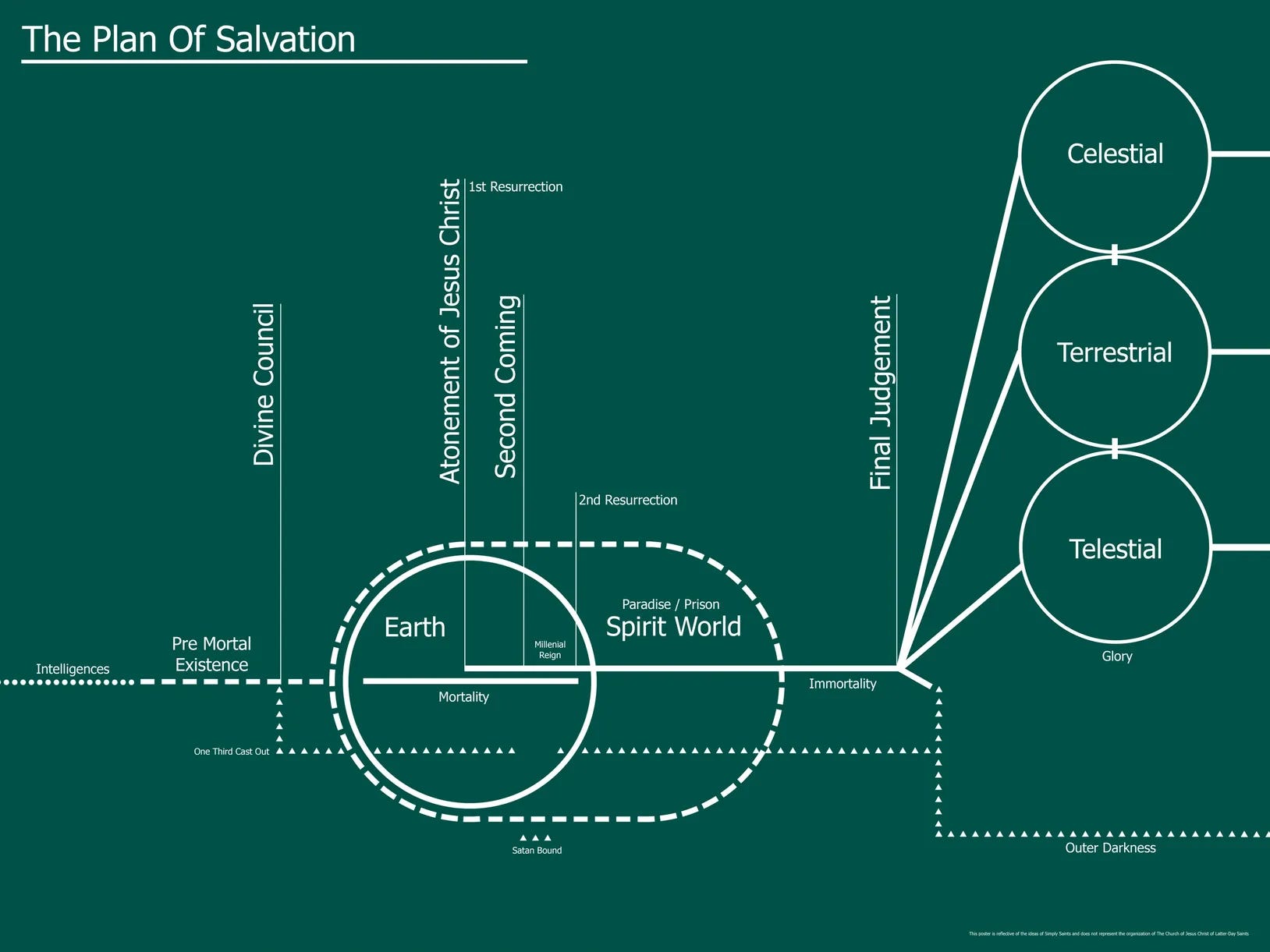
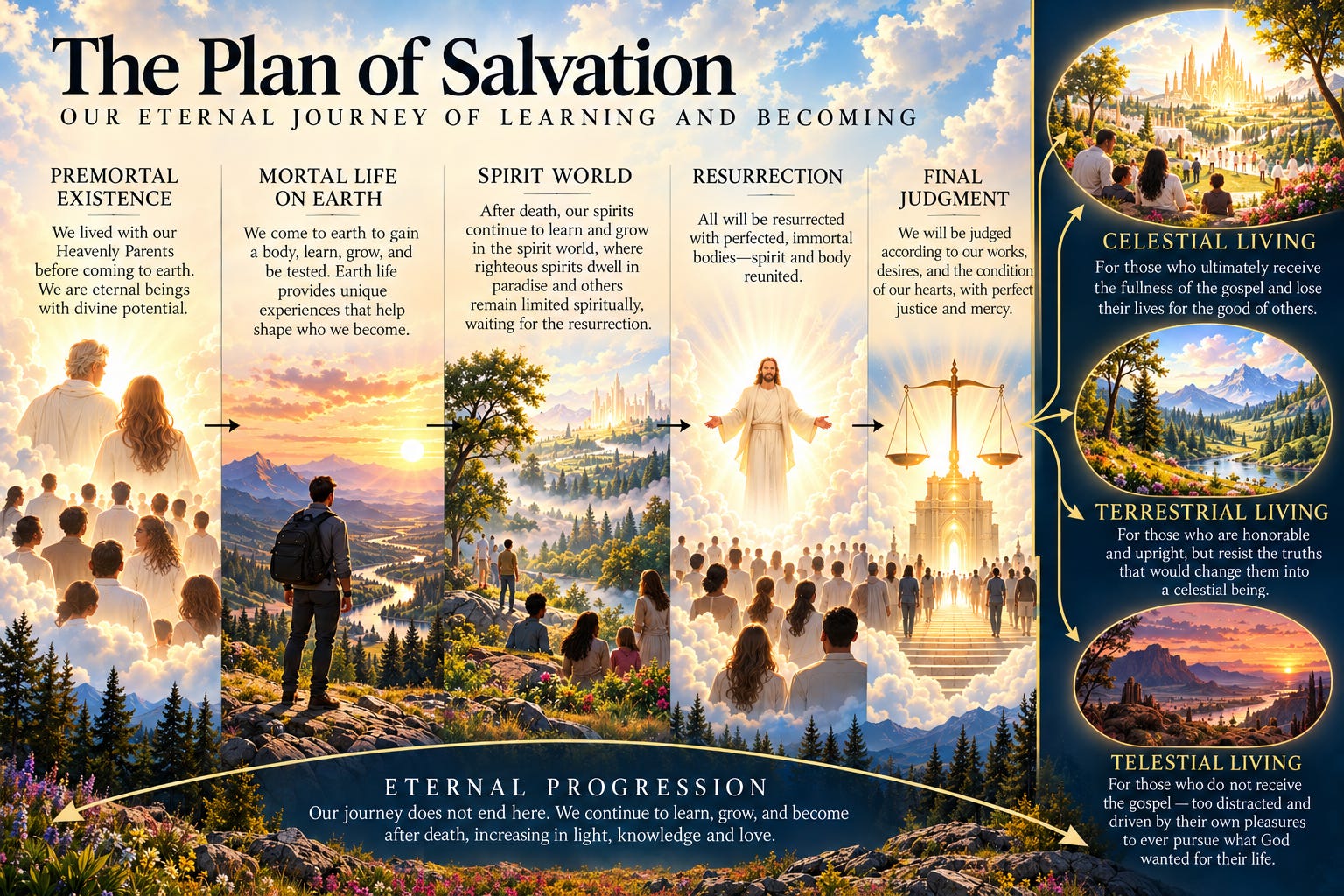
Latter-day Saints may be particularly interested in this focus on lifelong development since, in our belief, individual growth and learning continue far beyond the borders of this life.2 What our faith calls “eternal progression” highlights a vast developmental timeline that extends from long before birth to far after death — with earthly experience acting as both a central engine of change and decisive trajectory-setter in the direction of that change.
“Whatever principle of intelligence we attain unto in this life, it will rise with us in the resurrection. And if a person gains more knowledge and intelligence in this life through his diligence and obedience than another, he will have so much the advantage in the world to come.” (D&C 130)
Rather than “created from dust” (ex nihilo), members of the Church of Jesus Christ cherish the conviction that we lived before we came here in loving family relationships with adoring Heavenly Parents. In some way not fully understood, these exalted beings provided spirit bodies for the substance of our fundamental “intelligence,” which Joseph Smith taught was “co-eternal” with God.
“Intelligence is eternal and exists upon a self-existent principle … The intelligence of spirits had no beginning, neither will it have an end.” (Joseph Smith, King Follett sermon)
Rather than vanishing one day in an inevitable annihilation — or existing in some suspended vacuum of frictionless, harp-playing living — we understand the “spirit world” into which all humanity eventually arrives to be a place of additional learning and growth, continuing what the earth itself was intended to be: an incredible education designed to move us towards exciting possibilities.
“That which is of God is light; and he (and she) that receiveth light, and continueth in God, receiveth more light; and that light groweth brighter and brighter until the perfect day.” (D&C 50)3
“The whole mortal existence of (humanity) is neither more nor less than a preparatory state given to finite beings,” Brigham Young once taught — “a space wherein they may improve themselves for a higher state of being.”4
“The object of this existence is to learn,” President Young taught on another occasion, “which we can only do a little at a time.”5 He elaborated that God “gives a little to his humble followers today, and if they improve upon it, tomorrow he will give them a little more, and the next day a little more.”6
For Latter-day Saints, then, earth really is a great schoolhouse — created principally for our growth, learning and testing.7 When Jesus comes to restore the earth’s “paradisiacal glory,” that growth and learning will enter a different phase as the human family heals and finds sweet reconciliation and rest.
Where do we end up?
At some point, a final judgment will take place — one that believers across the Abrahamic traditions anticipate as a time of great deciding. Usually, that future differentiation is portrayed as a bifurcated and ominous up-or-down, right-or-left separation between people bound for heaven and hell alone.

But the apostle Paul hinted to his Corinthian readers at something more. A short while after describing his glimpse of “the third heaven,” he taught:
“There are also celestial bodies, and bodies terrestrial: but the glory of the celestial is one, and the glory of the terrestrial is another. There is one glory of the sun, and another glory of the moon, and another glory of the stars: for one star differeth from another star in glory.”
While this has been interpreted differently throughout Christian history, Joseph Smith’s 1832 revelation interpreted this passage as referring to different “degrees of glory” in future heavenly worlds. In a sweeping vision, the prophet shared the following glimpses:
There will be individuals whose “bodies are celestial … whose glory the sun of the firmament is written of as being typical.”
And also “bodies terrestrial” — those who are of “the terrestrial world” — who “differ in glory as the moon differs from the sun.”
And there will be those of “telestial” glory, “which glory is that of the lesser, even as the glory of the stars differs from that of the glory of the moon in the firmament.”
This is what we believe Jesus meant when he said: “In my Father’s house are many mansions. If it were not so, I would have told you.”
And to be very clear, each of these will be wonderful places to be. None involve pitchforks or eternal torment. In a poetic rendering of the vision over a decade later in 1843, Smith described the lowest “telestial region” as “mingled in bliss” — while elaborating:
“And thus I beheld, in the vision of heav’n,
The telestial glory, dominion and bliss,
Surpassing the great understanding of men —
Unknown, save reveal’d, in a world vain as this.And lo, I beheld the terrestrial, too,
Which excels the telestial in glory and light,
In splendor, and knowledge, and wisdom, and joy,
In blessings, and graces, dominion and might.I beheld the celestial, in glory sublime;
Which is the most excellent kingdom that is —
Where God, e’en the Father, in harmony reigns;
Almighty, supreme, and eternal, in bliss.”
So much good ahead! So much, in fact, that we apparently don’t even have the human capacity to conceive of it mentally or emotionally quite yet.8
In 2023-2024, Presidents Russell Nelson and Dallin Oaks spoke more about all of this — with a plainness and directness that has been exciting.
Although these doctrines are uniquely associated with Latter-day Saints, others besides Jesus and Paul have spoken about similar things. In Rabbinic Judaism, the Babylonian Talmud describes seven distinct heavenly “firmaments” and names each one. And one of my dear evangelical friends once told me in private that he had a sacred experience where God showed him the reality of multiple heavens.
Human development as eternal progression
The question taken up here is this: what would a study of human development look like if these divergent heavenly possibilities were taken more seriously?
My friend Thomas McConkie sought to bring insights from adult development to Latter-day Saint praxis years ago. Here, I’m attempting something of the reverse: sketching how Latter-day Saint teachings about eternity could impact everything else people believe about development.
In a short introduction like this, outlining a few possibilities is all that can be accomplished. But instead of just imposing some theology on top of human experience or social science, done right, this should capture something valid about existing, real complexities of human development already seen around us — and inside us.
For people like me who believe these teachings about multiple heavenly possibilities to be eternal truth, that’s exactly what I have anticipated — that these insights could clarify changes happening all around us, all the time.
And maybe you could start to glimpse something I now see in the faces and lives of wonderful people all around me: the kingdoms of glory already forming right before our eyes.9

What kind of human being do you want to become?
If this earth is ultimately designed to shape us into different kinds of human beings, clearly we are all — every one of us — still in process. That’s why developmental language is important to keep provisional and formative, leaving wide-open so many fresh possibilities for everyone to make continued choices, moment by moment.
That’s really what I’m trying to offer here: something that clarifies for any of us — each undeniably and infinitely precious — what kind of a human being we truly want to become.
Here are 10 potentially pivotal insights human development could take from an expansive appreciation of multiple heavens to come:
1. Profound and ‘mighty’ changes are possible
I once asked a neighbor who didn’t share my faith, “have you ever experienced someone change fundamentally?” “No,” she said — explaining that she’d never witnessed that in anyone’s life.
That seems a pretty fair stand-in for secular theories of adult development today. If you’ve never witnessed a mighty change, why would you even see it as possible?
You wouldn’t. But it is. The Lord promises Ezekiel “a new heart … and a new spirit” — something he described in person in Jerusalem as being “born again.” Paul later called this “walking in a newness of life.”
Christ seems to know well how challenging this reality would be for our taken-for-granted ways of thinking. Because twice, we hear:
“Marvel not (don’t be surprised) that I said to you, ‘You must be born again,’” as Christ said in his conversation with Nicodemus.
And likewise, the Lord said to Alma the Younger: “Marvel not that all mankind, yea, men and women, all nations, kindreds, tongues and people, must be born again; yea, born of God, changed from their carnal and fallen state, to a state of righteousness, being redeemed of God, becoming his sons and daughters. And thus they become new creatures; and unless they do this, they can in nowise inherit the kingdom of God.”10
For those who like to believe that God’s fullest expression of love sounds something like “you’re wonderfully perfect, just the way you are” — the idea that such a profound change is not only possible, but expected-and-essential, could perhaps feel unsettling.
But for the many who dearly yearn for more peace and love in lives of continued heartache and loss, the prospect of a new heart, new mind and new life can feel thrilling. I love the stirring image in John’s revelation of the living God saying “I make all things new” as he dwells among His people in a future day of peace.
Developmental takeaways
A view of lifelong development that takes kingdoms of glory seriously would have to take this possibility of a “mighty change” as legitimate — not something to be ignored.
Developmentally, this means we should perhaps leave more room than many conventional theories do for major disruptions over time in the course of our lives. Instead of just becoming more of what we already are naturally — “That’s just who Frank is!” …. “That’s just Angela being Angela.” — this holds out the possibility of any of us becoming someone radically different, for better or worse.
In his faith development theory, James Fowler did acknowledge the “possibility — always present — of interventions of extraordinary grace” classified under the “rubric of conversion” — which made it “difficult to speak simply or solely of faith as a developmental matter.”
In sum, a theory of development grounded in eternal progression would need to account not only for gradual maturation, but for moments of profound reorientation in which the whole trajectory of a life distinctly changes.
2. Our ability to see things can expand or contract in dramatic ways
With the exception of a number of cognitive biases often explored in modern psychology, the secular insinuation often seems to be that human beings by and large see what’s around them clearly.
But scripture is adamant about just the opposite — describing eyes and minds that can be spiritually blinded when they have “turned away from the truth,” often due to the “craftiness of men” and the “god of this world.”
This happens as light and truth are taken away from people. As Alma tells Zeezrum in the Book of Mormon, “he that will harden his heart, the same receiveth the lesser portion of the word … until they know nothing concerning his mysteries.”
At some point, people’s eyes can become “shut” or "closed” in a veritable “blindness of their minds” or “blindness of their heart” — to the point that even while “seeing many things” they “observe not,” the brilliant Isaiah says, with eyes that “see and (yet) see not.”
This process can thankfully go in the other direction too, with eyes being opened to see more than any of us ever saw before. Alma continues: “he that will not harden his heart, to him is given the greater portion of the word, until it is given unto him to know the mysteries of God until he know them in full.”
Paul similarly speaks of attaining the “mind of Christ” — opposite to a natural mind that “receiveth not the things of the Spirit of God,” for as the ancient apostle says, “they are foolishness unto him: neither can he know them, because they are spiritually discerned.”

Developmental takeaways
I find it fascinating to consider a fundamental ability to see that is tied so intimately to who and how we are becoming. Others have raised similar insights over the years:
French writer Anaïs Nin once said, “We do not see things as they are, we see them as we are.”
Anthony de Mello likewise said: “We see people and things not as they are, but as we are.”
Harvard developmental psychologist Robert Kegan authored the 1982 text “The Evolving Self: Problem and Process in Human Development” — fascinated by how our ways of making meaning change as we mature through adulthood. He once wrote that “Our meanings are not so much something we have, as something we are.”
Far outside the theological realm, these others have recognized how becoming a different person can profoundly change how reality is experienced and interpreted.
It’s fair to say this cognitive insight alone — were it more widely embraced — could further revolutionize our understanding of human development. Imagine if more people could appreciate how seeing reality clearly, rather than mainly a function of methodologies, tools and technical procedures, may well be a matter of how we live and who we are becoming above all else.
This would mean that development involves not merely accumulating information or getting better at processing it — but instead, becoming the kind of person who is capable of seeing more. This would also mean taking seriously the potential of stepping back developmentally in ways that make us less capable of recognizing reality, including stirring truths and beauties once visible to us.
3. Our ability to feel and desire things can also expand or contract profoundly
All of what someone feels, wants, desires, loves, hungers for, and ultimately wills can also shift dramatically from this view. Just as minds can be blinded or opened, hearts can become hardened, closed, or turned away. They can also become softened, opened, enlarged, and changed.
“What are we here for?” Brigham Young once asked. “To learn to enjoy more, and to increase in knowledge and in experience.”
That “mighty change” Alma highlighted is more specifically a “mighty change of heart.” Later in the same book, the prophet Mormon described how deeper fasting and prayer led an ancient people to “wax stronger and stronger in their humility, and firmer and firmer in the faith of Christ, unto the filling their souls with joy and consolation, yea, even to the purifying and the sanctification of their hearts, which sanctification cometh because of their yielding their hearts unto God.”
Developmental takeaways
What would it mean to our broader understanding of human development to appreciate that the human heart — desires, appetites, cravings, longings — can also shift profoundly and fundamentally, for better or worse?
Among other things, this would make the development of desire itself a central object of study: not simply how people learn to work with variations in what they want, but how what they want can actually change.
Rather than neutral choosers who construct themselves from scratch, however, all human beings, according to British philosopher Charles Taylor, naturally live within frameworks of value that socialize and invite us to consider what is worthy, higher, lower, admirable, shameful, beautiful, etc.
The heart interacts constantly, in other words, with everything else around us. The complexities of human development, in this view, must include the gradual formation of the heart — what becomes attractive to us, what gives us pleasure, what we love, and ultimately what we are willing to live and give our lives for.
4. Our day-to-day choices are decisive in determining so much of our developmental trajectory — including the ultimate direction
So, how do these deeper patterns of heart and mind actually change? After emphasizing how central being “born again” is, Jesus then told Nicodemus something so critical that is easy to miss: “light is come into the world, and men loved darkness rather than light, because their deeds were evil.”
If we live and choose something over and over, we’ll eventually start to love it. That might be common sense to many of us — and it’s how Christ explained that our hearts and loves come to change as well.
Our choices impact more than just what we love, though. “Mortality is a master class in learning to choose the things of greatest eternal import,” President Nelson taught. “Far too many people live as though this life is all there is. However, your choices today will determine three things: where you will live throughout all eternity, the kind of body with which you will be resurrected, and those with whom you will live forever. So, think celestial.”
More than just a particular kind of heart we are choosing, this modern-day prophet, whose witness changed my life, explained in his 99th year that we’re also gradually choosing the kind of body and relationships we will one day enjoy forever.
Developmental takeaways
Bottom line: We’re again in the process of becoming different kinds of human beings. This recognition of a kind of eternal evolution taking place, moment by moment — choice by choice — could clarify and focus so much of human development today.
It was the Scottish-American philosopher Alasdair MacIntyre who pointed out that we are not simply making isolated choices — but ultimately becoming someone distinct through the unfolding story of those choices. As he wrote: “The unity of an individual life is the unity of a narrative embodied in a single life.”
All of this places agency much closer to the center of developmental theory. Rather than seeing development primarily as something that happens to us through age and circumstance, this could help us appreciate more in a developmental sense the thousands of seemingly small choices that form the person we eventually become.

5. We are either moving towards more light and goodness or less
At some point, we do settle into a way of being we are most comfortable and committed to — effectively choosing the life we want. But for now — in what Alma in the Book of Mormon calls our “probationary state” — the relentless challenges of this life still nudge most of us forward (or backward) — in one direction or another.
“We are to progress and improve every day of our lives,” Brigham Young once taught — with Joseph Smith also teaching: “If we are not drawing towards God in principle, we are going from Him.”
This changeability implies that the qualities we seek to develop fall on a spectrum — moving infinitely in both directions in an eternal sense (towards ultimate fullness or utter depletion). So, we can experience:
A continued expansion of awareness and knowledge — or a contraction of the same
An ongoing expansion of agency and power — or a diminishing of both
A forever expansion of love and connection with others — or a gradual removal of this most sweet part of life
A continued expansion of our ability to feel joy and delight — or a blunting of the same
That developmental scholar Paul Baltes once wrote in 1987 that “considerable diversity or pluralism is found in the directionality of changes that constitute” the development of an individual organism across the lifespan — “even within the same domain,” he added.
Harvard’s Richard Lerner similarly cautioned that “all-too-often growth, power, and unmitigated development are assumed to be good” — underscoring the importance of keeping in view the end or purpose of development.
To wit, Spencer W. Kimball once wrote, “You are sent to this world with a very serious purpose. You are sent to school, for that matter, to begin as a human infant and grow to unbelievable proportions in wisdom, judgment, knowledge, and power.”
Rising up or sliding down
For my purposes here, we can touch on two main directional trajectories: a progression from telestial upward to the celestial — and the opposite: a digression from celestial downward towards the telestial.
From Telestial to Celestial: This is the pathway encouraged by prophets and angels alike: refuse to allow the “lusts of the flesh” to become our first love — instead, cultivating our mind and heart to attach to something higher, better and more joyful. Over time, what we repeatedly focus on and choose begins to shape what we love, until our deepest desires become increasingly aligned with God’s.
From Celestial to Telestial: Although we all start off with heavenly possibilities, “trailing clouds of glory” as William Wordsworth said, every one of us can come to love something more than God and what God wants for our lives. That can be our body, the body of others around us, sexual pleasure, food, alcohol, music, money, power, accomplishment, etc. While any of these can be a good or natural part of life, once they take a preeminent place in our hearts, they can drag our development down precipitously.
Developmental takeaways
Developmentally, this appreciation of the constant, inherent change that Buddhists call “impermanence” further sets the stage for a theory of human development centered on the hundreds of choices we make every day in response to our circumstances, rather than only the circumstances themselves.
This also highlights the directional nature of change: not every change is growth, and some adaptations may move us further from flourishing rather than toward it. Thus, development could involve both increasing or decreasing capacities for awareness, agency, love, connection and joy.
Instead of only asking “How have I changed?” we may start to ask things like: “Is this change bringing me more in line with God” and “What ultimately am I becoming?”
6. It’s possible for a trajectory going one way to be reversed and move in the opposite direction
This insight is arguably the best news of all — the very truth that Christ says three different times in Latter-day Saint scripture should be a special focus of teaching and perhaps even the only thing we teach:
“Say nothing but repentance unto this generation….thou shalt not preach anything but repentance unto this generation.”
To secular eyes, this can feel like a big fat attempt to rain on the parade of feel-good affirmation and validation. But through sacred eyes, this feels a lot more like saying: “hey, we found a way to give everyone a ton more joy and peace and love — without any side effects!”
“Too many people consider repentance as punishment — something to be avoided except in the most serious circumstances,” President Nelson taught in 2019. “When we choose to repent, we choose to change! We allow the Savior to transform us into the best version of ourselves. We choose to grow spiritually and receive joy — the joy of redemption in Him.”
“Discover the joy of daily repentance,” he added. “Repentance is a blessing … a joyous opportunity,” he told a group of children on another occasion — explaining that it “means that every day you try a little harder and do a little more to become like the Lord Jesus Christ …. Just think every day, I get up, bounce out of the bed in the morning and say, ‘Oh, something wonderful is going to happen today. I’m going to be more like Jesus.’”
“Try a little harder to be a little better.” — Gordon B. Hinckley
Instead of a downer, I hope repentance can feel thrilling to my children. Yesterday doesn’t have to be the same as today! Just because Ebenezer Scrooge was a mean grump for so many years, doesn’t mean he can’t jump on his bed Christmas morning and start showering love on everyone around him.
The same is true for us, in real life.
Developmental takeaways
In secular social science, it’s often said that “the best predictor of future behavior is past behavior.” However true that often is, it sure makes life dull and boring to assume this about everyone around us.
Why can’t they change too? This is often missing from many models of development: the possibility of genuine reversal — a wild card that makes everything a lot more interesting. If any one of us can repent and change direction, then the developmental trajectory of a human life is never reducible to its previous years. Something refreshingly new can begin, no matter what yesterday looked like.

7. We can choose to stop developing
Although we may well end up arriving in a celestial or telestial way of living, there is a third option, of course: arresting our development so we land in more of a middle ground.
Instead of fully ascending into family-focused celestial ways of being, or deteriorating fully into a me-focused telestial life, a stoppage at the terrestrial is a real possibility — described in revelation as the “honorable men of the earth, who were blinded by the craftiness of men … they who are not valiant in the testimony of Jesus; wherefore, they obtain not the crown over the kingdom of our God.”
Among other things, the idea that this developmental outcome is ultimately in our hands underscores the enormous importance of each moment we have. Each breath. Each new day.
Two different ways of getting stuck
Development, again, is not something that eventually happens to us or runs its natural course. Where we go and where we stop is something we have a large say in — with two distinct possibilities worth keeping an eye on:
Resisting full celestial living— plateauing at the terrestrial. A person may be honorable and genuinely good, yet resist the deeper surrender, covenant commitment, and transformation involved in celestial living. The Doctrine and Covenants also describes the terrestrial world as those who “received not the testimony of Jesus in the flesh, but afterwards received it.”
Resisting full telestial living — stabilizing at the terrestrial. A person may also resist descending into a life dominated by sin and worldly desire, choosing instead to try and live honorably in response to the light they have received. The terrestrial then represents not the wholehearted consecration of the celestial, but also not a wholesale rejection of God and truth characterizing a telestial trajectory.
These are both real possibilities developmentally. But none of us have to allow our progress to stop! Consistent with her conviction in eternal progression, the brilliant Latter-day Saint poet and leader Eliza R. Snow taught in 1873: “We are never to come to a standpoint. We are to be progressing, and growing better. If we have done well to-day, we must do still better tomorrow.”
Developmental takeaways
Although change and development of some kind seems like a fairly constant reality, this highlights how plateauing, stabilizing and getting stuck are also real possibilities developmentally.
Among other things, this raises a deeper question about whether human beings can become so comfortable with an intermediate way of living that they cease reaching toward further transformation — or whether they continue opening themselves to greater light, love, commitment, and truth.
8. How we relate to bodies — ours and others — is consequential to our eternal development
In a secularizing modern world, it’s easy to see the body as something largely ornamental and mostly for our pleasure — be that our own body or someone else’s. But for Christians who affirm the bodily resurrection, the body is something very different.
“Don’t you know that your body is a temple of the Holy Spirit who is in you, whom you have from God?” Paul asked the people in Corinth, stating earlier: “If anyone destroys (violates/defiles) the temple of God, God will destroy him; for God’s temple is holy, which you are.”
This is why questions surrounding pornography, chastity, and fidelity matter so much to believers — along with how we dress, how we eat and avoiding substances that hurt our physical health.
None of this is about being a “prude.” All of it’s about doing our best to ensure our body is a place the Holy Spirit can dwell.
Paul takes it even further: “You are not your own. For you were bought with a price. Therefore glorify God in your body and in your spirit, which are God’s.”
The flesh-faith connection
That’s why Paul, like all Christians and many other believers, speaks so seriously about sexual immorality: “Every sin that a man does is outside the body, but he who commits sexual immorality sins against his own body.”
Most sins involve pain inflicted on ourselves. But betraying chastity usually also involves hurting others severely, as collateral damage from chasing more and more of our own pleasure. As I’ve written about recently, pouring your heart and attention into pornography also literally changes who you are — just as the process of turning away from it often corresponds with a change in who we are too.”11
Developmentally, we could say that those who choose to center their lives and hearts around sexual pleasure as their highest transcendence become someone different from those who “bridle all your passions.”12
The closer people come to worshiping their own body — and good feelings they can stir up in that body — the farther they are from worshiping God and wanting to have any relationship with God at all.13
Becoming different bodies
Much like our minds and hearts, our bodies can also profoundly change as we develop in one direction or another. “They who are of a celestial spirit shall receive the same body which was a natural body,” restoration scripture says — noting that “ye shall receive your bodies, and your glory shall be that glory by which your bodies are quickened.”
Yet for those not willing to follow a celestial way of living, this won’t be the case: he or she “who is not able to abide the law of a celestial kingdom cannot abide a celestial glory.” In that instance, scripture says they will develop into something else — “enjoy(ing) that which they are willing to receive, because they were not willing to enjoy that which they might have received.”
Developmental takeaways
It was the French philosopher Maurice Merleau-Ponty who helped bring the body back into serious philosophical discussions about how we experience reality. Maybe human development needs to do the same?
Instead of only one domain within human development, alongside cognition, emotion and relationships, this may prioritize more how our bodies are the place where our deepest loves and loyalties are galvanized and made more permanent. How we inhabit, regard and treat the body surely plays an important and direct role in the kind of person we are all becoming.
9. How we regard others in relationships is also consequential to our eternal development
The ethic of “love your enemy” is one way in which the Christian tradition contrasts with other ideologies and faiths. But other traditions express similar ethics beautifully. I love Jewish writer Emmanuel Levinas describing the face of the other as an inescapable ethical summons14 — and Martin Buber’s call to encounter the other as “Thou,” rather than “It.”
I have also known enough tender and loving Muslim thinkers, from Eboo Patel to Asma Uddin, to appreciate how the ethic of love runs deep in Islam as well. In my Latter-day Saint tradition, we focus in relationships especially on ancient invocations against contention, prophetic calls to prioritize family15 and more recent emphases on peacemaking and bridge-building.
Levinas describes how our response to the face in front of us changes us. We become a different person if we take the truth we see in a suffering face, and yield to that by showing care and love. And in the opposite direction, a man who walks out on his wife and children becomes a different person — much like Harry Potter’s Voldemort splitting himself in half as he does violence to another person.
Developmental takeaways
What if human development could regard this ethic of care for others not simply as an evolutionarily smart way to preserve the species or an anthropologically wise way to reinforce the tribe — but as a literal method of transforming oneself (and everyone around you) into a different kind of human being?
We might then see relationships as life-changing instruments through which development happens. Every encounter with another person presents an opportunity to become more capable of love, patience, mercy and self-giving — or, conversely, more practiced in indifference, domination or grievance.
10. How we relate to God is the ultimate pivot point in our developmental trajectory
New York University’s Jonathan Haidt and colleagues have proposed a variety of different “moral foundations” that people have in their lives — including care, fairness, loyalty, authority and sanctity. Although this scholar’s primary focus has been pointing out how liberals and conservatives vary in these foundations, I was intrigued by Josh Coates and Stephen Cranney’s 2024 analysis of current and former believers — demonstrating how these moral foundations appear to shift when people step away from faith.
This made sense to me. If someone consciously decides to step away from a life focused on the reality of a supreme being — especially a god who cares enough about your development to outline a secure covenant path — then what happens next?
In many cases, it seems like moral foundations of sanctity, loyalty and authority drop out of one’s worldview considerably, at least in terms of substantial influences — while care and fairness take on more central prominence. In other words, life starts to revolve around your own feelings and how you see others being treated — rather than any summons external to you, including feelings or expectations God may have about your life.
How do we see God?
From this view, how exactly we come to relate to God in our hearts and minds has profound effects on everything else in our development. When Nephi asked his brothers, “Have ye inquired of the Lord?”
They responded, “We have not; for the Lord maketh no such thing known unto us.”
These were brothers who had prayed previously, at least a little. In fact, they had seen an angel and heard the voice of God. But nothing about those experiences ever appeared to catch their hearts quite like Nephi’s own experiences.
In our case, we might ask: Do we talk with Him, listen to him, trust him, follow him?
Or not? In other words, are we centered on God — or centered on something else?
When God issues a command in scripture — or through prophets — do we “live by every word that proceedeth out of his mouth” — or do we live by every thought that proceedeth forth out of our own heads?
How do we see God’s commands?
However unpopular the idea of obedience to God’s commands is today, the idea flows throughout all scripture. And Latter-day Saints understand it to be “the first law of heaven.”
This is the serious problem with all the popular, easy-on-the-ears hip Christianity that downplays obedience — minimizing the very thing that can supercharge people’s spiritual development: greater alignment with God’s will.
The grace to become
By the law itself, however, “no flesh is justified,” Lehi teaches his children in the Book of Mormon. “Or, by the law men are cut off. Yea, by the temporal law they were cut off; and also, by the spiritual law they perish from that which is good, and become miserable forever.”
Our freedom and redemption, this ancient prophet then explained, come “in and through the Holy Messiah” who can “answer the ends of the law, unto all those who have a broken heart and a contrite spirit; and unto none else can the ends of the law be answered.”
“Wherefore, how great the importance to make these things known unto the inhabitants of the earth, that they may know that there is no flesh that can dwell in the presence of God, save it be through the merits, and mercy, and grace of the Holy Messiah.”
I love that verse!! Among other things, this reflects Søren Kierkegaard’s emphasis on Christianity not simply as something we believe or claim, but as a new relationship with God through “a transformative process of becoming.”16
Becoming — not just believing
“In contrast to the institutions of the world, which teach us to know something, the gospel of Jesus Christ challenges us to become something,” then-Elder Oaks taught in 2000. More recently in 2023, he reiterated: “The gospel of Jesus Christ challenges us to become something,” before adding:
“The Final Judgment is not just an evaluation of a sum total of good and evil acts — what we have done. It is based on the final effect of our acts and thoughts — what we have become.”
Rather than ominous anticipation of a final judgment, I believe this awareness can fire us up to make good use of all our time. “Human beings are expected by their Creator to be actively employed in doing good every day of their lives,” Brigham Young once taught — “either in improving their own mental and physical condition or that of their neighbors.” He called the “principle of increase, of exaltation, of adding to that we already possess, is the grand moving principle and cause of the actions of the children of men.”17
Developmental takeaways
If this theological vision is correct, then our deepest developmental questions may ultimately be relational: What — or whom — is my life becoming organized around?
Our answer to that would not merely characterize our present identity. Over time, it would also help explain the kind of person we are becoming and, ultimately, the kind of existence we are preparing ourselves to receive.
What’s your heaven?
I love asking people this final question. For some, walking their dog in the mountains really does seem to capture something about their true heaven. For others, the quasi-transcendence of drinking and partying is much closer — or watching performative intimacy on a screen.18
But there are others for whom the greatest joy is found in something else entirely: lifting others up, strengthening them, teaching them — bringing them joy — be that young children in a home or neighbors all around them.
That’s the life I have gradually and deeply come to love over time — a life of joy, peace and love that shocks me more and more each passing year. I’m convinced no human-designed pleasure fantasy could ever top it.
If all the foregoing is true, then how seriously we take these questions really may shape the details of everything else. “A man’s idea of the significance of the words ‘eternal progression’ will largely determine his philosophy of life,” taught President David O. McKay. “The great secret of human happiness lies in progression.”
Notes:
Thus signaling subtly to people that “early childhood is where the most meaningful changes happen” — and “the rest of your life, you’re pretty much who you are.” For instance, Lawrence Kohlberg proposed four stages of moral development youth presumably cycle through before reaching a “post-conventional” adult morality that is more fixed. Reflected here, there has also historically been some focus on later stages of life too — such as Erik Erikson’s work on intimacy, generativity and integrity as adults age.
“We are in the school and keep learning, and we do not expect to cease learning while we live on earth,” Brigham Young once taught. “And when we pass through the veil (in death), we expect still to continue to learn and increase our fund of information. That may appear a strange idea to some; but it is for the plain and simple reason that we are not capacitated to receive all knowledge at once. We must therefore receive a little here and a little there.”
In another formulation of this same thought, Brigham Young once taught “This work is a progressive work, this doctrine that is taught the Latter-day Saints in its nature is exalting, increasing, expanding and extending broader and broader until we can know as we are known, see as we are seen.”
Preparation for this “more glorious and exalted sphere,” as Brigham Young likewise called that future sweetness, is central to why we believe a Savior or Messiah came into the world, why he offered teachings, commandments and laws and why he invites engagement on our part via discipleship and covenant living.
For Latter-day Saints, as has been true of other people anciently, the temple is a central place where all of this is more completely understood and grasped. Everything about a temple draws us closer to the Savior and opens our minds to the “wonders of eternity” in order to live celestially outside of the temple, instead of how the profane, craving-addicted world would socialize us to be.
Selective italics here and below are my own.
Rather than a drill sergeant or a probation officer watching over me, this crystallizes the image of a loving father (and mother), doting over their adoring child and showing supreme patience - connected to their awareness of both the gradualness of change and the relatively early stages of growth any child is in, compared to a parent’s own state (especially a heavenly one!)
I read this echo of supreme patience in God’s usage of “little children” to refer to us:
As the Lord taught earlier Saints in this era: “Behold, ye are little children and ye cannot bear all things now; ye must grow in grace and in the knowledge of the truth. Fear not, little children, for you are mine, and I have overcome the world, and you are of them that my Father hath given me; And none of them that my Father hath given me shall be lost.”
A year later, he likewise encouraged: “Verily, verily, I say unto you, ye are little children, and ye have not as yet understood how great blessings the Father hath in his own hands and prepared for you; And ye cannot bear all things now; nevertheless, be of good cheer, for I will lead you along. The kingdom is yours and the blessings thereof are yours, and the riches of eternity are yours.”
Although a language of “testing” and “proving” amid a time of “probation” is often used in our tradition — much of this can feel dissatisfying to modern minds and hearts, as if earth life is a big SAT test to see where we can go to college or worse, a supervisory state with a probation officer always with an eagle eye on our penchant for messing it up again.
If these metaphors fail as they seem, to translate for our generation, it’s important to not miss the truth they’re trying to convey. Something along the lines of: “So what will you choose? Let’s see, amidst the smorgasbord of ideas and options life throws at you, where you’re going to focus your attention and pour out your heart. So much of our future lives — and eternities — will naturally revolve around that choice.”
I do think Terryl and Fiona Givens are right to highlight the limitations in a language of retributive justice to capture the full beauties of the gospel. Nonetheless, I do think a language of testing and proving can work on our hearts in a positive way. For instance:
This from Brigham Young: “This is a world in which we are to prove ourselves. The lifetime of man is a day of trial, wherein we may prove to God, in our darkness, in our weakness, and where the enemy reigns, that we are our Father’s friends, and that we receive light from him and are worthy to be leaders of our children.”
Or this from Alma: “This life is the time for men to prepare to meet God; yea, behold the day of this life is the day for men to perform their labors. And now, as I said unto you before, as ye have had so many witnesses, therefore, I beseech of you that ye do not procrastinate the day of your repentance until the end.”
“But as it is written,” Paul tells the Corinthians in reference to Isaiah’s earlier language, “Eye hath not seen, nor ear heard, neither have entered into the heart of man, the things which God hath prepared for them that love him.”
Some faces and hearts are full of a light and goodness that seems to increase every day, while other countenances seem progressively harder and more closed — somehow limiting some of the beauty and sweetness God might be able to give them.
Latter-day Saint teachings on human transformation go beyond a “spiritual rebirth” to consider how God’s plan is leading his children to become more like our Heavenly Parents — becoming, in Paul’s words “heirs of God, and joint-heirs with Christ.”
Although I find these teachings beautiful, myself, I prefer to focus here on more of the widely appreciated, common-ground convictions around spiritual rebirth — recognizing that other Latter-day Saint beliefs can be challenging to understand for other Christian believers. I will say, though, that Latter-day Saint teachings do have surprising parallels with the ancient Christian doctrine of theosis, in which salvation was understood not merely as a change in status before God but as a transformation into the likeness of God.
“Few things will complicate your life more quickly than violating this divine law,” President Nelson taught in reference to chastity. “For those who have made covenants with God, immorality is one of the quickest ways to lose your testimony. Many of the adversary’s most relentless temptations involve violations of moral purity. The power to create life is the one privilege of godhood that Heavenly Father allows His mortal children to exercise. Thus, God set clear guidelines for the use of this living, divine power. Physical intimacy is only for a man and a woman who are married to each other.”
In recent years, I’ve been struck by how seven different times at the beginning of Revelation, John hints that all the best things in the future depend on whether we “overcome” the impulse to worship something other than God — and thus leave our “first love.”
Paul also adds, “Therefore glorify God in your body and in your spirit, which are God’s” — citing other things most people don’t see as seriously: “So whether you eat or drink or whatever you do, do it all to the glory of God.”
“Any addiction — be it gaming, gambling, debt, drugs, alcohol, anger, pornography, sex, or even food — offends God,” President Nelson taught. “Why? Because your obsession becomes your god. You look to it rather than to Him for solace….Please do not let an obsession rob you of your freedom to follow God’s fabulous plan.”
The summons is inescapable without hurting ourselves and becoming another person, that is. For instance, the father who walks out on his family and abandons his wife and children becomes a different human being by doing so.
“Truth comes through the face of the other,” his writing implies, with Levinas stating once: “the face is the other who asks me not to let him die alone.”
For us, the messy practice of family life is a reflection of who we most deeply are, who our eternal parents are and what our future potential truly is. This video illustrates that so well:
Can you tell I love this book?! I feel the same way about the Bible. Here’s how the angel described this process to King Benjamin: “For the natural man is an enemy to God, and has been from the fall of Adam, and will be, forever and ever, unless he yields to the enticings of the Holy Spirit, and putteth off the natural man and becometh a saint through the atonement of Christ the Lord, and becometh as a child, submissive, meek, humble, patient, full of love, willing to submit to all things which the Lord seeth fit to inflict upon him, even as a child doth submit to his father.”
“Hear it, all ye Latter-day Saints!” Brigham Young added. “Will you spend the time of your probation for naught, and fool away your existence and being? You were organized, and brought into being, for the purpose of enduring forever, if you fulfil the measure of your creation, pursue the right path, observe the requirements of the celestial law, and obey the commandments of our God.”
Because what’s being witnessed on a screen is, of course, never truly intimate. Performed sexual delight is always a show and always harmful to everyone participating: men, women, viewers. That’s no exaggeration: Everyone is harmed by it, emotionally and eternally speaking. Without exception.