



Since the recent Washington, D.C., summit on antidepressant tapering, I’ve been intrigued by the public discourse that’s taken place on how to make sense of it all. There’s a lot to be learned by sitting back and just watching a big discussion taking place — whether through formal “discourse analysis” or more of a basic content analysis, like the one I share below.
For the most part, bigger legacy media outlets continue not to take much of this very seriously. As far as many outlets are concerned, everything associated with RFK is a clown show — even when he happens to be raising some important questions. As a result, we see ominous headlines like:
The Strange Alliance Trying to Remake American Psychiatry1 (New York Times)
RFK Jr. Is Coming for Your Antidepressants (Daily Beast)
What I personally found most interesting was what ordinary readers were saying about efforts to encourage safer tapering. Drawing on a sample of hundreds of comments from a New York Times article on the recent “Mental Health and Overmedicalization Summit,” I decided to go deeper in exploring the many disagreements and significant complexity involved.
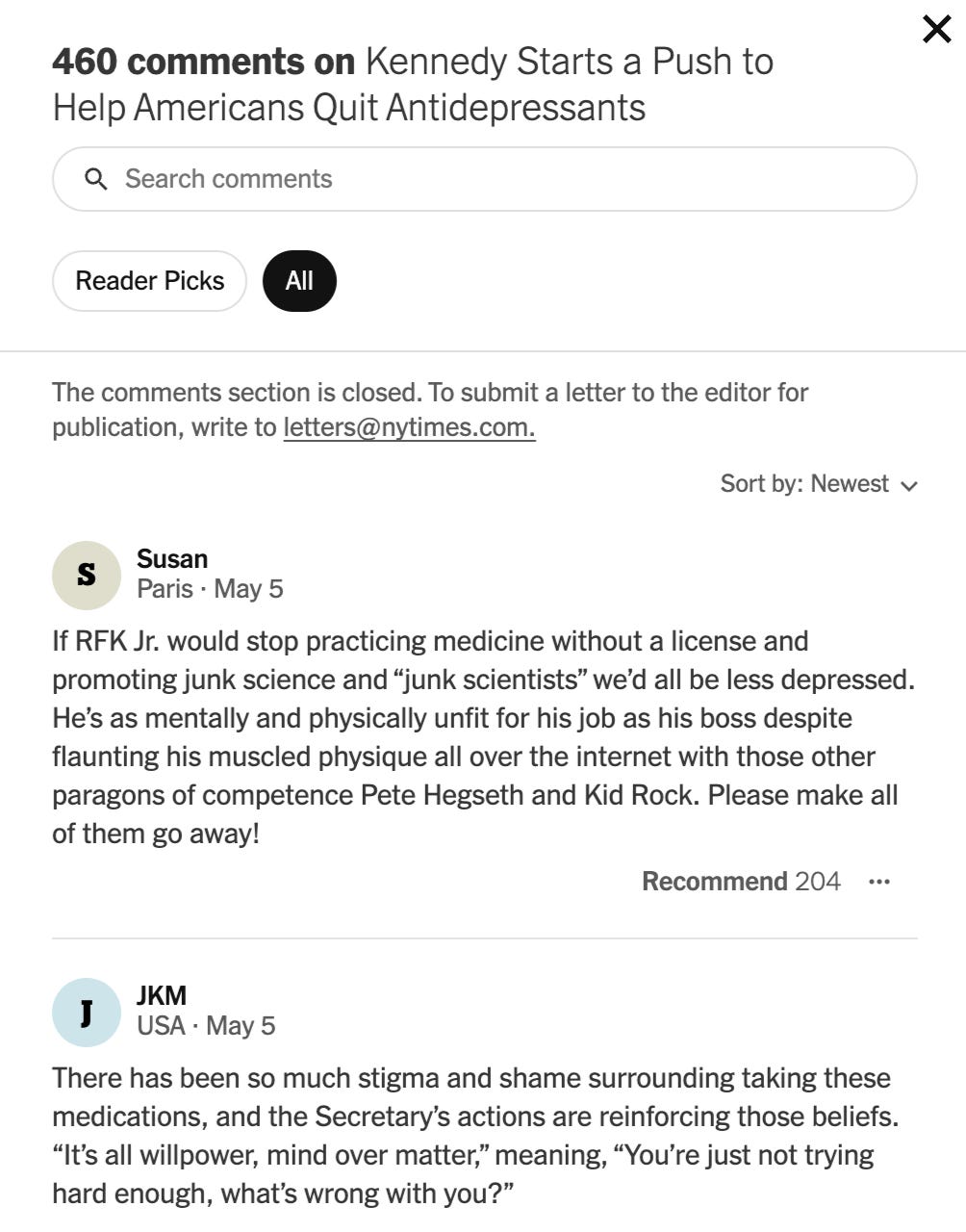
Across the many fascinating comments, three broader takeaways stand out:
There are many across the ideological spectrum who agree there needs to be more support and research for those curious whether gentle tapering from one or more psychiatric medications could be helpful.
There are also many others who can’t seem to get over the idea that this issue is now connected to Robert Kennedy Jr. and President Trump — with their frustration and fear seeming to overwhelm any curiosity.
There are many important questions being raised by people with concerns about this initiative and the approach being taken by this administration.
Within these broad brushstrokes, I break down sub-themes that seem worth highlighting, sometimes bolding a particular part of a quote that deserves special attention. You’ll notice again this is not a short-form article. Like the original report, I’m trying to put in-depth information in your hands, especially for those interested in the topic.
Where could your empathy and understanding most grow?
By way of preface, it seems to me having a broader grasp on the complexity of this conversation could provide more grounding and humility for anyone involved, no matter your view — maybe especially as you have a chance to hear out deeply a point of view you don’t share.
So consider skimming a little, and focusing on the parts that could benefit you the most. For instance:
Firmly pro-medication: If you think the impetus behind this effort is naive, unscientific or even reckless, spend some time in section one below. You’ll probably come away with a little more empathy and appreciation for how some of this might be helpful.
Firmly anti-medication: If you think the questions around antidepressants and tapering are simple, and simply a function of greed, power or ignorance, try skipping to the third section — where an assortment of really important concerns are raised about this initiative.
Done with Trump/RFK: If you are so done with President Trump and RFK that you could scream — and sometimes actually do — the first section will be helpful to you as well — especially in seeing this isn’t just about conservative politics. It’s about people experiencing deep suffering — reaching out for some additional support.
Supporting Trump/RFK: If you’re generally a supporter of President Trump and RFK and struggle to hear the kind of opposition they face without losing your cool, take a deep breath and work your way through the second section recapping people who are expressing their concerns about how this administration is going about this.
My own take-away is that the more sensitive and important a conversation is, the more grounded, humble and open to different perspectives we all need to be. Few conversations need that kind of a foundation more than this one. That’s what motivates me to share this in-depth tour of the public conversation happening. I have a feeling it could invite more humility, empathy and openness for anyone willing to listen in. It certainly did for me.
Three bigger themes in the conversation about safer antidepressant tapering:
1. There are many across the ideological spectrum who agree there needs to be more support and research for those curious whether gentle tapering from one or more psychiatric medications could be helpful.
There’s no shortage of people expressing appreciation for these efforts to learn more and provide support to those needing this kind of help. That starts with a number of people who shared their own experiences tapering off (or trying to taper off):
“I was on anti-anxiety and antidepressants and still wasn’t feeling well. My psychiatrist said I would be on them for my entire life. I stopped taking them [note — this should be done gradually if you’ve been on for years] while starting up a strict exercise and nutrition regime. I’m much better now. I know I am prone to anxiety and depression, and if I ever stop exercising regularly or (start) eating poorly I will fall back. It’s like an assailant walking behind me and waiting to pounce. This is my incentive to explore all food options and understand how they affect my well-being. I frame it as an interesting, exciting journey to optimize my life.” (anonymous from Chicago)
“I’m not a fan of Health Secretary Kennedy, but I agree with him on this. Fifteen years ago I was prescribed an SSRI with assurance that it is not addictive. I tried quitting at least three times over the course of the years. I did so very, very slowly and gradually reduced the dosage. Each time I had dreadful ‘rebound effect’. Look it up, if you don’t know what it means. It’s the worst state of emotion I ever experience and far, far worse than I ever felt before taking them. Truly dreadful. I don’t blame my MD prescriber because I assume he had been assured by the pharmaceutical manufacturer that their product was non-habit forming. Now I am resigned to taking the SSRI every day because the thought of going through that withdrawal and rebound again is truly frightening.” (CC, OR)
“I slowly weaned myself off an anti-anxiety and depression medication about a year and a half ago after 20 years and am so glad I did. None of this is easy….. After so many years of taking meds and working on issues, the anxiety was resolved enough to leave the meds. The depression is a daily struggle and I’m not sure how much difference the medication made in the long run. It does dull you to a certain extent and the side effects are not all known. I’m grateful I was able to get off them but each person needs to make their own decision. This is an extremely personal and complicated decision. It would be nice to have a more holistic approach to everything in medicine. A lot of doctors in this country tend to just throw drugs at the problem and deny even the most basic of natural answers like diet, exercise, sleep, stress and vitamins, etc. A stronger social support system would help everyone.” (Anonymous)
It was interesting to see the different pathways to ‘feeling again.’ For instance, similar to this person describing how the medication “does dull you to a certain extent,” others recounted how gentle tapering had helped them be able to feel more again in life:
“I have been on and off antidepressants most of my life. I recently stopped taking fluoxetine after taking it for about 6 years. It was like waking up from a dream, the medicine had blunted me emotionally so much. It helped immensely when I needed it 6 years ago, but taking it reflexively after its utility had declined was not to my benefit.” (Anonymous in San Francisco)
“I finally got myself off of them a year ago and I can finally feel again.” (anonymous)
A mother from New Mexico, Ana, writes: “I was on antidepressants through my college years, which blunted my emotions, made me act like a different person, lose interest in school and generally have a worse than bad time—a passionless, emotionless time where I drank heavily just to try to feel something.” She described the process of getting off the medications as “awful” — and how it took 2 years to “rebuild my sense of self and heal my brain.”
Then others pointed out that in their experience, the antidepressant had helped them feel again:
“I’m 31. I’ve been on SSRIs since I was 16. When I experienced my first major depressive episode, I had a robust support system: friends, loving parents, engaged teachers, a fantastic therapist, and a personal trainer my parents hired to come help me exercise three times a week. Even though I had every type of support imaginable, I still could not crawl out of that cave. I felt like a ghost stuck in my own life. And then I started Lexapro. I still remember the feeling of the sun warming my skin the first time I went to the park a week or so after starting the meds. For the first time in forever, I could actually FEEL it. I felt like a little kid waking up from a nightmare in their mom’s arms.” (AM, South Carolina)
“Back in 1992, Prozac saved my life. Over the course of several weeks my life went from solid gray to a rainbow. I’ve likened it to the scene in Wizard of Oz when Dorothy opens the door and the movie goes from black and white to color—only in slow motion. It basically gave me all of my emotions back; it was neither a happy pill nor did it blunt my feelings. Since then I’ve been on a number of different meds, benefiting from them all to one degree or another. Some have been difficult to get off of, most have not. I’ve also benefited from Transcranial Magnetic Stimulation, as well as Cognitive Behavioral Therapy.” (Michael Spence, San Diego, CA)
Others described being encouraged to taper too fast:
“I think that starting the discussion on the overprescribing of antidepressants is helpful. I was prescribed one (and truly needed it) but I never felt that my primary who I met only once before actually explained my symptoms. After years of therapy, I tried to quit. The first time, I had such bad brain zaps. The second, I had to go back on in a day or two because my irritability was so bad. Now my third time I am finally getting more support. Each other time I was told to just take a pill cutter and cut my dose in half! [way too fast, according to the best research] My medicine was and is lifesaving, but we truly have a problem in America with how mental health is treated by medical professionals.” (Ann)
“While I am concerned about some of RFK Jr.’s suggestions, I actually affirm him here. As a former psychiatric patient, I have had multiple experiences where psychiatrists would simply pull me off of a medication or tell me “You can stop taking the medicine” WITHOUT methodically tapering me or providing me tapering advice. This led to much worse mental and physical health struggles than before I took the medications. Paid professional tapering could save lives.” (Eli, California)
As reflected here, several expressed concern that people are getting on meds too quickly and tapering too quickly — both without awareness of the potential effects of doing so.
“Many who receive these drugs don’t know how they were intended to be used, don’t understand the endpoints that were evidenced, and are too often not provided balanced contemporary information regarding affective disorders in making decisions. It’s honestly heartbreaking from the research side” (Another scientist, Maryland)
“I observe that many patients abruptly discontinue their SSRIs or SNRIs without consulting their prescriber despite having been told about the risk of discontinuation syndrome. Verbal or written consent about side effects or potential withdrawal symptoms is important. However, I wonder how many patients really pay attention to what they are hearing or reading. That being said, informed consent should be provided for all medications as there are so many non-psychotropic meds that can cause significant untoward neurological effects.” (Ann-Marie, Maryland)
“Discontinuing Benzodiazepines could use some much needed attention. Take them for a couple of weeks and you’re addicted. Some doctors don’t seem to know this. But they prescribe them anyway.” (Mowgli, from New Jersey)
Some expressed interest in considering tapering, but admitted being fearful of withdrawal effects:
“Those of us who have used and benefited from SSRIs nevertheless know that withdrawal symptoms may be worse than those of the disease….I am now at a point where I feel stable and experiencing no real blues or any of the typical effects of depression. I would like to try to go off them. But, but, but, as I alluded to, I don’t want to face the withdrawal.” (anonymous)
“I would love to quit my antidepressant, but I’m highly addicted to it. Even when I’ve tried to titrate off of it, I still get incredibly unsettling brain zaps. I truly hate it.” (Hank, Portland, OR)
Some admit feeling like they are in a situation where they cannot get off (at least, not with better help in how to gently taper over a longer period):
“I take Celexa and Seroquel….I do not know why they put me on Seroquel, actually. But I’ve been on it for over twenty years and cannot get off it b/c I can no longer sleep without it. I’ve told my psychiatrist this (not the same one who put me on it who’s long gone) and he said with such a low dose that I’m on, it shouldn’t be a problem getting off it, but it is. It really, really is… in my case with a drug I have to take now and can’t get off and didn’t know the reason for the prescription in the first place it’s frustrating.” (hmsmith0, Los Angeles)
“I have been on antidepressants for over 30 years and have found it very hard to taper off and discontinue them, even with doctor’s assistance, due to the extreme withdrawal symptoms. I would love some actual help. What is missing in RFK Jr.’s plan are accessible, affordable, medically sound methods to get people through the lengthy, painful pharmaceutical withdrawals and transition to viable, more organic alternatives. The lack of information here is a big concern.” (JJS, Boston)
Parents, families, and caregivers describe their experience having to navigate tapering for themselves:
“This is fantastic news! Other countries are decades ahead of the U.S. medical establishment in training prescribers how to help taper patients. The dearth of info here is astounding. For those who choose to go off, they deserve doctors who understand deprescribing. I’ve been tapering my teen off an SSRI over the last 18 months. We are two months away from the finish line. Her psychiatrist and family doctor were utterly useless so I had to do my own research. Because of the work of Dr. Mark Horowitz I’ve been able to minimize her withdrawal symptoms. The practice of putting millions on drugs that cause dependency without support to safely get them off is absolutely criminal.” (KW, Evanston)
“A big problem with SSRIs, SNRIs and benzos is people try to quit and even with what they think is a reasonable taper, often directed by a primary physician, find themselves slammed with unbearable depression and/or anxiety they mistake for their “real self” returning. It’s actually withdrawal, but they’re convinced they need the drug more than ever and return to it. I watched two close friends go through this. Withdrawal can be anguishing, even in measures, but can eventually offer more of a sense of pride and self-ownership than ever. See Benzobuddies online forum for indispensable support, they now include quitting antidepressants.” (gw, usa)
“Many people I know who have been on antidepressants describe near debilitating experiences trying to get off them, with little to no help from their prescribing physician. The ‘brain zaps’ are very real, severe dizziness. It’s easier for doctors to refill and for people to continue taking these drugs rather than deal with the transition.” (Lan, California)
A variety of professionals describe welcoming better tapering information, slow taper protocols, and informed consent:
“As a psychotherapist, I applaud this wholeheartedly” (DL, U.S.)
“I am an LCSW, and I talk with clients about exactly this all day every day… social connection, exercise, less screen time, mindfulness, meditation, creativity. It’s a step in the right direction. I’d also say making it easier for people to get therapy would be really helpful.” (Stephanie Adams, Murfreesboro, TN)
“As a psych NP, I rarely prescribe SSRIs. Statistically they do almost nothing for depression, once you include the many negative studies that the pharma companies didn’t publish….RFK Jr. is still wrong about most things though” (Mr. Wick, Ohio)
“I am shocked by the number of children in our community who are in therapy and on medication…. In one case it is a mentally ill parent who needs help but the child, who once had an amazing facility with emotion is now rendered unable to empathize or access emotion.” (Mental health care professional, New York)
People stay on antidepressants for decades because they start tapering down and have significant withdrawal symptoms. It’s not like a blood pressure medication where each week I’ll reduce my dosage by 25%. The tapering with antidepressants needs to be in tiny, minuscule increments. (this person encourages people to check out Outro Health — an online platform developed by leading researchers with physicians who will work with you using the safest hyperbolic method). (Debra, A social worker in ATL formerly in NYC)
“After decades working as a therapist in the mental health system, I want to say, it’s about time (way past time!) that Americans get more accurate information about the side effects, discontinuation challenges and the need for very slow tapers — with knowledgeable doctors (most trust Big Pharma taper guidelines which are way too abrupt and still not well researched) — off SSRIs. I’m hoping the understandable concerns about Kennedy’s leadership at the federal level will not confuse or lessen the importance of the information being discussed. Our for profit Big Pharma system cannot be trusted to provide full and unbiased information so people can make the best decisions for their mental health with their doctors. MUCH more sound science, accurate tapering data and accountability is needed with pharmaceutical use especially in psychiatry.” (East Coast therapist)
Several people highlighted identifiable gaps in what people know — compounded by the natural confusion many people feel about the experience:
Catherine from Denver highlights the clear need for more research: “Pharmaceutical companies should be required to do studies about how to taper off these medications as part of the approval process. Before they start these medications, patients should be informed about the issues they will encounter when and if they decide to stop taking them. Right now people who want to reduce or stop taking these medications have to figure out how to do it relying on anecdotal information from other patients. Not everyone wants to take these medications for the rest of their life.”
Indigo from the Pacific Northwest admits it’s mighty hard to tell what’s really happening on a personal level: “These medications can exacerbate mental health issues too, and unfortunately the only way to tell if the medications are the cause is to stop taking the medication; and the only way to test is to increase the medication. Both are not ideal.”)
And an anonymous commenter emphasized how unclear the larger picture continues to be: “There are a lot of anecdotes about both the helpful and harmful sides of antidepressants but notably very little on the aggregate effects. Are Americans being overprescribed, resulting in net harmful outcomes? Or do they actually need more treatment? Or are they consuming about the medically warranted amount? Nobody — not individuals, not doctors, not professors, not epidemiologists — seems to have a clue.”
A commenter called “carmel fruit farmer” in NY wondered why people aren’t paying attention to the research that exists: “It is shocking to me that this research (showing the drugs are not generally effective long term) is widely ignored, but perhaps because they often bring short-term relief, doctors don’t suffer any consequences from prescribing an ultimately ineffective treatment.”
“The difficulty many patients have stopping SSRIs (as well as SNRIs and tricyclic antidepressants) is underappreciated by general practitioners.” (JC, Brooklyn)
David in Washington, D.C., shared his belief that there were “many hundreds of thousands of people who are hit by serious withdrawals from SSRIs which were never warned by their prescribers. Prescribers often then routinely attempt to blame these new symptoms on relapse and deny what patients are experiencing. I have personally spoken to hundreds of people this has happened to. This is a system failure.”
As reflected here, many of the positive comments were not anti-medication. They were pro-support. Commenters described being started on medication too casually, kept on it too long, given too little information about side effects, or left to figure out withdrawal on their own. They also often framed the initiative not as a reason to take medication away, but as a long-overdue attempt to give patients informed consent, individualized guidance and a realistic path off medication when they no longer need or want it. As reflected here and below, these people draw on their experiences to raise meaningful questions, such as:
What would a trustworthy evidence process look like — especially when patient stories point in different directions?
What evidence should guide this — anecdotes, population data, clinical expertise, patient experience?
Are medication harms being addressed too late — after people are already dependent?
Should tapering research, informed consent, and discontinuation planning be required before medications become routine long-term treatments?
How do we know who should stop? Susanna in Canada wondered: “It may well be that SSRIs are overprescribed, but he offers no empirical evidence as to who should stop and who should continue, and further, he wants to lump everyone in the same group…..It is difficult to know which cases need a short course and which are long-haul. Blanket pronouncements are likely to do a lot of harm.”
In other words: Can policy distinguish between overuse, misuse, underuse, withdrawal harm, and life-saving long-term treatment?
Some wondered whether we’ve been too quick as a society to ignore other ways to support those with depression:
“I was depressed at some point in my life and after talking about it for 3 minutes with my doctor he immediately jumped to antidepressants. Not diet, not exercise, not social contact. But pills. This experience has been echoed by most of my friends. This country is obsessed with a quick pill to solve an issue. …Those are 99% of the time not the solution. Very few people have exhausted all the options that would make them require those pills.” (Bernard, California)
“If your gut is out of balance, your mental health is too. Fixing your gut microbiome is a game changer. Also, express your feelings and thoughts, exercise, eat healthy foods, be of service to others.” (Frank, austin)
“Instead of treating underlying situations like loneliness, social media induced distractions & anxiety, people are simply seeking solace in antidepressants. The next big thing that is already here is weight loss drugs. Anyone that has without an iota of conviction to limit eating, or make healthy choices in food and exercise is now jumping on the Ozempic bandwagon. I applaud Mr. Kennedy is at least trying to address this.” (Columbus, OH)
A self-described middle-aged woman from Massachusetts described her relief and excitement that more attention is being given to this: “As someone who has tried many psych meds and had withdrawal, I’m thrilled to see a push towards other things that have clear benefits, both short- and long-term: nutrition, exercise, social connection, & therapy (CBT, EMDR, DBT, IFS, ACT, ERP, etc., etc.). I’m (saddened) at how quickly providers reach for pills, multitudes of them. I have seen many people on 2, 3, 4 different psych meds — what on earth are providers thinking?!”
But a number of people expressed broader, more cynical levels of distrust in the system as a whole:
“1 in 6 Americans take an SSRI, and the APA has the audacity to push back at the suggestion that they’re overprescribed.” (RGB, OR)
“My wife is a Pharmacist and dispenses antidepressants to hundreds of patients each week. I can tell from our casual discussions (no names taken) that there is drug pandemic in this country. People are getting prescribed these mind altering medicines way too easily. A lot of them are often too young.” (Columbus, OH)
“Pharma’s mission is to get you on their medications and make you life long customers.” (Richard, Boston)
David from Washington, D.C., pointed out that “Over half of U.S. psychiatrists (55.7%) accept industry payments from pharmaceutical companies totaling over $340 million between 2014 and 2020.”
“My gut tells me it’s possible that the system could be corrupted by profit-seeking pill manufacturers who get doctors to over-prescribe their medications in an arrangement that benefits both of them at the expense of patient safety and health. But I’d rather have regulatory decisions in this area made by qualified medical experts looking at data” (Christopher Walker, Tainan, Taiwan)
“1 in 6 take SSRIs, Big Pharma has totally rigged the system. A tiny tiny amount of the population needs SSRIs. The rest, NO,” wrote Frank in Austin — pointing to 2008 research showing antidepressants barely outperforming sugar pills in trials.
“Wow this caused me to sit up and take notice. The Trump admin of all people taking steps on the huge antidepressant overprescribing issue?? Seems like bizzaro world but here we are. This dirty secret is simple: it’s faster and more profitable for providers to just hand out pills than to dig deeper and find behavioral solutions.” (Ro, San Francisco)
“Psychiatric meds are vastly overprescribed in North America and often without a psychiatrist involved or only briefly at the outset of treatment before you’re handed off to a family doctor and an LCSW. The reckoning can’t get here soon enough.” (AM, Canada)
“The fact that (Kennedy is) not a doctor is a monumental qualification. The Pharma companies own this country.” (Swede, midwest)
Other related questions were raised — such as whether screenings catch struggling kids early, or create false positives and unnecessary treatment? And who decides?
“Regarding mental health screening- there are many clinicians who are advocating removing these screenings because of the very high number of false positives they produce. The screening process for many mental health conditions is very broad and subjective and can lead to the unnecessary drugging of children which carries its own risks.” (David, Washington, D.C.)
Some begrudging acknowledgment that Kennedy was at least right about this:
“I find myself agreeing with Kennedy on this issue (for once), as research indicates that these drugs are not generally effective long term.” (carmel fruit farmer, NY)
“I’m no fan of Kennedy, but there’s some truth to what he’s saying….there’s a point where many want to stop taking the medication, but it’s really really hard.” (Debra, A social worker in ATL formerly in NYC)
“Kennedy may be off on a lot, but this topic isn’t one of them.” (Pum1917, Vancouver, BC)
“I hate RFK Jr. He’s very dangerous. But I also think SSRIs are overprescribed and their risks (though not often life threatening) are not sufficiently discussed. The side effects are real. While I’m not advocating or suggesting Kennedy is right, there is truth in what he’s espousing.”
“Even a broken clock is right twice a day. I wanted to hate this given RFK’s wild absurdities, but his quotes seem almost reasonable about using these medications as an option as opposed to the default treatment. They have a place (and they’ve had a place in my own life) but unfortunately he has a decent point here.” (Mike, nyc)
“This is long overdue, so I applaud RFK on this though he’s mostly a crank. Almost 17% of the population being on daily psychiatric medications is a stat that should alarm all of us. The ease on which these prescriptions are doled out over the recent decades is nothing short of criminal negligence. These medications have their place in therapeutic care, but they are used and abused far beyond that. Providing resources to help people taper off of these is a great idea, hopefully there is actual substance and resources behind this proposal. Imagine if an adversary targets SSRI factories around the world. A widespread and sudden shortage would render many people incapacitated.” (Rory, Alexandria, VA)
“Kudos to Secretary Kennedy. Taking a drug for too long can produce irreversible mental and physical adaptations.” (Sequel, Boston)
“Sounds like a positive step. I believe several books have been written by people, particularly women, who thrived subsequent to weaning off these drugs. However, Big Pharma et al. won’t take such revisions lightly.” (David Cohen, Roslyn Heights, NY)
“Great idea!...SSRIs are not suitable for anything other than temporary treatment if so. A recent Lancet study found them effective no more than 15% of the time compared to a placebo.” (Conservative Liberal, CA)
As you can see above, whatever reservations they may still have about the messenger, a striking number of commenters welcomed the underlying goals: more information, more informed consent, more attention to withdrawal, and more support for people who want to taper safely.
These positive comments were rarely simplistic endorsements of Kennedy. More often, they were qualified affirmations from people who had experienced the problem directly. Indeed, the most compelling positive comments were often personal rather than ideological. They came from people who had struggled to discontinue psychiatric medications, people who felt poorly informed before starting them, parents who had to research tapering protocols themselves, clinicians who had seen overprescribing or inadequate guidance firsthand, and patients who held two truths at once: these medications can be lifesaving for some and harmful, blunting, or difficult to escape for others.
2. Many other people can’t seem to get over the idea that this is (now) connected to Robert Kennedy Jr. and Trump — with their frustration and fear seeming to overwhelm any curiosity.
Even though the research and advocacy involved in helping support those tapering spans decades and even though those who have benefited from these efforts span every belief, political background or worldview, the fact that Trump and Kennedy (and Tucker) have been responsible for bringing it more into the public eye appears to irreparably stain the whole issue for many.
The strongest pattern here is a much broader political reflex, rather than simple disagreement about antidepressants, withdrawal, or overprescribing. Many readers seemed to interpret the entire initiative primarily through their distrust of Kennedy, Trump, MAGA and the current administration. That distrust often overwhelmed any curiosity about the substantive questions around long-term prescribing, withdrawal, informed consent or non-drug supports.
Some reflected a belief that nothing good can come from this administration — with their overt hostility towards RFK and Trump reaching a point that they openly acknowledge they cannot see anything positive or consider anything good coming from these efforts:
“This man is a danger to society. He needs to resign. To my reckoning he has not one idea worth a salt.” (Steve Mason Ramsey NJ)
“Lunatics and grifters, ALL of them in this administration,” writes KG in Louisville, KY. “RFK Jr. might have a couple of sound ideas regarding health and well-being every once in a while….A Magic Eight ball could guide U.S. healthcare policy just as effectively.”
“Of all the truly ridiculous things that are going on in the United States under Trump, RFK Jr. being in a position of great power in the health care field is the most ludicrous and dangerous” (bstar, baltimore).
“RFK Jr is the last person on earth I would take advice from on my medical care.” (JD, USA)
“Why should we believe one word that comes out of the mouth of anyone in the Trump administration? They constantly lie, lie, lie. Kennedy is no different. He has an agenda and he will say what he thinks he needs to say, as well as take unilateral action, to accomplish that agenda. He has been a disaster for Americans’ health.” (JenD, NJ)
“Kennedy has absolutely no business occupying the job he does. As is true with the entire Trump cabinet.” (Patient Zero, Portland, OR)
Others emphasize how this seemed to be another example of this administration rebuffing expertise — and speaking where they don’t have any credibility to do so. As reflected below, the administration’s questioning of other experts and push-back on other widely accepted conclusions leads many to feel deep suspicion about this seemingly happening again:
Cynthia Andersen writes, “First off, RFK Jr is not a medical doctor and has no business in addressing medical issues. Like POTUS, he refuses to consult or acknowledge experts in the field.”
“If RFK Jr. would stop practicing medicine without a license and promoting junk science and “junk scientists” we’d all be less depressed.” (Susan, Paris)
“This guy has NO business dispensing medical advice!” (Debbie in NC)
“Kennedy should keep his hands off our healthcare. He’s not a doctor or health professional of any kind.” (Steven Carters, Oceanside, CA)
“Might as well take your health and medical advice from the first random person you meet on the street, for all this guy’s qualifications. Antidepressants save lives. RFK Jr.’s advice won’t.” (JLC, PNW)
“Who is Bobby jr. to tell patients what they need or don’t need. That’s for one’s physician to decide.” (Wind Dancer, Cheyenne, Wyoming)
‘Even if antidepressant overuse is real, RFK is the wrong messenger’ some effectively say. For instance, one immunologist from Malvern, PA writes, “While Mr. Kennedy may be right about inappropriate use of SSRIs, I’d rather get my guidance from qualified mental health professionals.”
Implicit in these concerns is the question: Who decides when medication is needed — patient/doctor, or federal officials? How can the initiative support informed choice without becoming pressure, restriction, or interference?
“Only a patient and their psychiatrist may decide when and if it makes sense for the patient to discontinue psychotropic medications,” writes an individual from Maryland. “The remainder of this dialogue and numerous lay opinions is irrelevant.”
For some, they made clear their feelings that this administration is part of why they feel depressed: “I suspect that Kennedy is now a major source of depression for many people,” said Bodger in Atlanta. “I know that I get really bummed out when I see or hear or read or even think about him although I doubt that there are any pills that would help.”
There were many other similar sentiments:
“With all due respect, does anybody really think that the right time to forego antidepressants is while Trump and his minions are running the country into the ground? As far as I can tell, we’ve never needed them more than we do right now.” (NT, Saint Paul MN)
“Imagine the next 2.5 years under the Trump administration without antidepressants.” (VV in Connecticut)
“Most people are probably taking antidepressants to survive this unhealthy political climate, managing rising costs/low pay, and the absence of meaningful healthcare” (EGT, NYC)
“Just the idea of Kennedy makes me depressed.” (Jim London)
“If we could throw out the Trump administration, that might enable a lot of us to throw out our antidepressants” (Todd, WA)
“Here’s the deal: you and your administration step down and I will quit taking my antidepressants” (Seaskiguy, Seattle, WA)
“The use of antidepressant medications should substantially ease up with the eventual demise of MAGA and the Trump Administration.” (Steve, Le Chien)
“Guaranteed that the number of antidepressant prescriptions will drop precipitously once Trump and his minions, including Kennedy, Jr., are no longer in a position to ruin people’s lives.” (N christopher smith, virginia)
“It will be so much easier for everyone to quit antidepressants when the entire Trump administration is a bad memory. Just the thought of it is a balm.” (W C Maddog, WC. Pa)
“Americans are depressed, freaked out, and sleep-deprived because Donald Trump is in office.” (Portland)
“I rely on antidepressants to help me cope with the constant stream of difficult and distressing realities we’re facing—cruel mass deportations, children being separated from their families, attempts to suppress free speech, efforts to silence the media, actors, and late-night hosts, economic instability, war, mass layoffs, the blatant enrichment of the President and his allies, the Epstein files, and so many other troubling issues.
Antidepressants and therapy are the only things helping me maintain some sense of optimism—that things might eventually return to some form of normalcy, and that I’ll be able to move through the world without feeling weighed down by the level of hatred we’ve endured over the past two years. In the meantime I will gladly take my daily little blue pill!” (Debbie, Connecticut)“What Trump is doing is systematically raising anxiety and depression levels throughout the U.S. (and the world, for that matter) with his reckless aggression and threats to other parts of the world, his raising prices here through tariffs and energy, his wanton destruction of national treasures (selling and leasing public land for his whims or cronies’ profit), his authoritarian tactics, his suppression of democracy...and many other things to list here. And, because Republicans are standing by and doing nothing to ameliorate any of the effects of these policies. Those plummeting approval ratings? That’s where you’ll find anger, fear, and despair. I personally know people who have felt they will have no choice other than suicide when the Republicans cut Social Security and Medicare to pay off their tax cuts and wars of choice. And I’m a psychiatrist, by the way….” (Dumbstruck, Vermont)
“Now we have more people feeling depressed and/or having a feeling of helplessness thanks to this very government.” (Opus, Cape Cod)
“Psychotherapy and SSRIs are the two component glue that holds my sanity together. Recently, I’m having lots of sessions with my therapist that are focused on the overwhelming sense of dread whenever I remember that people like RFK Jr. exist and wield incredible power. My therapist, in turn, recently upped my meds.” (Rhode, Island)
“Psychotherapy and SSRIs are the two component glue that holds my sanity together. Recently, I’m having lots of sessions with my therapist that are focused on the overwhelming sense of dread whenever I remember that people like RFK Jr. exist and wield incredible power. My therapist, in turn, recently upped my meds.” (Rhode, Island)
Again, some saw this as another example of this administration harming the American people:
Val in New Jersey insisted this was another example of this administration “just continu(ing) to ‘pick’ on the people who they should be serving.”
“RFK Jr. should mind his own business,” Mary in Indiana says. “I know what works for my own mental health not the government. He should work on himself before exploiting society.”
“I’d be open to the conversation on if there is an overprescription crisis” writes Caitlin in Texas. But added, “These are life-saving drugs and these matters should be handled with care but this toddler is taking a sledgehammer to the system and hoping it works. It doesn’t matter to him who gets hurt in the process.” (Caitlin, Texas)
Given their deep hostility and distrust to the administration, many could only see the outcomes of this tapering as a possible disaster. For instance, Thurston Howell III in Los Angeles wrote that if this “ill-advised policy…causes a person who needs antidepressants to lose access, that person can become suicidal and/or dangerous and, at a minimum, lose interest in functioning appropriately and being productive. Stigmatizing them and jeopardizing their access to the drugs is both cruel and dangerous.”
In the wake of this all, some pushed back: wondering, are we really being fair with this proposal — or dismissing it reflexively due to our political passions?
A smaller number of commenters argued that many readers were rejecting potentially legitimate concerns precisely because the wrong political messenger had raised them. For instance:
Bernard in California noticed this same theme: “Thus, anything RFK Jr says is automatically bad and dismissed. If he said apples were good, most people here would stop eating apples.”
Elle writes, “Those of us who are desperately seeking a quick end to the current MAGA regime accomplish nothing when we launch ad hominem attacks on any and every Republican. Let’s lead by example, let’s be reasonable, let’s refuse to be cruel. If one or two good things can come out of this administration, that’s a win for us all.”’
Several asked why this is a ‘conservative issue’ — rather than a liberal one (which it’s been more so for decades) — and wondered what would happen if the politics were reversed:
“MAHA has outflanked the Democrats. Being skeptical of big pharma should be a liberal issue. It was prior to 2020. 16 percent of people is too much to be on daily SSRIs. I was overprescribed them as a child.” (Sal from New York)
“If RFK was a Democrat, this left wing readership would be cheering him on.” (Swede, midwest)
“Something tells me if this was being pitched from a trusted left leaning outlet the reaction would be quite different.” (Reader, Tribeca)
Several wondered whether the outrage was inflated far beyond what reality called for — and wondered whether critics were too quick to condemn something with potential real benefits:
“Psychiatric medications have a role in care, but we will no longer treat them as the default, we will treat them as one option, to be used when appropriate, with full transparency and with a clear path off when they are no longer needed,” Mr. Kennedy said. That actually sounds quite reasonable. But judging from the most liked comments here, one would think that he’s coming for your meds. (Rio Grande Valley)
“Outrage over what? These recommendations are just calling for more information, safer deprescribing and informed consent. No one is trying to take your SSRIs away. Sheesh.” (Numa, Ohio)
3. There are many important questions being raised by people with concerns about this initiative and the approach being taken.
The fact that politics has clouded this conversation shouldn’t surprise anyone (is there a single issue in America where this hasn’t happened?). This abundance of hostility should not distract from a whole range of other important questions.
Many commenters were not simply defending antidepressants or attacking the tapering initiative. They were asking whether a legitimate concern about overprescribing and withdrawal can be addressed without reviving stigma, discouraging needed treatment, ignoring chronic illness, overlooking access barriers, or replacing one kind of one-size-fits-all medicine with another.
I attempt to summarize these thoughtful concerns below, in their own words — organized into a few broader areas:
First of all, many people described personal benefit they have found with their antidepressant treatment so far:
“I have struggled with depression, my whole life. And I was born when there was no social media in fact in my childhood answering machines came on the scene. Fluoxetine was a lifesaver for me. I have now been escitalopram since the late 90s. I’m almost 71. Why in the world would I stop this medication?” (Darlene Moak, Charleston SC)
“Prozac saved my life. I had terrible OCD since I was a child. I’ve been taking 20 mg (lowest dose basically) for much of my life. When I stop taking it…symptoms return….For me a low consistent dose works wonders.” (Dallas, TX)
“For some of us, these meds literally are a matter of life and death.” (Linda K, California)
“If you just suddenly stop, you increase the chances of some withdrawal symptoms. I have been on an SNRI for decades for dysthymia. It has made a huge difference.” (Jay, Canada)
“Frankly, unless you have depression and/or anxiety and have taken an SSRI, you have no idea what you are talking about. For reference, I do exercise, eat relatively well, get treatment for sleep apnea, go to talk therapy once a week, have strong relationships, and take a GLP-1. I am very lucky to be able to do so. Regardless, I was prescribed Lexapro at 42, and it has literally changed my life for the better, even with everything else I am doing. So much so that I would never consider stopping the medication. For those of us who it works for, it is an absolute blessing and not something that should be discouraged.” (Name/location not captured)
“Antidepressants saved my life and still do.” (Independent, Texas)
“I thank God every day for the medical miracle they are to my brain. They are the difference between a life well lived and crawling under the blankets to “cope” with depression and anxiety.” (Too old for this, Boston)
“Without my antidepressants, I would not be able to function in society,” says Sara Emerle in Albrightsville, Pa. “They give me a chance to live a life that isn’t defined by constant pain. That isn’t overprescribing; it’s medically necessary care….I don’t know what would happen to me without my medications.”
“I am on antidepressants and they allow me to have a career! I can do my job and do it beyond well because my medicine inhibits my social anxiety disorder. ITS FOR MY MENTAL HEALTH!!!” (Sarah, North Carolina)
“I started taking Lexapro shortly after (Trump) was elected the first time, and I honestly believe it saved my life. I was very skeptical about starting it, but my doctor, correctly, said that it would help me function a lot better in the world. I still have anxiety but it is now manageable, rather than crippling. I will take it for the rest of my life.” (BC, New England)
“Whether it was a bout of ‘male menopause’, family trouble or far too much international travel thru changing time zones in a very short period of time or all combined, fortunately my good friend a Westchester Cty. NY Orthopedist recommended 20mgs/day of SSRIs. They did the trick and along with swimming every day, enjoying my work, family & friends, they helped put me back on track!” (NYer in the EU, Germany)
“I intend to restart (antidepressants), as they help with the daily feelings of doom I have.” (Carla, CA)
“There are medications, and there are medications. I had to try a couple of them before we found the one that worked for me. I’ve been on it for about 40 years, and I would never give it up. My life is so much better now, thanks to an SSRI that works really well for me.” (Not My Real Name, Monterey County)
“I cannot possibly stop taking antidepressants while the state of our government is so despair-inducing. But seriously, why should I? I lived half my life weighed down by an enormous amount of childhood trauma. Antidepressants have helped me live more fully and comfortably — with almost no side effects. They may well have saved my life.” (Colleen, East Haddam)
“I have gone from an introverted and seriously depressed young mother to an extroverted fully engaged grandmother over my 74 year lifetime of taking two different antidepressants. I would never jeopardize the joy I have found in my current life by quitting these wonderful meds! I also have never experienced any side effects.” (Merle Savedow, Philadelphia)
“I had panic disorder in ‘98. I had three children, a wife and job. I struggled. No sleep for days. It was hell. I went to a GP and he had no clue. I decided to go see a psychiatrist against my wife’s wishes because of the stigma. After a short conversation, he almost immediately diagnosed my issue and prescribed Zoloft and trazodone for sleep. Helped almost immediately. I am now 72 and healthy, looking back on a successful career and three lovely grown children. Stable, no side effects, and steady state for 28 years. I have no complaints. Say what you will.” (Alaska Tom, Alaska)
“These medicines have been a great benefit in my life….If you wanna quit them and try something natural, go for it. But, leave me alone to make my own choices. I’m functioning just fine and living a happy life.” (Bob McBobbybob, Arizona)
“Prozac has saved my life. A few years later, my doctor added Topamax because it turns out I was BiPolar Type 2. Without these medications I doubt that I would be here. RFK, Jr. has no business interfering in anyone’s medical care, he is NOT a physician and my medical or psychiatric care is NOT HIS BUSINESS.” (txdoglady, Albany, Oregon)
“Without antidepressants I would probably not be here today. I will not be taking mental health advice from a man who dumped a bear carcass in Central Park.” (Gaia, Earth)
“These medications saved my life twice. Each time I was suicidal from PTSD/Anxiety/Depression. The meds along with talk therapy have made me the mostly functional 71 year old I am now.” (Oldgoalie, Michigan)
“I have been on happy pills for over 40 years….I would have killed myself by now without them.” (Kris R, Sunny CA)
“For years I struggled and Lexapro is the only thing that has helped me sleep through the night.” (Margaux, Denver Colorado)
“There are those of us with serious, chronic mental illness, including major depressive disorder, that benefit from SSRIs. Nobody surveyed me when coming to these stigmatizing recommendations. In the years before I took SSRIs, my mental health flailed even with therapy and appropriate lifestyle choices. SSRIs stabilized me enough to level the playing field so I could do the work in therapy.” (Kristi, Knitting out there somewhere)
“Antidepressants can be life-saving, and there should be no stigma associated with their use. No one would stigmatize a diabetic for needing insulin, or someone with a strep infection who took an antibiotic.” (EJ, Northern California)
“I live with bipolar 2 and feel I am well cared for which include antidepressants which I will likely be in for the rest of my life. A life that will possibly be long because of the benefits of antidepressants.” (Eleanor Harris, South Dakota)
“Millions of people are functional because of antidepressants.” (Wendy, Denver)
“Antidepressants saved my life on three separate occasions. Each time, I was clinically depressed. Each time, I absolutely would have ended my life if not for Wellbutrin. No amount of exercise or sunshine or saunas or red meat or whatever else Kennedy wants to promote would have helped me. Each well-intentioned suggestion only made me feel worse; I felt guilty and at fault for my own depression. It was like trying to fix a broken bone by putting weight on it. Antidepressants are the cast for the broken bone. To suggest taking that away or lessening its use: it’s just appalling. By the way, each time, I was able to step down my dosing under a doctor’s care without adverse effects. Doctors know what they’re doing. Kennedy does not.” (ML, Here)
“Wasn’t until my 40s with multiple severe life pressures that I finally got on an antidepressant and it changed my life for the better. I never plan to stop, nor should I based on the genetic testing.” (Spring, Portland, OR)
“SSRIs and other psychoactive drugs saved my life by controlling the depression long enough for therapy to become effective.” (KMT, Illinois)
“(Mental health) conditions run in my family and I’ve struggled with suicidal thoughts since my teens. The medication allowed me to go out in public and function when I could barely leave the home. It allowed me to get out of bed in the morning and go to work when I wanted to not go on.” (Philip G, Raleigh, NC)
“(Antidepressants) saved my life. Taking them made me realize how “normal” people exist. I’ve been 20 years on the same one. Have stopped twice with no issues but the depression came roaring back after a decently long break. No major side effects. Not worth stopping — no upside and many downsides. Without them it’s likely I would not be alive. So read your books and studies and believe what you like, but I’m deeply grateful they exist and I have access to them.” (Grateful for SSRIs, Baltimore)
Some who found benefit acknowledged the complexities of treatment and the potential value of learning more about safe tapering. Mike Charlie from Montana wrote: “SSRIs helped me through an acute episode of depression. Maybe even saved my life. But coming off of them was awful. Nausea for weeks. Sleeplessness for what felt like months. I was determined to get through it because I didn’t want to go back and repeat any of the experience. For the long run, however, Cognitive Behavioral Therapy was the best 500 bucks I ever spent. Of course it wasn’t covered by insurance.”
Others described family members benefiting:
“I have taken myself off antidepressants before. I can get through the withdrawal, that’s not an issue. But I feel so much worse when I am not on them. The article talks about emotional blunting. Some of us need our emotions blunted because anxiety and depression are painful,” said Jennifer from Ohio. She later added, “I need to be blunted emotionally because when I’m not, I have suicidal ideation.”
“For members of my immediate and extended family, SSRIs have been life changing and are indispensable.” (WWRD, NYLON)
“Antidepressants saved my mother from a life of constant depression. Every time she went off her meds, she relapsed. Every time she went back on, she came out of her depression within a few weeks. I am very grateful to medical science that she recovered her health, and my childhood and our family lives were also saved.” (WikiMart, Vancouver)
“My husband has been on antidepressants for decades. It changed his life and most likely saved our marriage. This June, we will be married 53 years. If any moves are made where his medication is no longer covered by insurance or goes the way of birth control and is no longer available, I am sending him to live with you.” (Diana CA, USA)
“Some people need to be on antidepressants, my 94 year old father in assisted living is on Lexapro and needs it to control his anxiety disorder.” (Wind Dancer, Cheyenne, Wyoming)
“(Lifestyle approaches) work for me,” Chris T. from Boston says, “It doesn’t work for my partner, who is like night (darkness) and day (light) off and on his antidepressant. He could exercise, sleep, eat well, meditate, whatever, but that single once daily pill is the only thing that ever seemed to make a difference. People need to remember that these medications are actually life changing for some people.”
“My mother’s anti-anxiety medication changed my life. A children’s hospital emergency room nurse, she did her solid best to keep two boys locked in the house away from all potential dangers she saw at work daily. I remember twice her getting ticketed for driving too slowly on the highway. After medication, I traveled to Italy to live with a host family for a summer — every summer. I ventured into the city regularly, alone and with friends. By 17 I traveled the East Coast by Greyhound with a couple friends with her permission. She got her first speeding ticket when I was 15 while attempting to rush my brother to his hockey game, a sport he was suddenly okay with him playing. She traveled to Italy with me when I was 18 and did not hyperventilate on the airplane. Her medication didn’t just represent a lifting of the veil of anxiety for her, it was freedom for my brother and I. I cannot speak to side effects, but she could have stood to be a little emotionally more numb if anything. The only side effect I noticed was that she appeared to be really living for the first time in my life and probably for the first time in decades in hers.” (George S, Maryland)
“My children are both testimonials to the great benefits of these drugs. My son’s bipolar was terrible until he got the right drugs. I didn’t think he would finish high school at one time. Now he has a masters in computer science and is very successful. Thank God for these drugs!” (Linda, Chicago, IL)
“Find out what meds work for you, or in my case, my son. He’s still here, and I am grateful for the medication.” (Jax, SC)
Others shared their general perception of the larger benefits:
“For many people their antidepressants are like oxygen, they can’t live without them.” (Juan, Miami)
“Antidepressants, while perhaps overprescribed and misused or abused by some, have helped millions of people function more optimally, productively, happily.” (Scratching, US)
Second, some raised concern about pressure some may feel from these tapering support efforts. Specifically, for people who experience depression as chronic, the focus on tapering and considering other things can feel off-putting — with a sense of ‘when are you getting off’ pressure unwelcome.
“For many people, psychiatric conditions are chronic,” writes someone from New York, “so this is like telling type one diabetics to stop taking insulin! But go ahead, take ibogaine, peptides, creatine, beef tallow, raw milk, and go work on a farm, that’ll fix everything.” (Name not captured, New York)
“If the initiative were solely about helping Americans who want to wean off these drugs, that’s actually a need area. But for those of us who have determined with our doctors that ongoing treatment is best for our long-term health? Stop trying to sell us on steaks and pull-ups.” (Alex, Virginia)
One woman from Fuquay-Varina NC insisted her condition will always require medical treatment: “I hate the psychiatric drugs I am required to take as much as I hate the opioids for my husband. But I have no choice to not take them. They help me manage a rather complicated, treatment resistant condition…..I believe in prayer, self awareness, therapy, exercise, nutritional support, and even holistic medicine. But you know what? At the end of the day, I’m still going to be bipolar 1….Meds will be required.”
Another individual in Chicago asked, “Why talk about it like depression is curable?” (reflecting the belief many have that depression is inevitably life-long).
Many people support better tapering information while insisting medications remain available:
“Fine, help those who want to stop taking antidepressants. But for those of us who benefit from long-term antidepressant use, don’t do anything that will make it harder for us to continue to fill our prescriptions.” (Ken Cooper, Albuquerque, NM)
“I’ve been utilizing SSRIs for decades, starting in my 20s when anxiety and panic were debilitating. I have been a very careful steward of my tenuous mental health…using meditation, exercise, therapy, nutrition, and many other modalities. And they have all been useful tools. But the medication has without question been instrumental in my stability and ability to live a normal life. I have tapered off at times, for pregnancy, nursing, or just to “see”. But I have been incredibly grateful for these meds and would have had a much more difficult life without them. Medical freedom means not dictating to me about my medication choices nor negating my need for them.” (PDurgin, Baltimore)
Third, it’s clear for some people that tapering doesn’t always leave people in a better place. Depending on the circumstances, withdrawal effects during tapering can be very hard:
“I am in the midst of withdrawal from 17 years of SSRIs, and I also wake up every day very much wanting to die. The experience of withdrawal very often does go well beyond brain zaps and some flulike symptoms.” (AM, Richmond, VA)
There were a number of worries about negative consequences as people try to taper.
“Sorry but suicide and suicidal ideation are far worse than withdrawal symptoms.” (Howard, Gloucester County, NJ)
“There will be more suicides. I am a physician. Antidepressants work.” (SC, SC)
“Without SSRIs some people will no longer be able to survive, and all the therapy in the world cannot fix that. I know. I will not return to the days of debilitating depression that does not respond to gimmicky self-help strategies or one hour per week therapy.” (Tula, Vermont)
“Not long ago — in response to the effects of overprescribed opioids — the prescribing pendulum swung so far in the opposite direction it caused a rash of suicides and dependencies on dangerous street drugs from legitimate pain pts who could no longer get the necessary meds to manage life-altering chronic pain.”
One especially cynical observer, Ethan P from Austin TX insisted that “The road off SSRIs is self-medication through alcohol or heavier barbiturate style addiction” [not true — many experience being able to go off at a gradual pace, and learn other ways to navigate emotional distress]
Sometimes declining the additional assistance of antidepressants can also leave people in a harder place:
“I have a relative who declined antidepressants because she wanted to get through it herself. She had major depressive disorder, spent two years living in acute despair, and the despair slowly melted away over the next five years. She has never been able to work since and is now at retirement age. So Secretary Kennedy, did she make the right decision?” (Jay A, Edmonton Alberta)
Fourth, when the medications induce more depression, it can be really confusing:
“I believe that maybe SSRIs could help some people. I’m not saying that. It’s just that when they make you want to kill yourself more and the doctors tell you ‘that’s normal, it’s a side effect of the medication’ what’s the good of taking it if it’s supposed to make you want to kill yourself less?” (Ben, Missouri)
Some wonder: Are we confusing withdrawal with relapse — and how can patients tell the difference? When symptoms return after stopping, is that withdrawal, relapse, or evidence the medication was needed? Maybe these aren’t withdrawal effects after all?
So much of the focus in the withdrawal community is helping people recognize withdrawal effects, instead of assuming it’s all a return of depression. One man in Oklahoma, going by “Vadoret” — said just the opposite, encouraging more scrutiny of whether withdrawal is an accurate language for what may perhaps be a return of depression:
“In some people depression is a chronic medical problem that, like other chronic medical problems, necessitates ongoing treatment. I have never heard that recurring hypertension when antihypertensives are stopped, or recurring high cholesterol when agents for dialipidemia are discontinued, represent “withdrawal”. People understand that, if you stop treatment, the problem recurs. Sometimes nutrition and exercise are not good enough for maintaining a normal blood pressure and blood lipids, and therefore pharmacological treatment is needed (and can be lifesaving). In the case of depression….for some people, exercise, psychotherapy and nutrition are not enough, either. Then, antidepressants are indicated.”
Others shared similar sentiments:
“Maybe his relative was “suicidal, every day” after stopping their antidepressant because they were depressed and needed their medication?” (Mary, Waterloo NY)
“That’s not withdrawal nor an after-effect. That’s an indication that she needs to go back on SSRIs!” (Terry, Texas)
“The fact that you cannot get off of it may suggest that you actually need it. Just like a diabetic patient cannot get off insulin. I wish you well.” (Evergreen, CA)
Citing the ordeal of an unnamed family member who he said “was suicidal, literally every day” when she discontinued an S.S.R.I. after taking it for several years, Annie from British Columbia said, “It sounds to me as if the medication was HELPING his family member.”
“If I have hypertension and decide to abruptly stop my medication then I will have a steep rise in my blood pressure. Why would anyone be surprised that someone who needs an SSRI becomes more depressed when they stop their pills?” (Richard Grossman, Portland, Maine)
Still others emphasized the potential role of withdrawal: “I believe the reason they are unpleasant to get off is because of withdrawal. In many cases, the behaviors are much worse than before one took the medication.” (Eli, California)
Fifth, several pointed out that relieving social, economic and political distress could really help people with depression. As reflected below, some asked: Are antidepressants being used to compensate for deeper social problems? Are medications being asked to solve distress that is partly social, economic, relational, or cultural?
This group shifted attention away from medication entirely, arguing that depression and anxiety are being driven by economic insecurity, isolation, political chaos, unaffordable health care, poor working conditions and social breakdown.
“The best ways to fight depression would be to address the root causes. This includes increasing access to healthcare, education, and opportunities to leave unhappy environments whether they are families, workplaces, or neighborhoods.” (Eli, California)
“If the government wanted fewer people on antidepressants they could do an awful lot more to make the country a better place to work and live. Just to start listing things....guaranteed health care, a law mandating sick leave and work breaks, paid family leave, and fully funded schools.” — RWWR, US
“Want to get Americans off antidepressants? Give people universal health care, paid parental leave, free college education, free childcare for working parents, and stop policing our bodies or our personal choices and stirring up controversy for financial gain. Oh, and raise the minimum wage to a livable one. Amazing how that would work for so many.” (Karen, Bay area)
“(Don’t) let the anonymous polluted rat-race maze world off the hook here: it needs renovating as surely as did the HVAC system in that 1990s brick schoolhouse. Our immune systems are overtaxed with pollution and our tissues and organs are inflamed with the stress of loneliness, rushing, overstimulation, and hypercompetition.” (Adam, Oregon)
“If this administration actually did something to help people thrive perhaps we would see less depression. It will not improve anytime soon with the flood of layoffs happening due to AI coming on line throughout corporate America. Yes, kids should not be on social media and neither should many adults.” (Youth Wants to Know, San Francisco)
“Nothing like losing your health insurance and drowning in bills to increase anxiety and hopelessness. Maybe our wonderful government could work on those problems instead of telling the victims to just tough it out.” (Howard Larkin, Willow Springs, IL)
“If people had to work only one job to make ends meet, and basic needs like health care, child care, quality food and time/place for exercise were affordable, maybe less people would need antidepressants in the first place.” (JBL, Rochester, NY)
“In the last few years alone, the NYT has reported Americans’ problems with: ultra-processed foods, obesity, alcohol, cannabis, phones, social media, pain medication, fentanyl, ADHD medications, and now SSRIs. It’s time we take a look at the broader picture — these are not isolated issues….This cannot be separated from the political and cultural environment. A society that feels it has lost all sense of agency, and is constantly promised some magic external force will help us, will keep desperately searching for more.” (AC, New York)
“If our government truly prioritized Americans’ well-being and success, we would have guaranteed healthcare; family leave to take care of our children and loved ones; educational excellence regardless of zip code; fair wages with continued opportunities for growth; and stability in retirement and old age. Grotesque income inequality would not exist. No wonder people are depressed.” (EJ, Northern California)
Sixth, lifestyle interventions can be uniquely challenging and sometimes not show a noticeable effect. One individual noted they can take energy many depressed people don’t have:
“The idea that a severely depressed person can just hop out of bed, prepare healthful meals, go to the gym and hang out with friends is preposterous. Depression for many makes it impossible to get out of bed, shower, and be involved at all in the world outside of the decrepit misery in one’s head. To think otherwise indicates minimal if any knowledge of this awful potentially deadly disease.” (AB, NJ)
Others insisted they hadn’t been helpful to their own struggles:
“I will not return to the days of debilitating depression that does not respond to gimmicky self-help strategies or one hour per week therapy.” (Tula, Vermont)
“It’s not about therapy. I can go to therapy. It’s not stopping my social anxiety which paralyzes me at work. I’m wired this way. Therapy isn’t going to stop my face turning red, my thoughts from spinning, the panic that ensues. My medicine does it by balancing the chemicals in my brain.” (Sarah, North Carolina)
Seventh, others wondered: ‘Who will pay for the non-drug alternatives? Alternatives sound nice, but they are often unaffordable or unavailable — taking money that we don’t necessarily have.’
Said another way: ‘is it realistic to recommend therapy, exercise, nutrition, and social connection without making those supports affordable and accessible?’
These people point out that psychotherapy, exercise, social connection and nutrition are often expensive, inaccessible or unsupported by insurance, making medication the most realistic option for many people:
“If they actually wanted fewer people to use antidepressants they would make therapy cheaper and easier to access. I don’t see that as part of the plan.” (Tom, Tampa)
“Who exactly is going to pay for the alternate treatments? It is extremely difficult to find experienced and talented mental health practitioners who take insurance.” (AB, NJ)
“As a psychiatrist told me, sometimes a prescription is all a patient’s health insurance will cover. Psychotherapy takes too long and costs too much despite often being beneficial.” (WTK, Louisville, OH)
“By one token I hate to say I agree with RFK Jr. on anything but we do overprescribe many medications but the alternatives would include therapy while we have a severe shortage of therapists and have no plan to address it and most insurances will not cover ongoing therapy but have woefully short coverage limits, made worse by many Americans that will no longer be able to afford either insurance or the cost of counseling.”
“Leave it to Kennedy and his MAGA/MAHA ilk to treat the symptom and not the disease. Access to good and affordable therapy is an insurmountable obstacle for so many. Perhaps addressing that should be Kennedy’s priority.” (Name/location not captured)
“I take Zoloft to control my anxiety disorder. I also have done talk therapy. My Zoloft costs $8 for a 3 month supply. The talk therapy, with insurance, is $179 per weekly visit, until I hit my insurance plan’s $9000 deductible. Maybe if I could afford regular talk therapy, I’d go that route more often, but I can’t. Maybe fix the cost problem first, before just telling people that they should try talk therapy instead.” (Ann, San Diego)
“Who is going to pay for all this talk therapy after they try to push everyone off their medications?” (Carson, Newcastle, WA)
“Who’s going to pay for all of these patients to be in therapy? Not insurance companies, not the government. Both are constantly using loopholes to get out of funding mental health treatment and as a result many therapists are no longer accepting insurance or Medicaid/Medicare so they can make a living.” (Gregory, Chicago)
“The non-medication treatments, primarily psychotherapy, are sometimes hard for people to access in practitioner shortage areas, with limitations imposed by insurance or even lack of insurance. Discontinuation symptoms from SSRIs vary and can be very much minimized with very slow and careful titration off the drugs but must be supervised by someone who is very familiar with that process, also often not always accessible to many due to limitations imposed by our healthcare system.” (PLO, Maine)
“Therapy is really expensive, SSRIs are cheap and relatively safe.” (Sam, MN)
“(This initiative) recommends psychotherapy, exercise, social connection, physical activity, diet and nutrition, among other interventions.” OK, but antidepressants are covered by insurance; most of the alternatives aren’t. My Medicare Advantage plan cut the wellness benefit in half this year. For people financially stressed in the Trump economy “golden age,” money for fitness, healthy food and psychotherapy co-pays aren’t in the budget. And people working overtime may be getting a tax break, but that leaves no time for social connection. I’m in favor of cutting antidepressant use, but let’s get real.” (Spucky50, Maine)
“Overprescription happens because we do so little to fund other types of care!!” (DH, NYC)
Others raised worries about undermining confidence in meds and increasing stigma — pointing out that the very attempt to raise these concerns about overprescription and lack of tapering support, the reality of depression could be questioned — and the benefits many had experienced on antidepressants:
“This sounds a lot like dismissing the reality and suffering of mental illness disguised as concern. Why not include people whose lives have been improved by SSRIs? ” (N’est Pas Une Pipe, Chicago)
“There has been so much stigma and shame surrounding taking these medications, and the Secretary’s actions are reinforcing those beliefs. “It’s all willpower, mind over matter,” meaning, “You’re just not trying hard enough, what’s wrong with you?” (anonymous)
“I live with bipolar 2 and feel I am well cared for which include antidepressants which I will likely be on for the rest of my life. A life that will possibly be long because of the benefits of antidepressants. My brother was diagnosed with bipolar 1 and his was a short and unhappy life in part because he rejected medication for his condition. He was not clear about much at the violent and horrible end to his life but this he made very clear: he did not want to live with the stigma associated with being a psychiatric patient. I believe this ridiculous contribution from MAHA would not even be considered if mental health care was not stigmatized and this contribution from our government serves mostly to feed that stigma. Stigma in mental health care is probably the greatest barrier among so many barriers to care. And stigma can and does kill.” (Eleanor Harris, South Dakota)
“Antidepressants can be life-saving, and there should be no stigma associated with their use.”
“My family has a long history of depression. In college, I began to feel hopeless and depressed for no reason. I couldn’t shake the feeling of defeat. I went to one therapist who told me it was normal to feel sad in college and that I should focus on improving my lifestyle. I tried. I learned to scuba dive. I joined clubs. I was studying abroad and diving in the South Pacific, feeling just as down and miserable about myself as before, when I realized I really needed help. I went to a real psychiatrist and he told me I had severe depressive disorder, based on a quantitative questionnaire. Later I was also diagnosed with anxiety and persistent depression. I have been medicated for a long time and now can keep the feelings of irrational hopelessness and despair under control. We can’t let RFK and his cronies stigmatize mental health care. No one should suffer years of unnecessary anguish just because some regressive fools want to bring us back to the “good old days”, when people suffered with lifetimes of untreated depression. He must be stopped.” (Dan, Vacaville, CA)
“There’s enough stigma around mental health as it is. Discouraging people from taking psychiatric medications is dangerous to themselves and potentially to others.” (GA)
“There are so many patients out there who struggle with the stigma of taking medication that could help them. I’m horrified. Antidepressants saved my life on three separate occasions. Each time, I was clinically depressed. Each time, I absolutely would have ended my life if not for Wellbutrin. No amount of exercise or sunshine or saunas or red meat or whatever else Kennedy wants to promote would have helped me. Each well-intentioned suggestion only made me feel worse; I felt guilty and at fault for my own depression. It was like trying to fix a broken bone by putting weight on it. Antidepressants are the cast for the broken bone. To suggest taking that away or lessening its use: it’s just appalling. By the way, each time, I was able to step down my dosing under a doctor’s care without adverse effects.” (ML, Here)
“We can’t let RFK and his cronies stigmatize mental health care. No one should suffer years of unnecessary anguish just because some regressive fools want to bring us back to the “good old days”, when people suffered with lifetimes of untreated depression. He must be stopped.” (Dan, Vacaville, CA)
Still others asked: are primary care doctors overburdened or undertrained for psychiatric prescribing? In other words: Is the core problem antidepressants themselves — or a system where many are prescribed without enough psychiatric expertise or follow-up?
“As to the use of psychotropic medications, it is important to remember that the overwhelming majority are prescribed by non-psychiatrists most of whose whole training on the diagnosis and treatment of mental disorders consists of a few weeks in medical school. If these medications are so dangerous, why not recommend limiting their prescription to psychiatrists who are actually trained in their use? Yeah, I know we have a severe shortage of psychiatrists. Why not attempt to address this.” (Steve, New York)
“The overwhelming majority of prescriptions for these medications are written by non-psychiatrist physicians most of whom have little training in the management of mental disorders.” (Steve, New York)
“GPs are not equipped to prescribe psychiatric medication. The problem of course is access to the appropriate specialist.” (K. Hebert, St. Louis, MO)
Some raised concerns about off-label uses of antidepressants. One individual described resisting such an off-label use:
“I’ve had more than one doctor try to prescribe these drugs for me, not because of depression or anxiety but because of pain. Noped out of that real fast, I still have scars from their turning me into a drug addict with “opioids are a game changer in controlling pain”. Once you start this class of drugs they are difficult to stop. Been there, done that, ain’t gonna do it again.” (tjcenter, Lansing, MI)
Two others describe benefits they had received:
“What sage advice does Secretary Kennedy have for those of us taking antidepressants to alleviate chronic nerve pain? Does he even know that this is a recognized use of these medications?” (Allen Nikora, Los Angeles)
“I’ll stop taking my tricyclic ADs just as soon as you cure tinnitus…the number one problem for military veterans and first responders….There is almost a billion people on this rock with tinnitus — of varying degrees. People like me who have it bad would have it even worse without ADs and benzos for those especially bad days.” (Cutter, Earth)
It was interesting to see a final group that essentially asked, ‘what’s the big deal….Isn’t this obvious and already well-known?’ These people were perplexed at why such a discussion needed to happen in the first place. Some insisted that lifestyle interventions were also not unfamiliar to professionals:
“There isn’t a single mental health professional or psychiatrist who doesn’t also talk about the importance of social connection, diet, and exercise.” (AC, New York)
“Every physician knows that psychotropic drugs such as antidepressants have side effects, need to be carefully monitored and slowly withdrawn, and can be combined with psychotherapy, lifestyle issues, exercise, and nutrition. What he is saying is obvious common sense” (IN, NY)
Others insisted that the patterns of overprescription and withdrawal were already familiar to physicians:
“It is well known that SSRIs need to be tapered slowly to avoid serotonin withdrawal.” (Dave, Arizona)
“Like many medications, SSRIs are overprescribed for some who don’t benefit and unavailable for some who would.” (Jim, Louisville)
Still others described antidepressants as settled science that shouldn’t even need to be debated publicly. For instance, Sara Emerle in Albrightsville, Pa. writes, “The F.D.A. has made clear that approved psychiatric medications are safe and effective when prescribed and monitored by a clinician. These are not experimental or excessive tools; they are evidence-based treatments that help millions of people function, stabilize and survive. Framing them as a problem of overuse ignores what they actually do.”
Conclusion: The need for balance, space and wisdom
What I take away from all of this is how important it is to have a conversation where the range of different experiences and interpretations are being heard. In a small way, that’s what I’m hoping to do by attempting to feature so many of them here.
From that place, I’m convinced we’ll be in a better position to meet individual needs which vary widely, and to ask nuanced questions that account for competing concerns. For instance: How do we support tapering for those who need it without somehow discouraging those who genuinely need the same treatment?
Three final comments illustrate well this needed balance that effectively makes space for nuance and complexity.
First, Y. Tony Yang, a professor of health policy at George Washington University writes, “For years, some patients were told that it was easy to stop taking selective serotonin reuptake inhibitors — the most frequently prescribed type of antidepressant medication. That was too glib. Now, the pendulum has swung back, and we risk treating these medications as chemical handcuffs. That is too extreme.”
Yang argues, “The real scandal is not that Americans use antidepressants. It is that we have built a mental health system in which a prescription is often the only door that opens quickly. Therapy is scarce, primary care is rushed, and psychiatric follow-up can be hard to find.”
Secondly, a woman named Summer asks how do we make room for both stories: harmed by medication and helped by medication, stating:
“Some people need meds and therapy. Some people do great with just therapy, some people don’t benefit from therapy, others don’t have access to a good therapist, especially in rural areas so meds are a life line,” said Summer — before expressing concern that the “nuance is going to get lost and these policies could really harm people. Acknowledging the withdrawal and setting some guidelines for how to go off meds is a good place to start.”
Lastly, Ana, a mother from New Mexico, writes: “I was on antidepressants through my college years, which blunted my emotions, made me act like a different person, lose interest in school and generally have a worse than bad time — a passionless, emotionless time where I drank heavily just to try to feel something. Getting off of them was awful and I had to rebuild my sense of self and heal my brain over about 2 years.”
Ana went on to describe returning to antidepressants a decade later in the midst of postpartum depression and anxiety. “I used a low dose and found them to be exactly what I needed to survive those days and be a good mom. I was able to taper off easily after a year of use.”
She described other friends who found the same medications “necessary to make it through bouts of debilitating depression and survive suicidal ideation” — then added “I am so thankful these medications exist for them.”
“I hold both truths in myself and for others: antidepressants can be both life-saving and destructive for different people at different times. Doses should be conservative and patients should understand the possible side effects before starting and consciously reflect on their state of mind to make sure the medication is what is best for them.”
I agree with this commenter’s analysis that the NYT story understated the problem and minimized withdrawal. As David in Washington, D.C., wrote:
“A few things this article leaves out:
the event started with a panel of 4 young people talking about the devasting impact that SSRIs have had on their lives. Two of them are currently disabled as a result and unable to work.
The author’s description of withdrawal symptoms as “brain zaps, restlessness and flulike symptoms” minimises the intensity of withdrawal making it sound like a mild case of the flu. For many people it is far more severe than than that and can leave people completely incapacitated for months or even years and can make people actively suidical (after never having these symptoms before)
The author claims that ‘subsequent studies have found less widespread withdrawal effects’ without acknowleding that these subsequent studies involved mainly industry funded trials lasting for short periods of several months which do not reflect real life consumption patterns for SSRIs. Consequently their results are not generalisable to the general public.
The quote added at the end of piece by Laura Delano is clearly intended to suggest that Delano thinks mental illness is an industry and that depression is a mythology. Having listened to the whole speech that is not the case. Delano was critiquing the corporate capture of mental health by commercial interests and the misleading claim that depression is caused by a low serotonin (which lacks empirical support) rather than dismissing the reality and suffering of mental illness.”