



The vast galaxy of websites and digital creations is not really one great internet. It’s two.
If your attention needs somewhere to go — with real-world faces and relationships not interesting enough — you can always go online.
The first internet
There you’ll have a choice:
Do you want validation for your deepest frustrations — maybe at the other political party, a certain leader, or that dumb call made by the refs last night? Algorithms stand ready to feed you a steady diet of grievance commentary and more evidence that your political enemies are pure evil.
Looking to reaffirm your worst fears and anxieties about the world? Rabbit holes await to convince you the world economy is collapsing tomorrow, American democracy is on the precipice, a world power is invading next week, and, of course, Trump, Obama, Gates and Musk are all the Antichrist.
Or maybe this is a bit much and you’re hungry for some steamy, sizzling video of illicit encounters that provide a moment of pleasure for days of emptiness. There are hundreds of millions of those out there. All you need is to open the right channels to your mind and heart — and this can be your daily poison.
Maybe this is all a bit much, and you’d like a little distraction — animal videos, goofy memes or something to make you laugh and keep your mind off something else going on? Got you covered.
But what if your soul yearns for something more than distraction, indignation, or superficial pleasure that leaves you numb and empty?
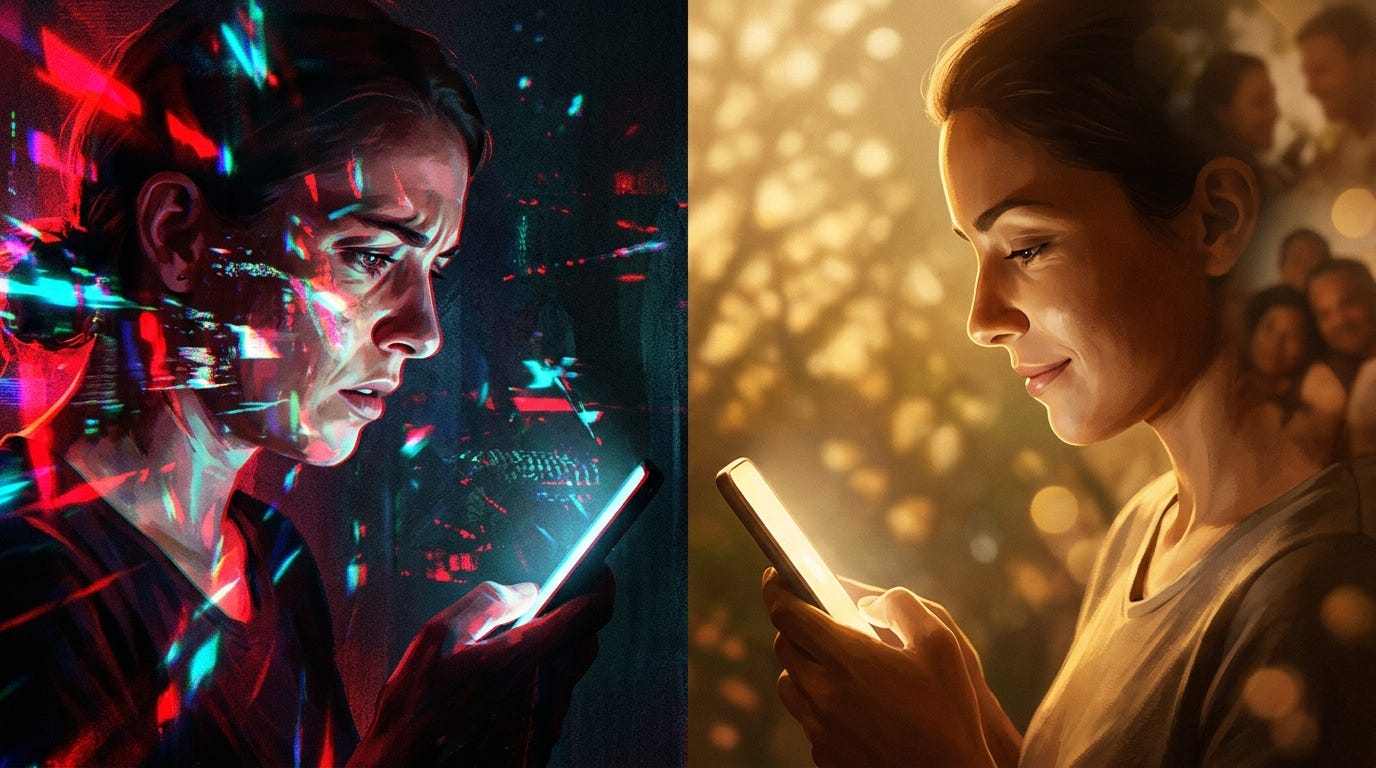
The second internet
If so, there’s also a whole world of content ready to help you feel and experience something so very different.
With a click of a button, you can forge fresh connections with your family going back generations on FamilySearch or hundreds of other genealogical websites. Every time you do this, you will feel something sweet come into your life. I know this from experience!
Want to strengthen your family relationships? There are countless resources to help you reconnect with parents, children, and grandchildren — or build new relationships with neighbors across the street.
If you’re eager to renew intimacy and commitment in your marriage, there’s an abundance of content ready to help you break free from patterns of lust, strengthen commitment, and rediscover the deeper joys of committed love.
Tired of being nudged to treat your political opposite like a monster? At Deseret News alone, we’ve published 100 things in the last couple of years to help you find a better way. Our motto many years used to be “things to feast the soul.”
If you are looking online for reasons for hope and joy, there are tens of thousands of videos sharing stories of extraordinary kindness, courage, generosity, and human goodness — along with powerful presentations of the gospel of Jesus Christ from different traditions.
Do you really care about discovering what’s true, rather than simply being told what you want to hear? There’s a thrilling world of thoughtful voices, historical discoveries, challenging perspectives, and serious scholarship waiting to be explored.
As you can see, the second internet is a place where you can become more curious, more compassionate, more knowledgeable, more connected, and more hopeful. It's a place where you can discover beauty, encounter truth, deepen your faith, strengthen your relationships, and find inspiration to become a better human being, like I’ve been writing about lately.
Of course, this second internet isn’t always going to make us comfortable (which the first one does far better). Sometimes the learning and growth we need can stretch us in challenging ways. So, it’s up to you to choose: the internet can either become an elaborate echo chamber, confirming everything we already believe, or an extraordinary opportunity to encounter perspectives, evidence, and experiences that expand our understanding.
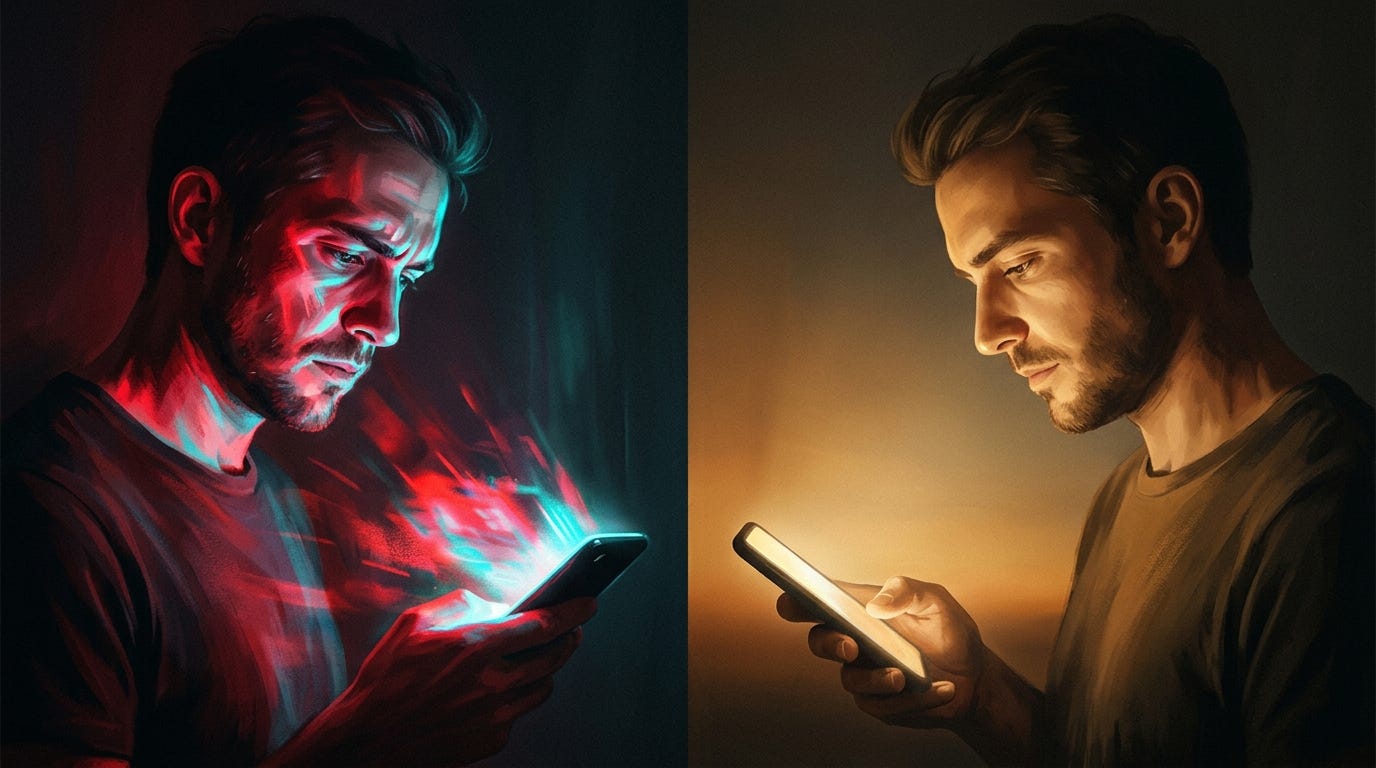
Which room do you want?
None of this is all that apparent on the surface of things. When we “go online,” we’re usually not thinking about our internet time this way at all. Instead, we just follow our impulse or habits wherever we scroll or check our news.
But the internet isn’t a single room you enter; it’s a fork in the road you choose every time you open up a screen.
And this can help us realize how our choice of a particular site or video today — or our many choices in the past to click here or there — ultimately curate a particular field of attention that is shaping who we are becoming.
“Tell me where your attention lies and I will tell you who you are,” wrote Spanish philosopher José Ortega y Gasset decades ago (“Dime a lo que atiendes y te diré quién eres”).
Our digital habits are quietly forming our characters. Can you see that?
We aren't just choosing what to look at online; we're choosing what kind of experiences day by day we're allowing to shape us.
More than just consuming content, we're cultivating, through our online choices, a certain way of seeing the world, relating to people, and experiencing life.
Living within a unique world
One of the strange things about these algorithms is that they can gradually make a very small slice of reality feel like the whole thing. For example:
If you repeatedly watch political outrage, you can begin to believe nearly everyone is corrupt, stupid, or malicious.
If you repeatedly consume catastrophic predictions, you can begin to feel that the world is perpetually on the verge of collapse.
The opposite is also true. If you repeatedly encounter hopeful stories, examples of generosity, and people working toward reconciliation, you can become more attuned to those realities too.
Bottom line: Spend enough time in one particular corner of the internet, and you might begin to think the entire world is as angry, frightening, corrupt, or hopeless as the content you're consuming.
But that's not the whole world! It's just the world you've been trained to see.
Deep longings, superficial soothing
What’s most interesting is that these two internets are competing for many of the same human longings.
Peace. Happiness. Love and belonging. We all yearn for them. And we assume what we’re consuming is doing something to help us find them. Yet:
Outrage offers a counterfeit sense of justice.
Conspiracy offers a counterfeit sense of understanding.
Pornography offers a counterfeit sense of intimacy.
Endless entertainment offers a counterfeit sense of delight.
Political tribalism offers a counterfeit sense of belonging.
That’s not why we click. None of us really wants to become angrier, more lustful, fearful, or distracted. Instead, we tell ourselves we’re looking to just “feel good” or “have fun” or “find out what’s going on.”
And when we come across more junk content, it often provides enough of a veneer to meet our ache that we don’t recognize what’s happening.
But what we really want — all of us, deep down — is connection, justice, real joy and truthful understanding. But too often, we end up settling for stimulating imitation, indignation, pleasurable distraction and confirmation of what we already believe.

Passive scroll vs. active pursuit
Have you noticed how the internet that feeds our baser impulses often finds us very quickly? By contrast, the internet that feeds our souls sometimes requires us to go looking for it.
The first internet is extraordinarily good at finding us. It knows how to trigger curiosity, anxiety, indignation, and desire.
The second internet requires more initiative. We have to deliberately seek out the voices, communities, conversations, and resources online that lift us, teach us and help us become the people we actually want to be.
If we haven’t learned by now, algorithms are indifferent to our peace of mind. They don’t necessarily care whether what we’re consuming is making us happier, wiser, or more connected.
Instead, they are optimized purely for our engagement. Outrage, lust, and fear are the highest-converting emotions on the web. So, if we let our basest impulses guide daily clicks, the algorithm will naturally drag us toward the darkest corner of the room.
My Fox News fast
I’m trying to get serious about this. So on my birthday this week, I made a commitment: No more Fox News.
Although this media organization has cracked the code for dopamine-spike news delivery, I don’t like what that daily dose does to me.
In addition to piling on selective evidence of the hypocrisy of one political party in particular, I’m weary of headlines like these: “Teacher makes 5 times her salary by signing up for (Porn site)”…. “(Celebrity) appears in sizzling new magazine cover”… “(Model) has fans gasping for air ahead of reboot.”
None of those are real news stories, though you’ll be persuaded otherwise there. (There are, of course, plenty of media outlets on the other side of the political spectrum that cultivate the exact same indignation, fear, and contempt).
Invariably, a steady diet of this fare will pull minds and hearts away from better things.
So I’m directing my attention elsewhere, including the Wall Street Journal and the Atlantic. There’s so much good, truth, and beauty out there. Do we really have time for the rest?
Shaping the soul
In the end, this isn't really about the internet at all. It's about the formation of the human soul through the repeated direction of our attention.
None of us simply uses the internet. Over time, whatever internet we use helps shape the people we become. Could recognizing two very different internets help us more consistently fuel our souls with the goodness, light and hope that one internet is designed to deliver — while avoiding the toxic nonsense piled up everywhere else?
So, ask yourself:
Where is your attention going?
Is the content you’re taking in helping you grow in love for the world and the people around you — or is it spiking your suspicion and contempt?
Are you becoming more interested in truth, or simply more convinced that you’re right?
With more choices available than any generation before us regarding where to direct our attention, maybe it’s time to start treating that choice as seriously as it deserves.
I took another small step to reclaim my field of attention. What about you? Which internet will you choose today?