


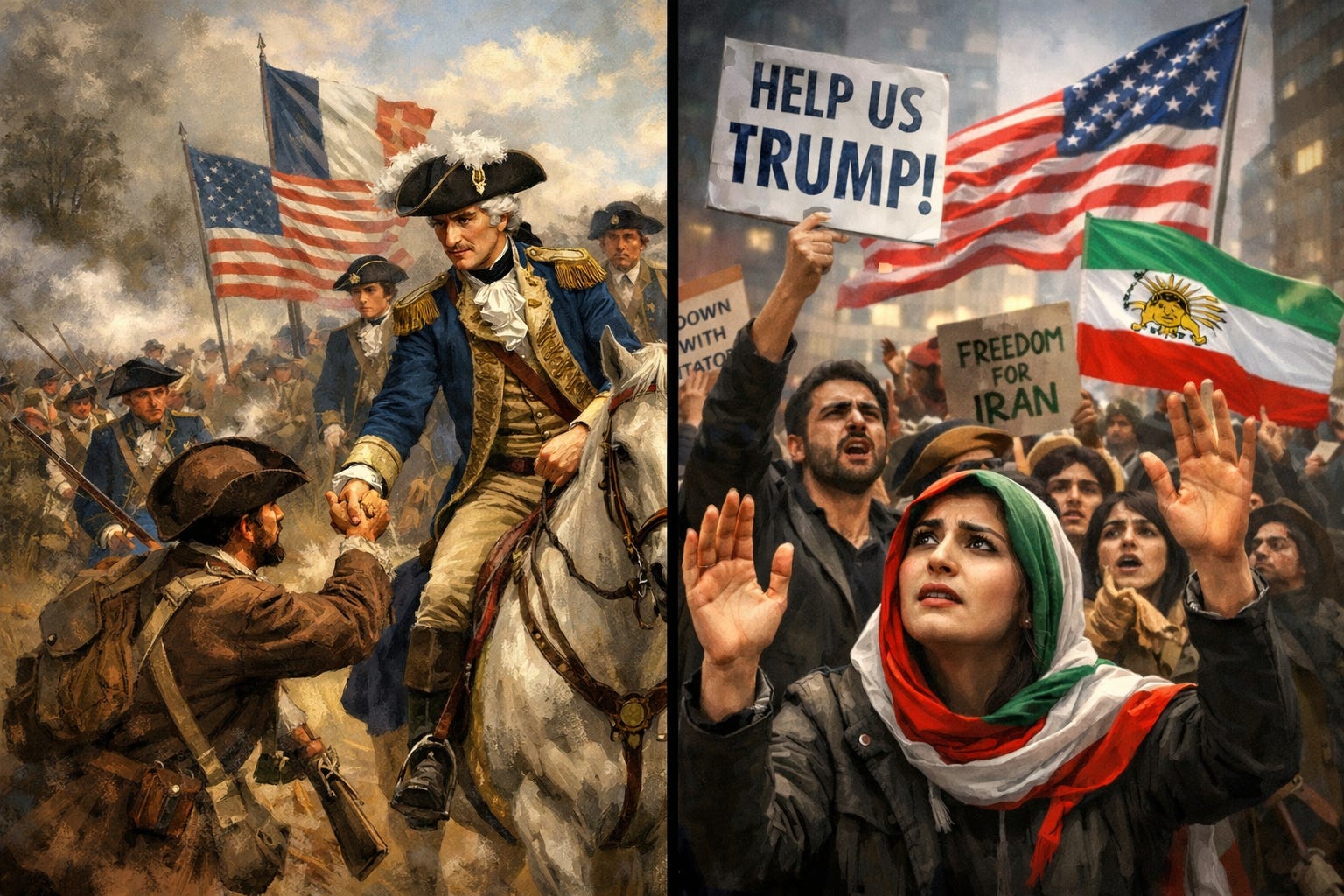
As we watch people fighting for their freedom in Venezuela, Iran and Ukraine, the voices of American isolationists are loud in our ears: “Stay out of other countries’ business”…”we’ve got enough problems on our own soil”….“We cannot be the world’s policeman.”….”we’ll just make it worse — we can’t really do any good anyway!”…”why would you trust American intervention anyway?”
There are good reasons that my fellow Americans arrive at these positions. Our history cautions against foolish and reckless steps overseas — especially when they undermine a country’s democratic choices, because the U.S. leaders didn’t like that decision (Guatemala in 1954 or Chile in 1970-73).
In fact, it was also in Iran in 1953 that the U.S. CIA instigated a coup against popular, democratically-elected Prime Minister of Iran Mohammad Mosaddegh. People have reasons to be wary of U.S. intervention in other countries’ affairs.
But they’re wrong to be so categorically cynical and militant about military support for other countries — especially when that is in line with the desperate yearning of freedom-seeking people.
In Venezuela and Iran, like Ukraine, it’s a situation where these people deeply want exactly what we have: liberty.
To insist, even in these cases, that the morally righteous thing is to stay away — or get as little involved as possible (surely never directly) - is to miss out on what that precious liberty could mean for these people, and to consider it might well be worth that sacrifice.
It’s especially galling to hear some of these isolationists wrap their arguments in “peace” claims — describing their refusal to interfere in “pacifist” terms, without acknowledging what our own inaction and isolation could mean for people living through horror and an entire absence of any peace (for instance, the tens of thousands of detained protesters in Iran).
The parable of the unaccountable bully
Once upon a time, a vulnerable boy got targeted by a much bigger goon on the playground. Everyone knew it wasn’t a fair fight. They knew the little tyke was going to get pounded without some assistance.
But … out of fear to trigger a broader fight with this same bully, the other kids on the playground backed off. They refused to get involved — at least not directly.
Sure, many of them would still pull the victim aside when they could — telling him how brave he was and offering fighting tips or creative techniques to get the upper hand. Some would slip him some extra snacks now and then to cheer him up a bit.
But nothing more. At a safe distance, they watched day by day, week by week, as the enormous bully brought his rage down upon this most unfortunate, vulnerable boy.
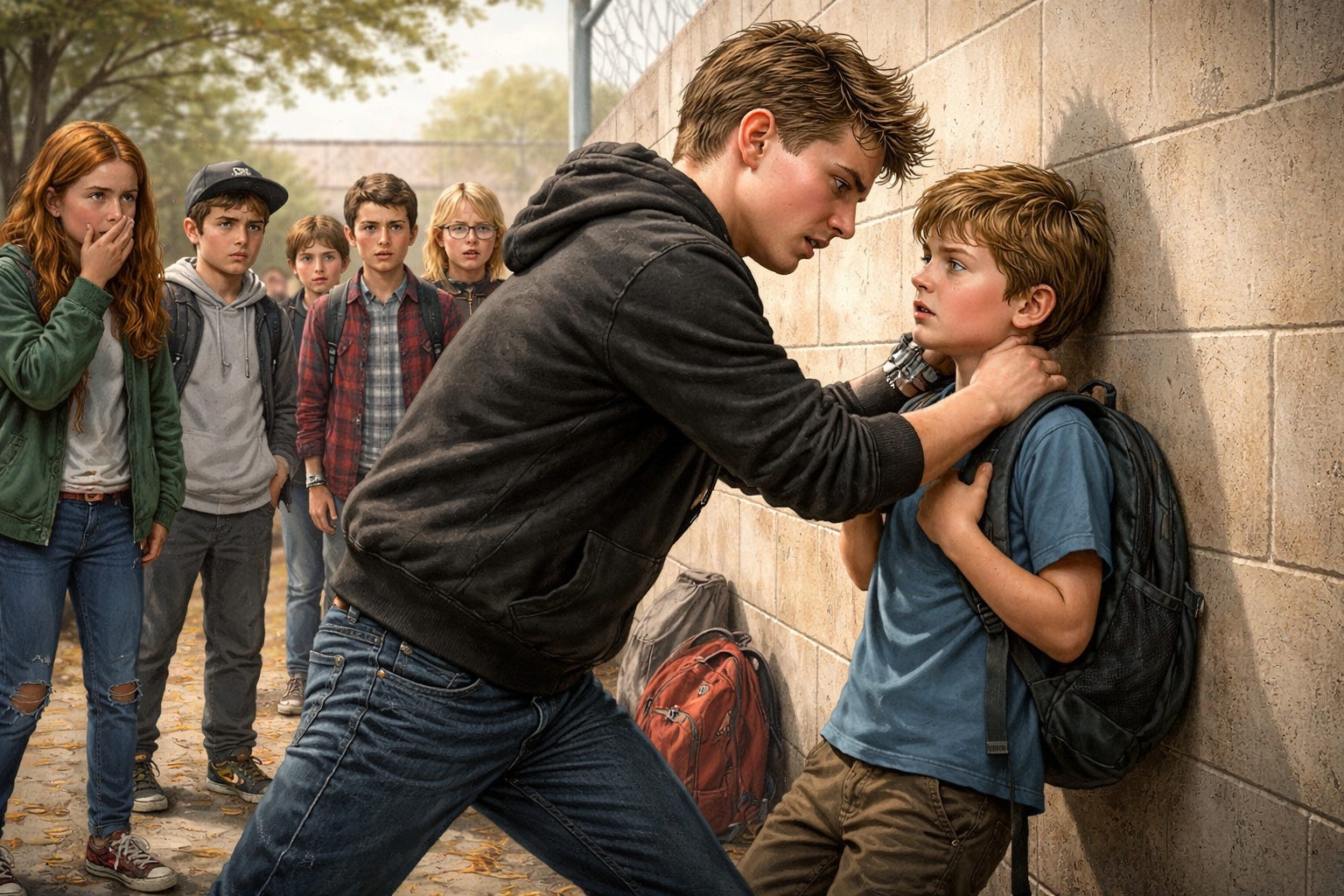
Even as the consequences compounded, the wounds, the blood, the agony — the children on the playground hewed to their principles with decisiveness. They were confident in having taken the middle school’s “moral high ground,” and they were going to stick with that.
After all, how reckless would it be to risk a wider escalation of the conflict?
Ukraine needs something more
I am 100% sure, as a wanna-be historian, that one day in the future, our children and grandchildren will look back with horror on why humanity didn’t do anything more directly to help Ukraine in its unfair fight against Russia.
“Why did you just watch Russia do that to the Ukrainians?”
“Hold on, now, we gave them all sorts of money and weapons!” — which of course, we have done and need to keep doing, at a minimum. I’m sure the Ukrainian people have also appreciated the heartwarming “visits” and “messages of solidarity.”
But let’s not pretend that this country hasn’t desperately needed way more than that from the Western powers — from the very beginning.
This is something the country deserved to expect from us as well. When Ukraine willingly gave up their nuclear weapons in 1994, they were assured in a joint multi-nation memo that other nations would not use military force against the territorial integrity or political independence of Ukraine — and that if they did the United States and other nations would “seek immediate Security Council action to provide assistance.”
That assistance has come, all from a safe distance, while we watch the smaller nation daily get assaulted, attacked, besieged…over and over, with an estimated 46,000 to 140,000 Ukrainian soldiers killed, along with at least 15,000 citizens. As many as 20,000 to 35,000 children have also been forcibly moved to Russia and as many as 8,000 Ukrainian soldiers are in brutal captivity).
All this we watch, day by day — when not tuning in to our favorite sports championship, concert or hit movie. And we pat ourselves on the back, of course, for the moral wisdom of avoiding a wider conflict.
Iran needs more help too
Now the brave people of Iran are getting massacred — especially those daring to ask for more freedom. While 6,159 deaths is cited as a baseline, no one really believes it’s that low, with other estimates of as many as 30,000 people killed (and another 49,000 detained, which many see as a fate even worse than death).
These are fellow children of God equally precious in His eyes. Yet even in the face of such brutality against brothers and sisters, armchair commentators sit back and scold anyone who dares to hope that the U.S. would actually do anything to step in.
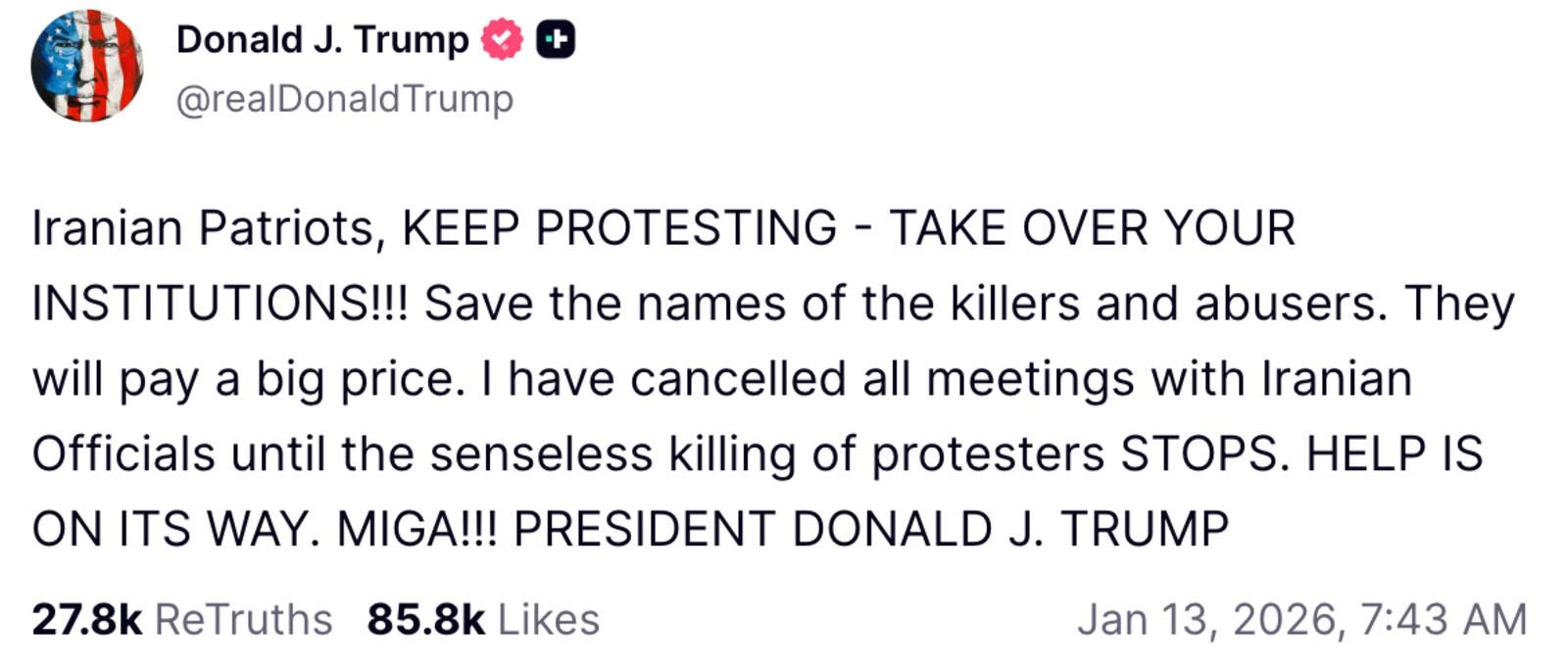
But, of course, it’s President Donald Trump himself who assured the Iranian protesters that he would step in if they were harmed, as I wrote about for Deseret News earlier this month. First here:
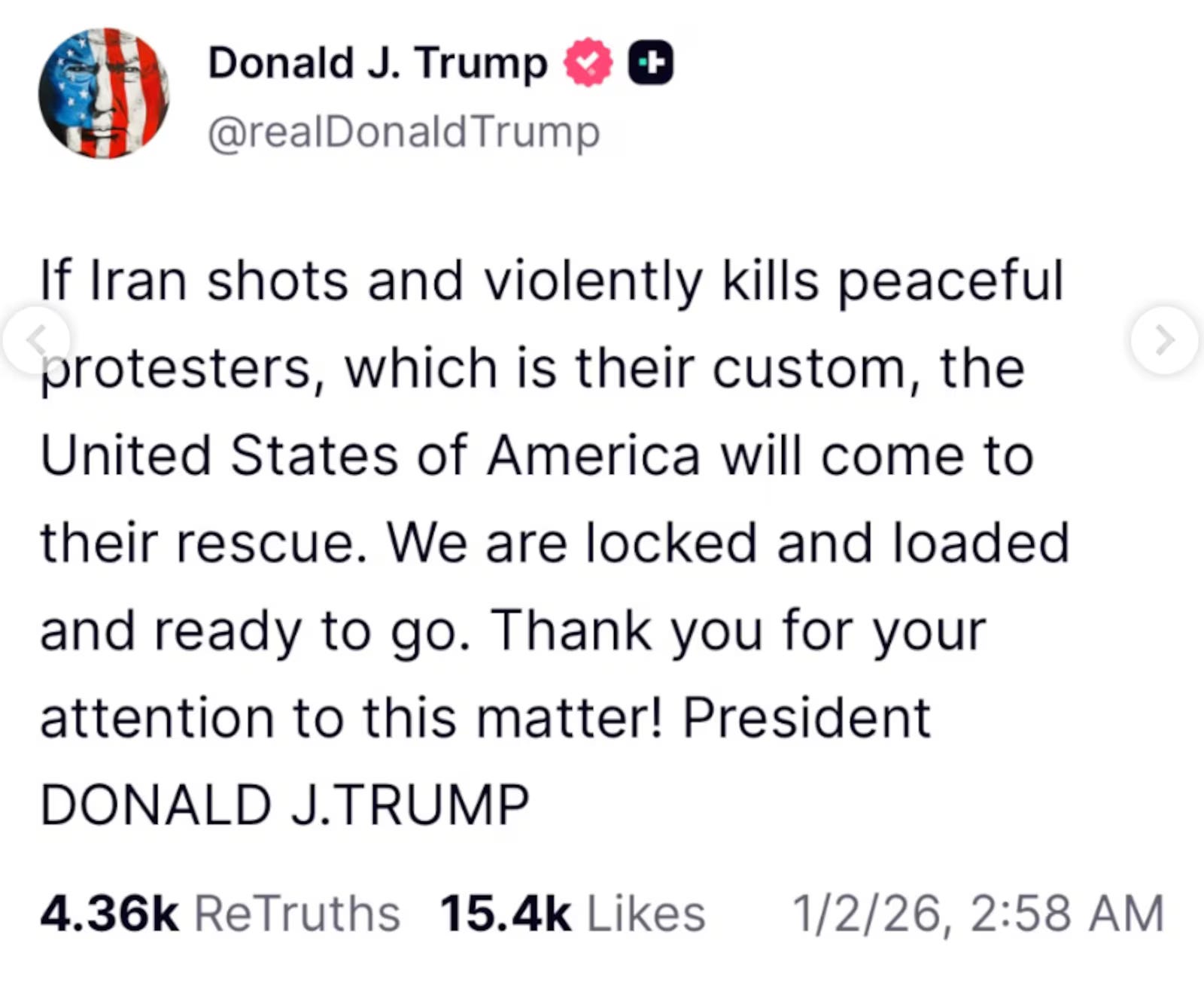
Then here:
NBC News likewise reported yesterday that “Through carnage of the government crackdown, Iranian protesters looked to Trump.”
At least some people really come into the streets “based on those statements,” as one relative of an arrested protester told CNN. For instance, the family of Siavash Shirzad attempted to dissuade him from joining the protest. According to Karim Sadjadpour in the Atlantic, this 38-year old responded, “Trump said he supports us. I’m going.”
He was among those killed.
Yet the high-minded isolationist lectures continue: “Diplomacy is the only way”... “de-escalate and bring these countries to the negotiating table” they opine, never realizing that there can be no negotiation with a government slaughtering its people, any more than you’d strike a deal with a murderer.
This reality seized me by the throat weeks ago as I was researching “Iran’s 250-year fight for freedom” for the Deseret News — a pursuit that’s been achingly, heartbreakingly rewarded with little more than blood and terror, over and over.
As New York Times columnist Nicholas Kristof said as Iran’s protest was flaring up, “I have covered these kinds of uprisings in other countries around the world, one of the things I’ve learned is that the slogan that ‘the people united will never be defeated,’ it’s not true.”
Citing China’s Tiananmen in 1989 and the Arab Spring starting in 2010-2011, this brilliant commentator warned, “there are very courageous democratic movements that simply can be crushed with machine guns.”
That’s exactly what happened in Iran, with the resulting horror buried in mass graves throughout the country, with surviving family warned not to ask any further questions.
An appeal from U.S. history
Some would be outraged by the insinuation Americans should do more for either people. But are we not our brothers’ and sisters’ keeper?
This is not about simply pouring more money into any of these countries — or throwing more weapons at them — although both will continue to be critical at times. (Ukrainian weapon shortfalls are leading to tragedies).
When I try to get in the mind and heart of those insisting on American isolation, I hear something at work inside them like this: “avoiding war is of such utmost importance, that this principle exceeds all else in importance.”
On that basis, of course, many people advocated strongly against the U.S. getting involved in World War II, despite the horrors perpetrated against the Jews we were hearing about. Those isolationist appeals that were persuasive to our leaders, until we got hit at Pearl Harbor.
Did Marquis de Lafayette feel or experience similar moral resistance at first, after considering coming to the aid of the nascent 13 colonies picking a seemingly hopeless fight against that era’s bully, Great Britain?
You bet he did. He faced resistance at nearly every turn. The French crown forbade officers from supporting the American rebellion — while Lafayette’s family warned he was risking his life for a romantic cause with little chance of success. But his decision, at age nineteen, to sail in secret on a ship he himself purchased to support the American cause paved the way for a formal French alliance in 1780 that added 5,500 troops to the American cause.
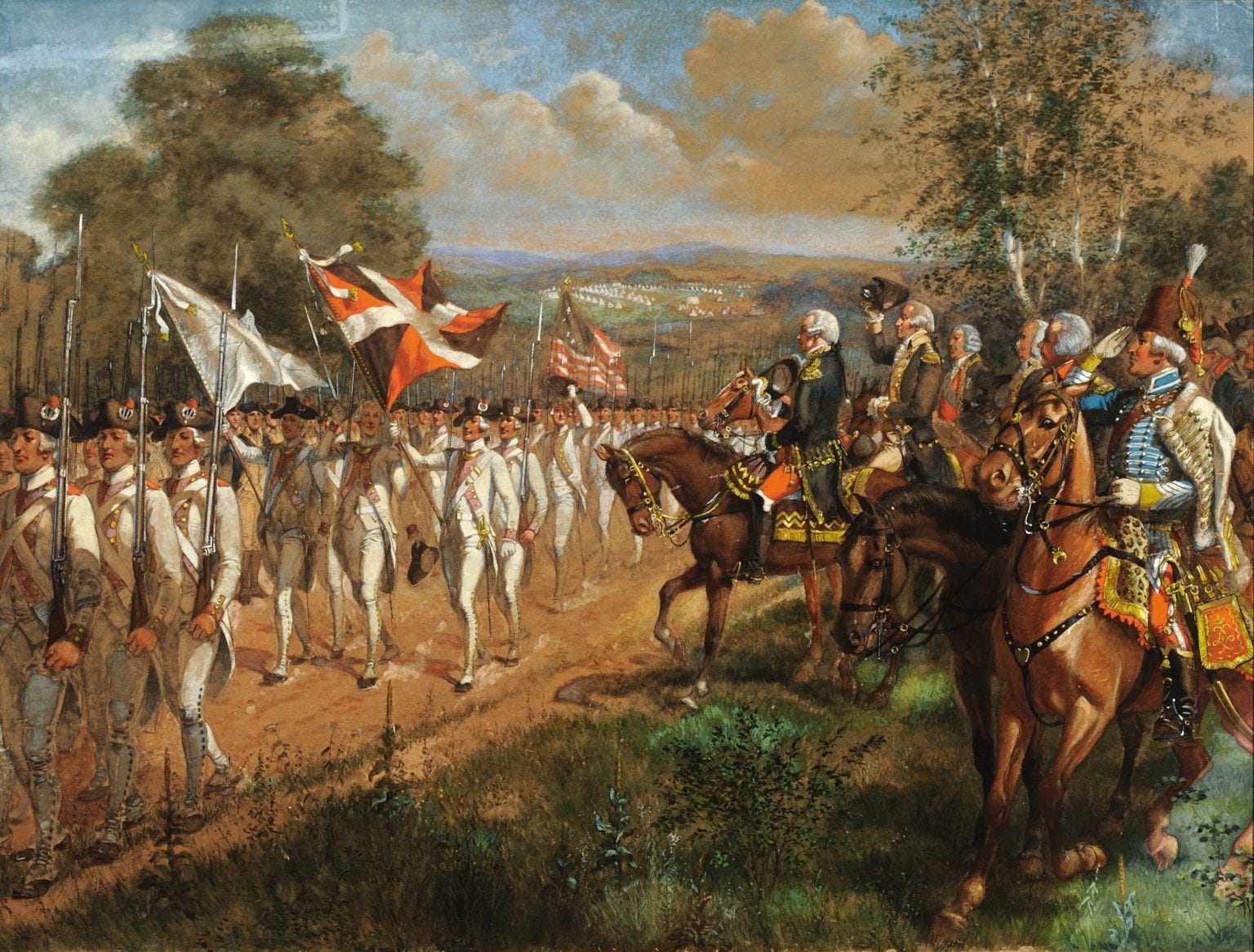
Around the turn of the twentieth century, Henry A. Ogden painted this scene of George Washington reviewing French troops at the Philipsburg encampment, the first time the allies shared a camp during the Yorktown campaign.
That help made a huge difference to U.S. independence. While the colonies might still have prevailed without the French support, some believe the rebellion could have collapsed from exhaustion or turned into a negotiated settlement short of full independence.
Reservations were eventually overcome, and history changed completely. We owe our freedom as Americans, in part, to the French. Are we willing to extend our support to other countries seeking their freedom too?
I hope and pray so. Please add your prayers this weekend too, as President Trump considers action.
There are 90 million Iranians yearning for their freedom, 29 million Venezuelans, and, of course, 36 million Ukrainians (along with 5 million Iranians, 7 million Ukrainians and 8 million Venezuelans living as refugees outside their preferred homelands). If the United States under President Donald Trump can do something that makes a difference for them securing that, history may ultimately smile favorably on the 45th and 47th U.S. President.
And I will too!
The first two images were created with the help of ChatGPT AI
Isolationism and pacifism are not the answer, but neither is warmongering.
Your article takes for granted that the United States is still operating under the Constitution with a viable government... but of course it's not. The U.S. government was infiltrated long ago by what Mormons like to call "the Gadiantons," and the thread that once held the Constitution is itself hanging by a thread. If we want to help Ukrainians, Venezuelans, and Iranians, we first need to cleanse the inner vessel...
"And again, I say unto you that the enemy in the secret chambers seeketh your lives.
Ye hear of wars in far countries, and you say that there will soon be great wars in far countries, but ye know not the hearts of men in your own land." (D&C 38:28-29)