



This commentary was published in Deseret News and Yahoo News on Friday night, Feb. 6, “The Super Bowl is a thrilling spectacle. Here’s why I skip it.” I wanted to share it here, along with several bolded additions and some photos that I didn’t share in the original version.
In the 2015 movie “Concussion,” the character Dr. Cyril Wecht says, “The NFL owns a day of the week. The same day the church used to own. Now it’s theirs.”
Only it’s not that way for everyone. Utah grandfather Ted Barley recalled watching the first Super Bowl in 1967. As a teenage boy watching with his father, he cheered Vince Lombardi’s Green Bay Packers, led by Bart Starr, to victory over the Kansas City Chiefs.
Barley has enjoyed the big game many times since, “especially for the commercials,” he admits. But something shifted for him more recently.
“A few years ago, I just decided this wasn’t the best use of the Sabbath,” Barley told me — concluding that football wouldn’t be a part of his Sundays anymore as a member of The Church of Jesus Christ of Latter-day Saints.
I’ll never forget where I was as a teenager when the Denver Broncos played the San Francisco 49ers in the 1990 Super Bowl. Living in the NFL desert of Utah, sheer geographic proximity forced us to pick between John Elway’s squad and the mighty Joe Montana and Jerry Rice.
But our family would not be tuning in. Mom had made other plans, arranging a Sunday night visit to a nursing home. As we walked down those hallways with uncomfortable smells, my brother and I craned our necks to catch a glimpse of the score as it played loudly for residents.

A scene like this might be a great opening for the latest tell-all memoir of a sadly deprived childhood within a home of high religious expectations. But that’s not my argument at all.
It’s precisely the chance to hold to a boundary like this, on a day “unlike all other” days, that I’ve found to be so good for my soul. So much so that I’m making my best pitch today for why you might consider opting out of this weekend’s garish cultural extravaganza entirely.
The Super Bowl cultural conversation
Most prominent arguments for skipping the Super Bowl, of course, cite any of the various sociopolitical complaints sparking calls for boycott in our hyperpolarized times. Those center especially on the political shtick of certain halftime performers.
Other conservative family groups have taken issue with perceived dark, occult and sexually explicit symbolism around certain halftime performances — ranging from 2020 graphic pole dancing by Shakira and Jennifer Lopez to Bruno Mars singing “your sex takes me to paradise” in 2014 or Katy Perry twerking with Lenny Kravitz in 2015. Then there are all those GoDaddy, Carl’s Jr. and Victoria’s Secret ads.
“More than any other event on the planet,” writes Matthew S. Vos, a professor of sociology at Covenant College, the Super Bowl “draws together consumerism, eroticism, entertainment, gambling, violence ... celebrity, and heady nationalism into a liturgical expression that has captured our hearts and minds like no other.”
Believers “promote it as a public good worthy of a perennial spot on the church calendar. Christmas, Easter, Pentecost, and Super Bowl Sunday,” the Christian scholar continues.
“When we momentarily turn away from an eroticized half-time performance, mute a commercial that ventures a bit too far into the profane, or gloss over (other details) that stand at odds with our faith and theologies,” Vos suggests “we sanitize the event just enough to make it palatable.”
Diverse families of faith
While all these are worthy conversations to have, my argument is far simpler. Although I enjoy a good football game like the next American, in 48 years of life, I’ve never watched the Super Bowl — or any Sunday football, mostly because that’s not what this day is for, according to many Christian traditions.
That’s what my father taught me, at least, from watching him never turn on Sunday football in all the years of my childhood (after enjoying plenty of great Saturday BYU football games). But on Sunday, Dad and Mom kept turning our attention somewhere else as a family.
When some of my friends regaled us with exciting stories about the big game the next day at school, I did sometimes feel left out. But I also sensed they might be left out of something I got to be a part of.
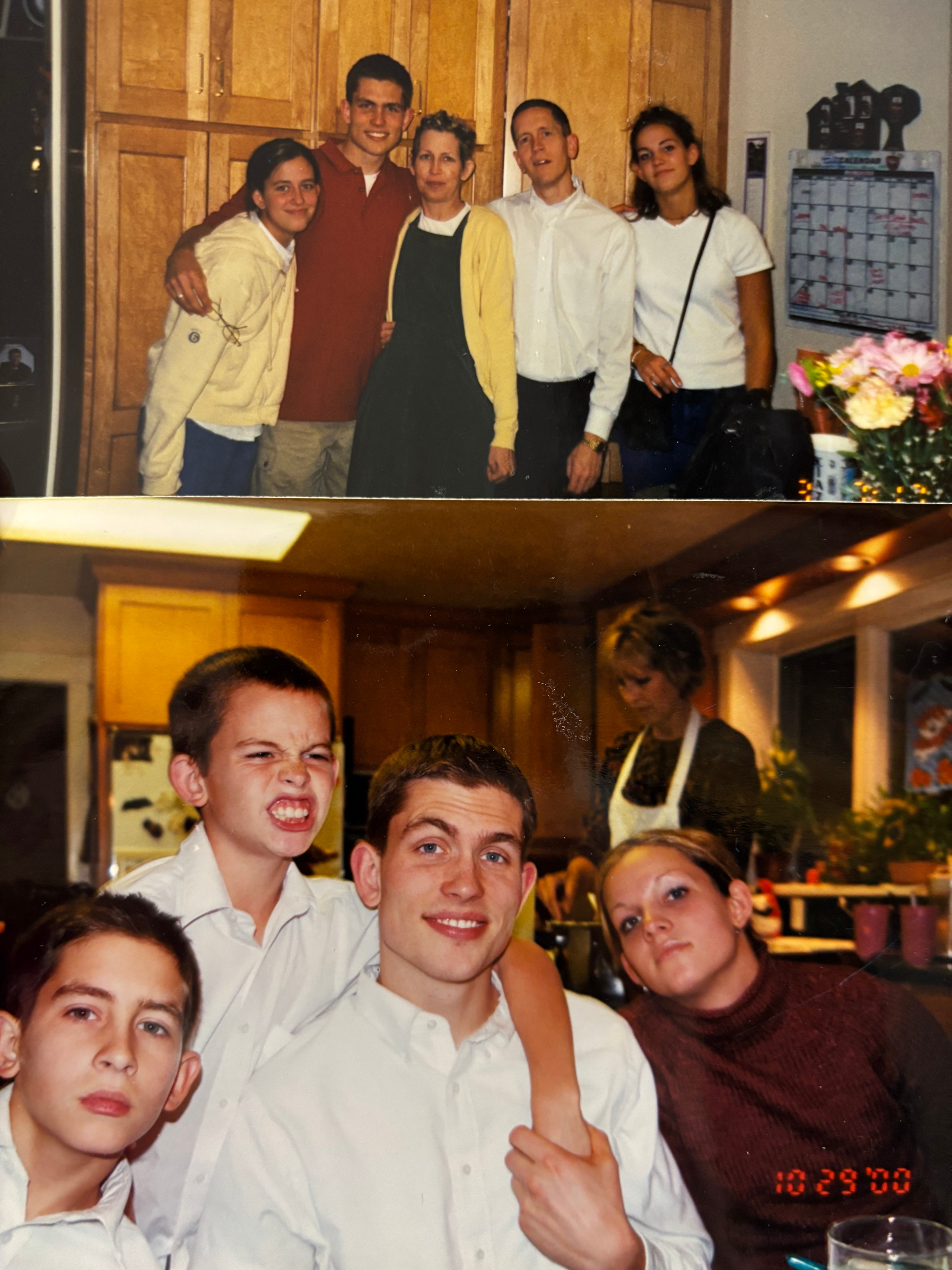
Sundays in the Hess home growing up
And what was that? A family practice that put something and someone else above the astronomical popularity of the game — symbolized by a line we refused to cross as a family.
I’ll pause here to say that I know plenty of God-fearing friends who draw different lines for their families — and I respect that. I have so many friends who see this as a wonderful chance to gather their families.
Also, some of those commercials are brilliant and often inspiring, like the “He Gets Us” series debuting in 2022 and featured again this year in their Super Bowl spot “More.”
So, this isn’t about getting judgy. If anything, the cultural judgment comes down harder on families who opt out of the guac and chip festivities.
Sabbath as retreat
Later in my life, I had to choose for myself what to do outside of my parents’ gaze. During college, I didn’t like Sunday being just another study day, and enjoyed the emotional break of preserving the day as something special, even if I had to stay up late Saturday and get up early Monday morning. I did so well academically that I ended up becoming a college valedictorian and getting admitted to my dream graduate program at the University of Illinois.
Sunday became an emotional refuge for me — a time I was allowed to mentally lay everything else aside, so I could make space for what felt most important. For me, at least, if I don’t have space enough for real stillness and quiet, my connection to God gets flat and I start to feel so distant.
As a young father, exhausted with young children, my wife and I found ways to make the Sabbath more of a mini-retreat for our little family — something Carrie Skarda and I ended up writing about in our books about mindfulness for Latter-day Saints.
This “delightful” Sabbath goes well beyond ‘whatever sounds like fun’ — that is, “not doing thine own ways, nor finding thine own pleasure, nor speaking thine own words” (Isaiah 58:13 ASV).
For those who “stop doing and saying whatever you please on this special day,” Isaiah makes clear that something truly profound can begin to shift inside: “You will truly enjoy knowing the LORD” (CEV). In other words:
“Then the LORD will be your delight.” (NLT)
“Then you will find your joy in the LORD” (NIV)
That doesn’t mean worshipping all day, but it does mean we keep exploring ways to design the day to reach for something higher. That often includes one-on-one time with our boys to check in, and together as a couple.
But my favorite activity is being able to stop and hold my daughter while we’re just together as a family…in so many variations: sometimes talking and reading, sometimes reminiscing or planning, sometimes playing a game or eating, sometimes praying and singing, and sometimes watching something uplifting.
Boys and boundaries
Now I have teenage boys of my own who eat, drink and sleep basketball. When we’re not looking, their favorite evening diversion is to check ESPN for the latest score updates.
Playing and watching sports together has been an incredible blessing as a family. Yet during the NBA playoffs, I extended the same challenge my father gave me — “let’s make this a day unlike any other day — where we show God what’s most important.”
They still had a choice. But I’ll never forget watching my teenage son going to bed Sunday night with no idea whether his beloved Golden State Warriors had won the decisive game.
That waited till Monday morning — a small thing, maybe. But not on the scale of his heart.
I marveled at this young boy’s willingness to voluntarily put something higher than his beloved Steph Curry.
At least for a day.
A day unlike all days
I know some may still see this as prudishly absurd, perhaps even wondering if we’re harming our boys with “high demand” standards that seem so old-fashioned. I wish these cynics could see and feel what they’re missing.
An entire day to place the Living God first in our lives — with nothing else allowed to intrude. I’ve found that experience profoundly changes the complexion of our family and the week ahead, like leaven in the loaf.
This used to be more intuitive to Americans. For much of our nation’s history, stores were closed on Sunday across the nation, something that only began changing significantly in the 1960s-1970s.
In 1917, police arrested managers of the New York Giants and Cincinnati Reds for trying to arrange a Sunday baseball game (New York legalized Sunday baseball two years later — with Pennsylvania the last state to legalize it in 1933).
No one wants to return to criminalizing behavior on Sunday. But in a world where so few boundaries seem to exist anymore — and those that do are constantly crossable and negotiable — I believe that teaching my boys this lesson matters enormously.
Simply put, I want my sons to be able to see and feel everyone doing something else — even things wildly popular — and have the inner ability to choose differently.
Of course, there are many ways to teach children this: Will you drink that substance when everyone else is? Watch that video when it looks so exciting? Say that word when you get frustrated?
You’ll make a good choice on the right red lines for your family. I will admit, it can still be hard to resist the cultural pull as a family when everyone else seems to be doing it.
Don’t feel bad for us. I’m grateful this isn’t what the weekend is for us. Sunday is, by far, the happiest, sweetest day of my week I look forward to more than any other. I just don’t think I’d feel that way if it was yet another day full of the same kinds of distractions as other days.
Hey, we still find ways to enjoy football. For me, ten minutes of highlights Monday morning is good enough, while my friend Ted Barley watched the last Super Bowl early Monday morning with his daughter Debi — pinky-swearing with each other to not check the score.
There’s something relieving and comforting for me to know there’s a day “unlike all others” in our home — a day where football and politics, Mr. Beast and Mr. Trump, are all refused entry.
It seems to me that there are at least two extremes in our approach to the Super Bowl and the sabbath day. On one extreme, there are those who are so deeply invested in the game and so immersed in the ritual, mostly without knowing it, that, at least for a time, there is no room in their hearts or minds for the Lord or respect for His day. On another extreme, there are those who fanatically avoid the Super Bowl on Sunday and criticize those who choose to watch it - like the scribes and the Pharisees who criticized the Lord's disciples for eating corn on the sabbath day - as if the practice of avoiding the Super Bowl on Sunday makes them righteous, or more righteous than others.
The Lord ordained the sabbath day, symbolic of the sacred time when He rested from the work of creation, as a blessing for us, and as a time for us to rest and to learn of Him and His work. A moderate approach to Super Bowl Sunday, in my opinion, is that it is a blessing to rest and to gather with loved ones, perhaps with the football game on in the background. Furthermore, I don't think that the Lord wants us to be ignorant of what is really going on in the world or about what these pagan, satanic rituals (like the Super Bowl halftime show) are all about.
Of course, as you mentioned, Isaiah got it right:
"13 ¶ If thou turn away thy foot from the sabbath, from doing thy pleasure on my holy day; and call the sabbath a delight, the holy of the Lord, honourable; and shalt honour him, not doing thine own ways, nor finding thine own pleasure, nor speaking thine own words:
14 Then shalt thou delight thyself in the Lord; and I will cause thee to ride upon the high places of the earth, and feed thee with the heritage of Jacob thy father: for the mouth of the Lord hath spoken it." (Isaiah 58:13-14)
Perceived dark, occult and sexually explicit symbolism?
No, it's not just "perceived."
Such events are obviously organized around satanic rituals.
(see e.g. https://www.instagram.com/p/DUeAPANknRk/)