


Last night, I got to spend an hour with some teenagers getting ready to start school again — talking about how to navigate stress, sadness, fear and anger with more mindfulness.
“Do you ever kneel down to pray - and instead, just think, think, think?” I asked them.
For those of you who have prayer as a regular part of your life, maybe you can relate.
Just more thinking
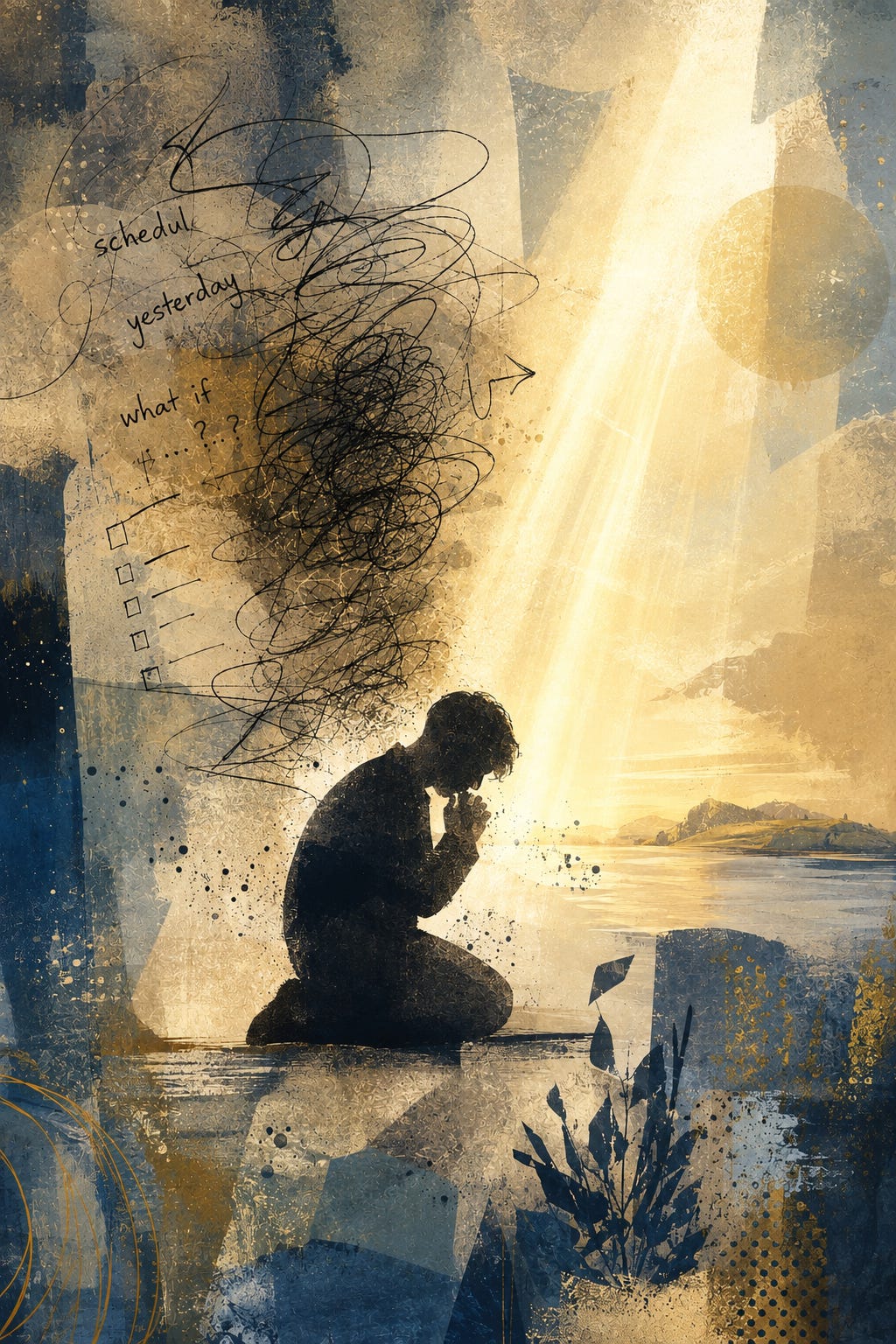
I woke up on a recent morning with so much on my mind. As I knelt to pray, I found my mind churning over everything — first, what the schedule needed to be that morning, then something that happened the previous day, then….
“Wait. What am I doing?”
Although my body — from the outside — looked like I was communing with God. On the inside, I was really doing just that: thinking, thinking, thinking, thinking.
Especially as the world gets more tumultuous and our individual lives carry more stress, it’s pretty natural that our minds are inclined to process all this over and over and over.
Which is what could make prayer so refreshing … a moment to not just be drowning in our thoughts - a time to actually press beyond them and connect with something thrilling outside and beyond them: the living God.
But what if we really struggle to know how to actually do this in practice - with our thoughts all over the place, like a “monkey mind?”
Singing
Sometimes first thing in the morning, I’ll have a song come to my mind. It’s becoming one of my favorite ways to start the day to sing quietly words of praise, gratitude, and worship, while everyone else is sleeping.
Have you ever tried singing alone, just you before your God?
On a practical level, verbalizing words like this in song helps ground my mind and remind me it’s not just me and my thoughts. Spoken language seems to cue my brain that I really am reaching for someone else outside of myself — a living God who has “filled me with his love” and peace on so many occasions in my life.
Speaking
Speaking out loud the words of my prayer has a similar effect on my mind. While I know silent prayer can be just as powerful, maybe this is one hidden advantage of verbalizing a prayer — again signaling to our brains that we really are speaking with someone else. We really aren’t alone in that room.
“Prayer is an expression of the heart. And we can pray silently. We ought to pray silently,” said Elder Jeffrey R. Holland in 2025, a member of the Quorum of the Twelve Apostles in The Church of Jesus Christ of Latter-day Saints. But then he added, “there is something about saying the words — and for me, saying them out loud.”
Redirecting
It’s worth pointing out that part of this is a totally normal part of prayer. The idea that our brain is going to be perfectly focused on anything is just not the reality of the human condition. As Jon Kabat-Zinn has often taught, it’s “in the nature of the mind to wander” — comparing it to the waves of the ocean coming in and out.
He then speaks to the expectation some have in meditation that their thoughts will somehow just stop: “If you try to make your thoughts stop during meditation (or prayer, I would add), you’re just going to give yourself a big headache.”
As the teenagers and I discussed, when we notice our thoughts wander off during prayer, it’s not a problem. Because in that moment you can gently and firmly bring your attention back to where you want to direct it: redirecting it to the living God.
Over and over, when the mind wanders, we bring it back. That’s meditation. And it seems to be a built-in, natural part of prayer too — along with lots of other parts of life (reading, talking, listening, writing).

Waiting
In that same conversation, Elder Holland returned to something he had said previously over the years — that if we wait till the very last moment of the day to pray when we’re exhausted to say our prayers, it might be only a “half-hearted prayer out before we tumble into bed.”
“Consider moving that prayer up to earlier in the evening, when you are alert and attentive and can make it more powerful,” he said. “Prayer time ought to be quality time, not just time that happens to be left over when everything else is done — the last gasp of the day, so to speak.”
If we make sure our prayer is “good time, high-priority time,” the apostle added on another occasion, then we can “really have that communication.”
I’ve found the same thing applies in the morning. Rather than assuming prayer has to happen in the first groggy moments of the day, what if we did a little stretching first, splashed some water on our faces, or went outside for a minute … waiting a little bit until our brains come online.
Walking
Pastor Francis Chan gets outside first thing in the morning — with a discipline of not checking his phone first. That’s when he starts his conversation with God — in a time that he says is his favorite time of the day.
More like a deeply reassuring hug than a superficial ritual?
I want to be able to say the same thing — to relish my time with God that much. To feel his love, his joy and peace so much that I have to tear myself away to move on to other things.
Rather than the reverse: having to tear my heart and brain and thoughts away from so many other things to spend a moment with the living God.
What a lovely article Jacob. I have found all those suggestions to be an integral part of my daily worship. Thanks for so beautifully illustrating them here. Sending love to you and yours! ShaunaMay 🥰
Much better articles lately. Well done.