


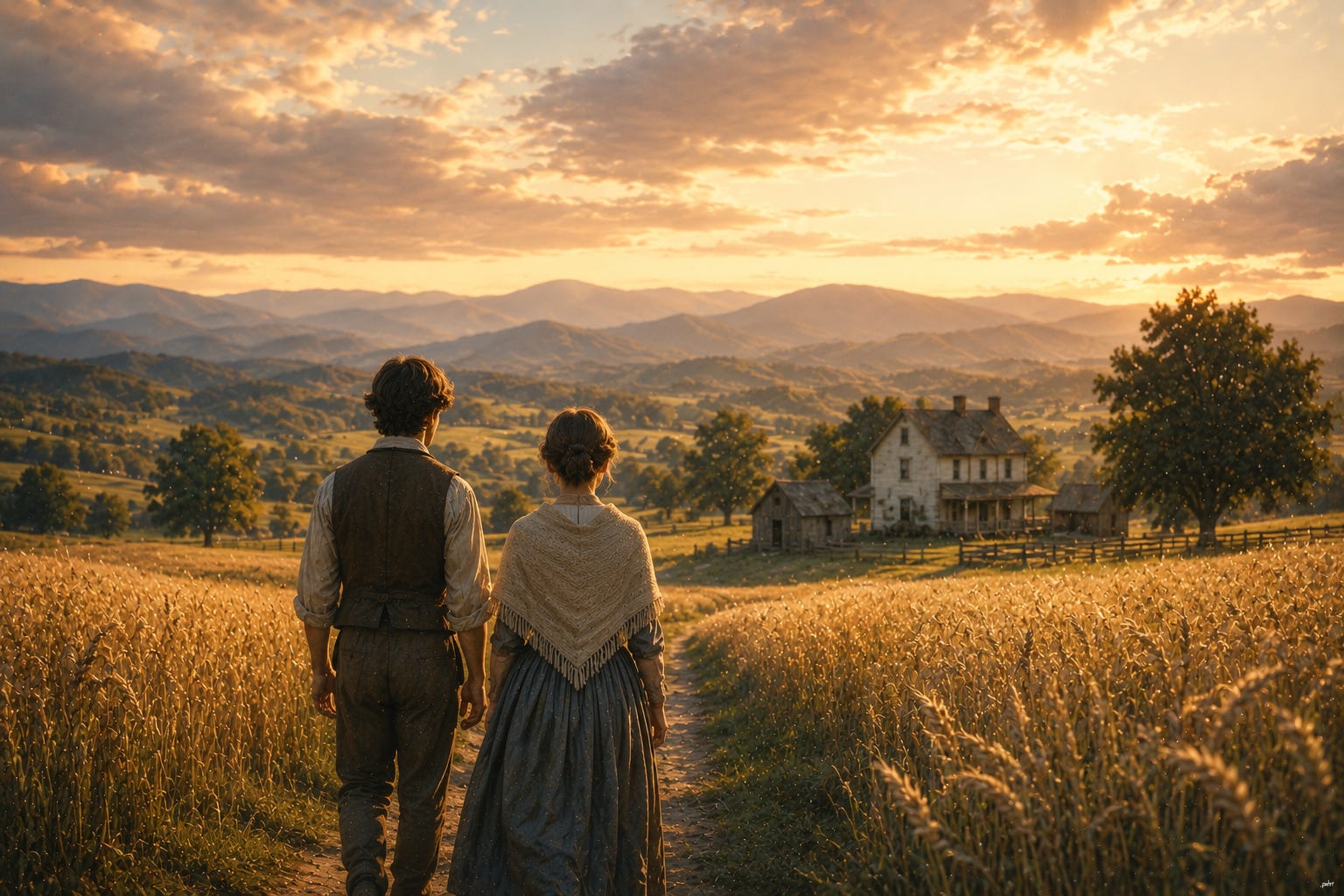
When we think of the American Revolution, we often picture famous men—Washington crossing the Delaware, Jefferson drafting the Declaration of Independence, soldiers enduring the bitter winter at Valley Forge.
But for my Hess family’s ancestors John and Catherine, this historic Revolution wasn’t a chapter in a history book.
It was their childhood.
John entered the world on January 31, 1767, in the rolling farmland of Derry Township—then part of Lancaster County, Pennsylvania—into a family that had already crossed one great divide.1 Barely fourteen years earlier, as I wrote about last year, his father Frederick had likely endured a dangerous Atlantic crossing in search of land, religious freedom, and a fresh beginning.
His son John would never know the old country. To him, Pennsylvania was simply home. But to his parents, America was still a remarkable gift they had sacrificed dearly to obtain.
Two years later, on October 25, 1769, Catherine was born farther southwest in Washington Township, on Pennsylvania’s increasingly rugged frontier—in a place that was officially a part of British Colonial America.
Neither child could have known they would soon witness the final years of Britain’s American colonies. Within a decade, everything they knew would change.
John’s Pennsylvania
John’s family lived among prosperous farms settled largely by Scotch-Irish Presbyterians and German immigrants. Wheat fields stretched across gentle hills, cattle grazed in rich pastures, and churches served as the center of community life.
Although peaceful by the late 1760s, the memories of frontier violence were still fresh. Only a few years earlier, during Pontiac’s War, terrified refugees from western Pennsylvania had streamed eastward after devastating raids. John’s parents had watched neighbors organize local militia companies and keep muskets close at hand.
Security was never taken for granted. As John learned to walk and speak, another conflict quietly gathered strength—not on the frontier, but between Britain and her colonies—triggered by the Stamp Act (1765) and then the Townshend Acts (1767) the year John was born—which unleashed growing resentment toward King George III.
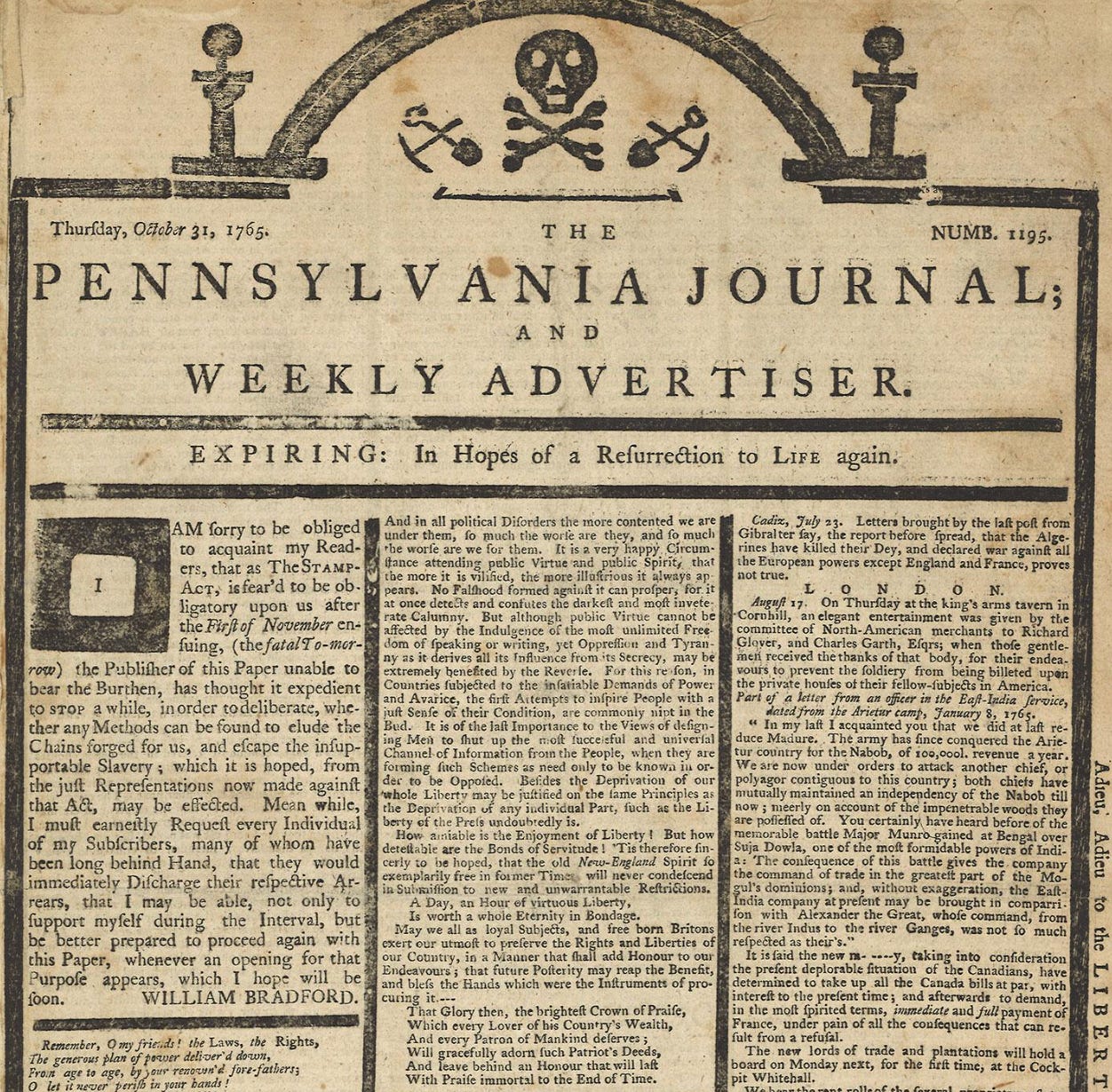
The famous October 31, 1765, front page of “The Pennsylvania Journal and Weekly Advertiser,” displaying skull-and-crossbones to protest the British Stamp Act, which took effect the very next day.
Adults debated politics in taverns after church meetings while newspapers carried troubling reports from Boston. At home, however, John’s parents belonged to a small German Baptist Brethren congregation that emphasized simple living, peace, and wholehearted devotion to Christ. Those convictions likely shaped how they experienced the coming Revolution—surely making it more emotionally complicated than others living through these events.
Catherine’s frontier
Catherine’s childhood began in a different landscape. Washington Township, in what later became Franklin County, lay much closer to the edge of settlement. The forests stretched westward toward the Appalachian Mountains, and beyond them lay territory still fiercely contested during the years following the French and Indian War.
Life demanded resilience. Families cleared forests by hand, built log homes, raised livestock, and depended heavily upon neighbors.
Even after the French threat had ended, uncertainty remained. Stories of raids and frontier fighting were common conversation, and nearly every household knew how quickly peace could disappear.
The war arrives
When the first shots of the Revolution were fired at Lexington and Concord in April 1775, John was eight years old—and Catherine was five.
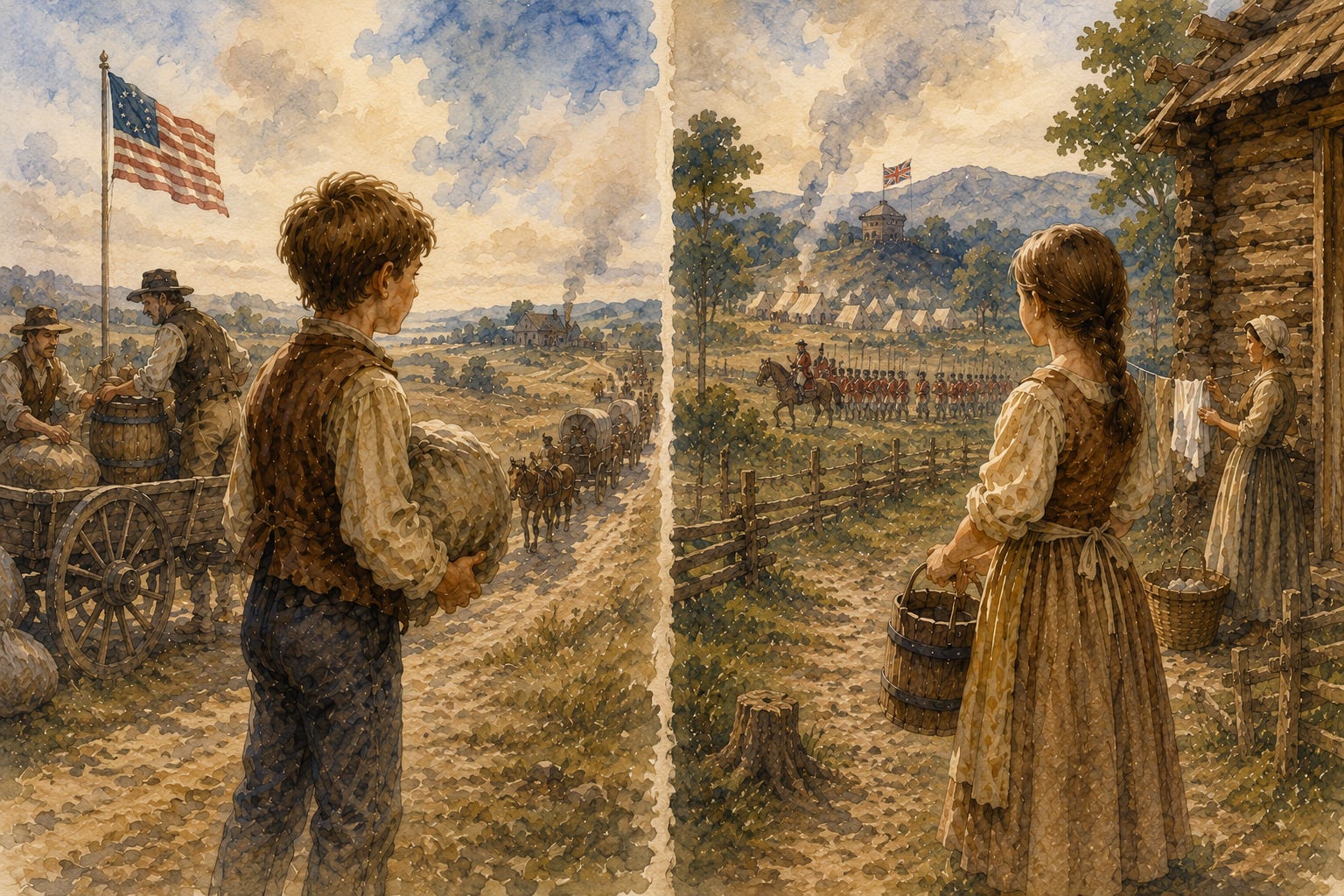
Neither carried a musket. Yet the war entered their lives immediately, since men from both communities joined local militia companies. Neighbors disappeared for weeks or months at a time.
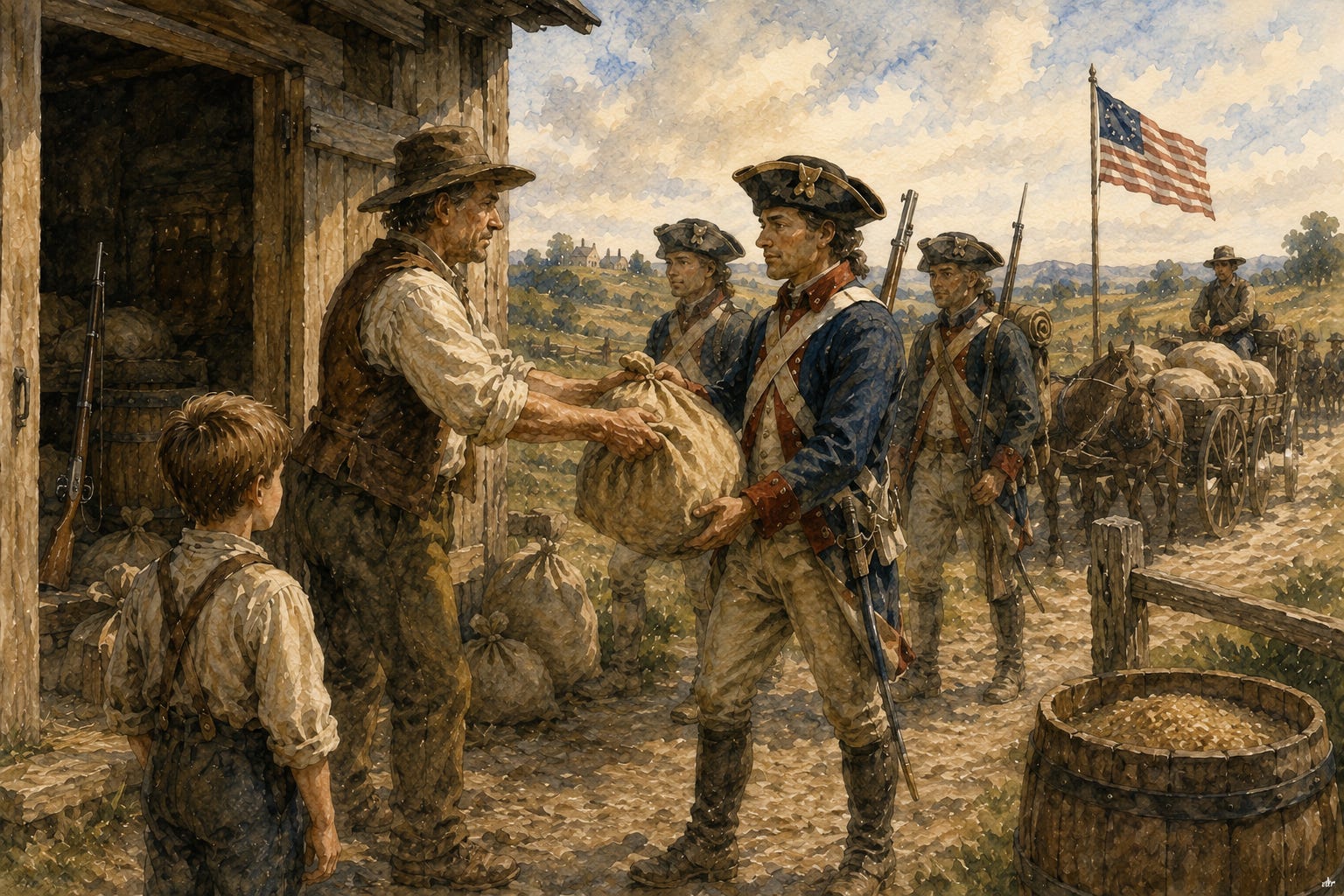
Church services increasingly included prayers for the Continental Army. Every harvest suddenly mattered, since Pennsylvania's farms became one of the Continental Army's greatest strengths. Flour, cattle, horses, wagons, blankets, and clothing all flowed eastward to feed and equip the struggling army.
Children often helped fill the gap left by absent fathers and older brothers. John’s own parents likely faced difficult choices in this regard. Like many Brethren and Mennonite farmers, Frederick appears to have believed deeply in caring for soldiers with food and shelter while refusing to take up arms himself.
Frederick’s other son and John’s brother, Henry, was listed as a “non-associator,” showing evidence the family was not willing to fight.
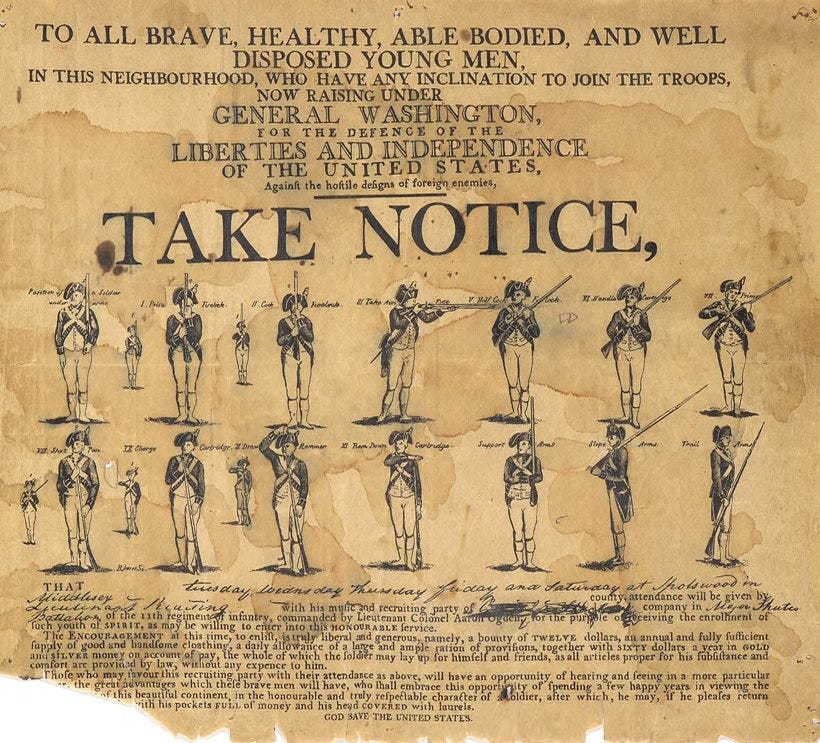
Broadside soliciting recruits for George Washington’s Continental Army, 1775 – Connecticut Historical Society
For a boy of eight or nine, watching his father quietly follow his conscience in such divided times could have become one of his earliest lessons in courage.
A world turned upside down
The year 1777 brought the Revolution startlingly close, when British troops captured Philadelphia. This forced the Continental Congress to flee first to nearby Lancaster and then to York—bringing the nation’s government within a day’s ride of young John’s home.
Overnight, the quiet farm country of central Pennsylvania became a vital artery of the Revolution—part of its logistical lifeline. Supply wagons rolled through the region carrying grain and livestock toward Washington’s army.
Rumors traveled even faster. Would the British march farther inland? Would Lancaster fall? Would their farms become battlefields?
No one knew. When Washington’s exhausted army settled into winter quarters at Valley Forge, farms across central Pennsylvania became essential to its survival. Flour, grain, livestock, and hay flowed eastward from counties like Lancaster, where John was growing up.
Although he was nearly a hundred miles away, the hardships of Valley Forge reached into his community through constant demands for food, wagons, horses, and labor.
Growing up too soon
Most children measure time by birthdays. John and Catherine likely measured theirs by the progress of a war:
John turned nine the year the Declaration of Independence was signed.
He was ten when Philadelphia fell.
Eleven during the terrible winter at Valley Forge.
Fourteen when news arrived of the victory at Yorktown.
Sixteen when peace was finally declared in 1783.
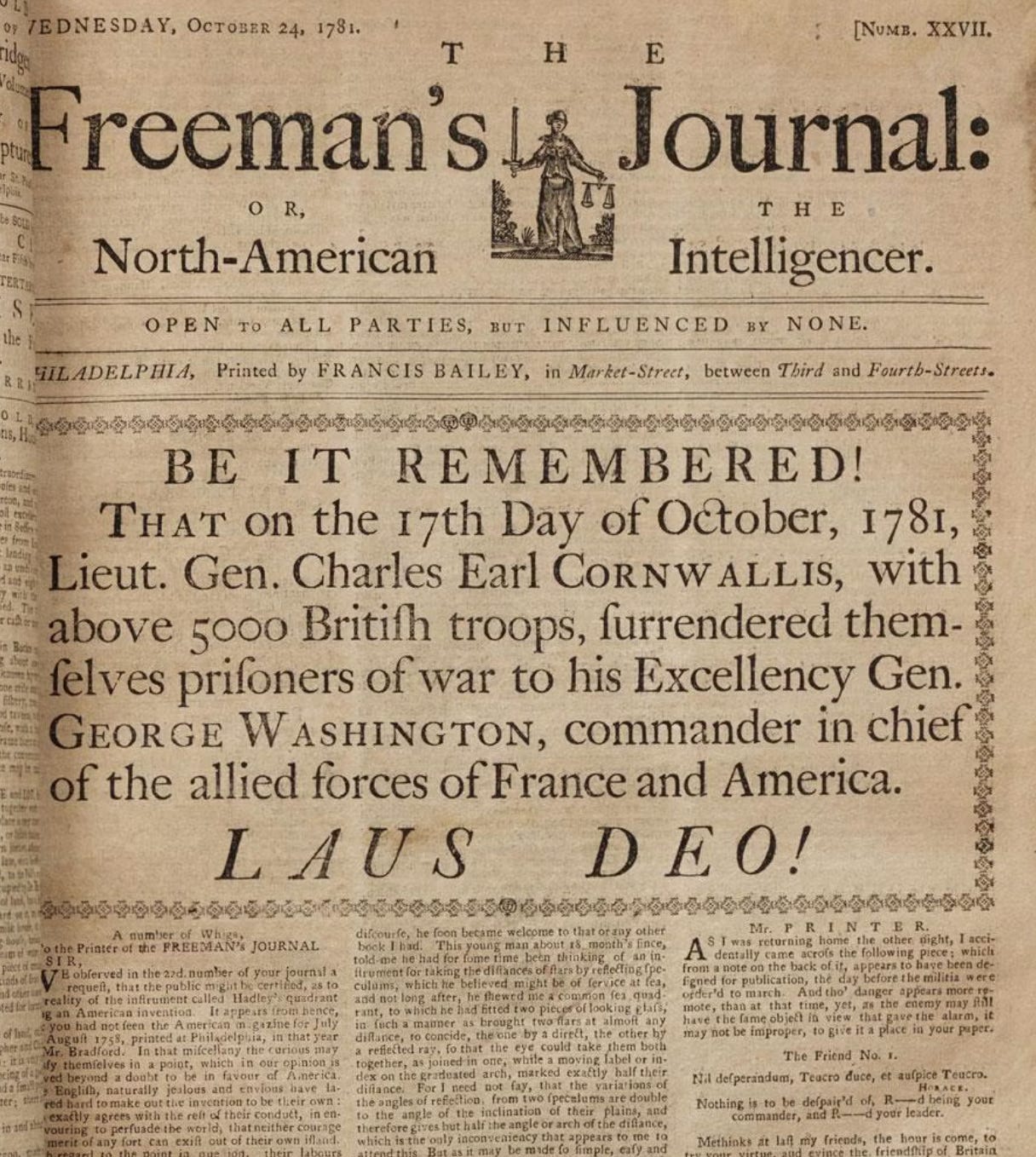
“Freeman’s Journal,” October 24, 1781. Patricia D. Klingenstein Library, New-York Historical Society, Newspaper Collection.
Catherine’s memories would have followed a similar rhythm. Her earliest recollections were not of an established nation, but of a people becoming one.
Their generation never knew childhood without uncertainty.
Building a new nation
When peace finally arrived, John was a young man of sixteen. And Catherine was thirteen.
The country surrounding them had changed forever. They had been born British subjects—and they entered adulthood as citizens of the United States.
The forests remained. The farms still needed tending. Yet the government above them, the flag they saluted, and the future they would build together belonged to an entirely new nation.
In time, John made his home in Washington Township, where Catherine had been born. Six years after the war had ended, they would wed in 1789 at 22 and 20 years old—raising their family among the same valleys and ridges that had shaped Catherine’s childhood, eventually settling on what became known as the Middour Farm near Quincy.
They had experienced both hope and sorrow after the war’s ending. As the new nation found its footing, John’s older brother Jacob had died in 1786 at only twenty years old. We do not know the cause. Whether illness, an accident, or some lingering consequence of the difficult years surrounding the Revolution, the loss surely impacted the family. Years later, John would name one of his own sons Jacob.
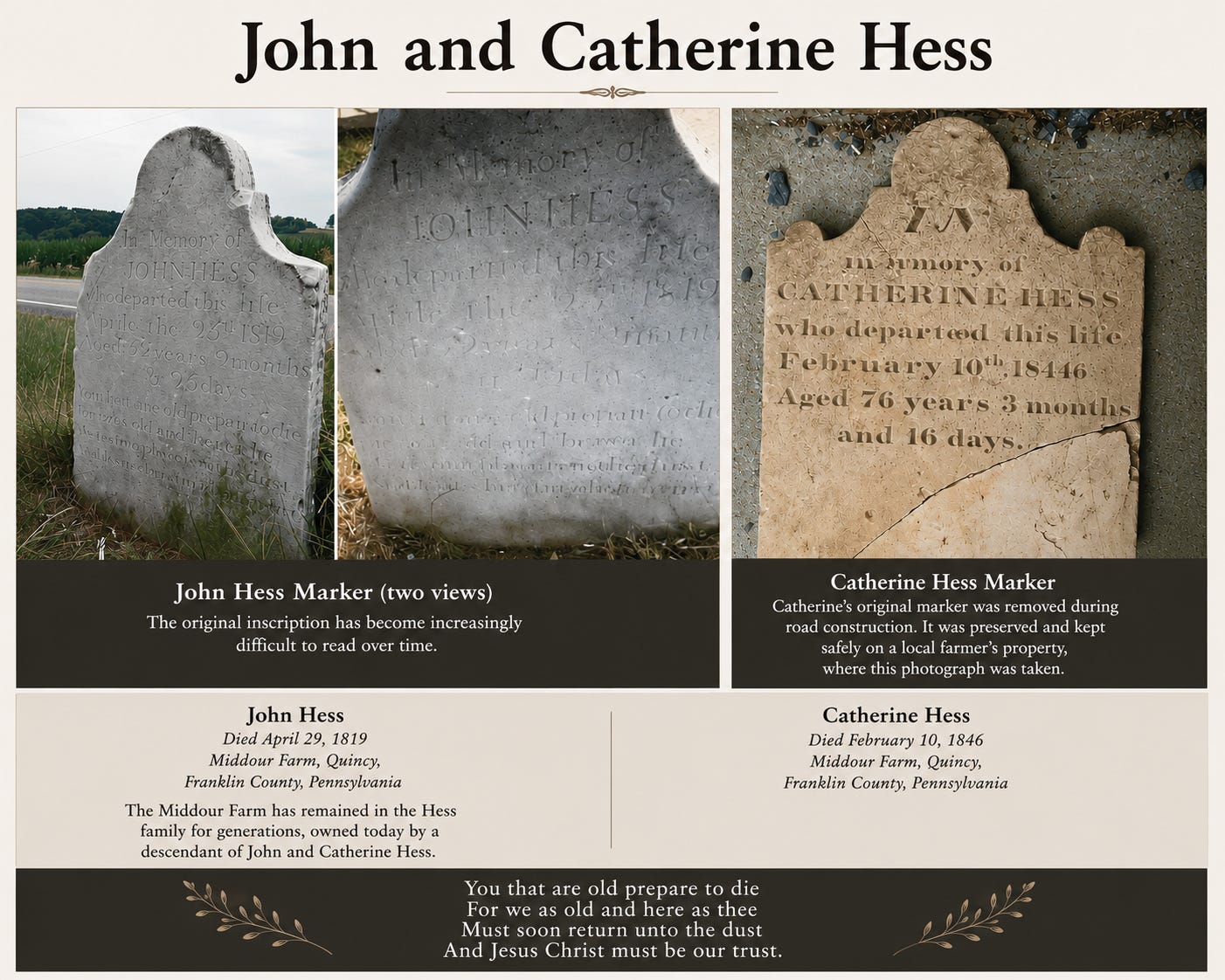
When John died at the Middour Farm on April 29, 1819 at age 52, he left behind more than land or a family name. He left a legacy he could scarcely have imagined as the world of his childhood slowly disappeared around him.
The British colonies of his birth were gone. His parents and grandparents who came from Europe had long since passed away. His beloved brother Jacob had been gone for decades.
Yet the nation that had grown up alongside him endured. John had been born the son of immigrants in Britain’s American colonies.2 He died an American citizen, leaving children and grandchildren who who would know the Revolution not as an epic memory, but as their own family history.
Catherine after John
In 1828, according to research by Naomi P. Hebbert in 1973, nearly every surviving child signed deeds settling John’s estate—a final family gathering preserved not in letters or diaries, but in courthouse records. One by one, you can imagine sons and daughters signing deeds acknowledging their portions and relinquishing any further claim to the family farm, allowing it to remain intact for the next generation.
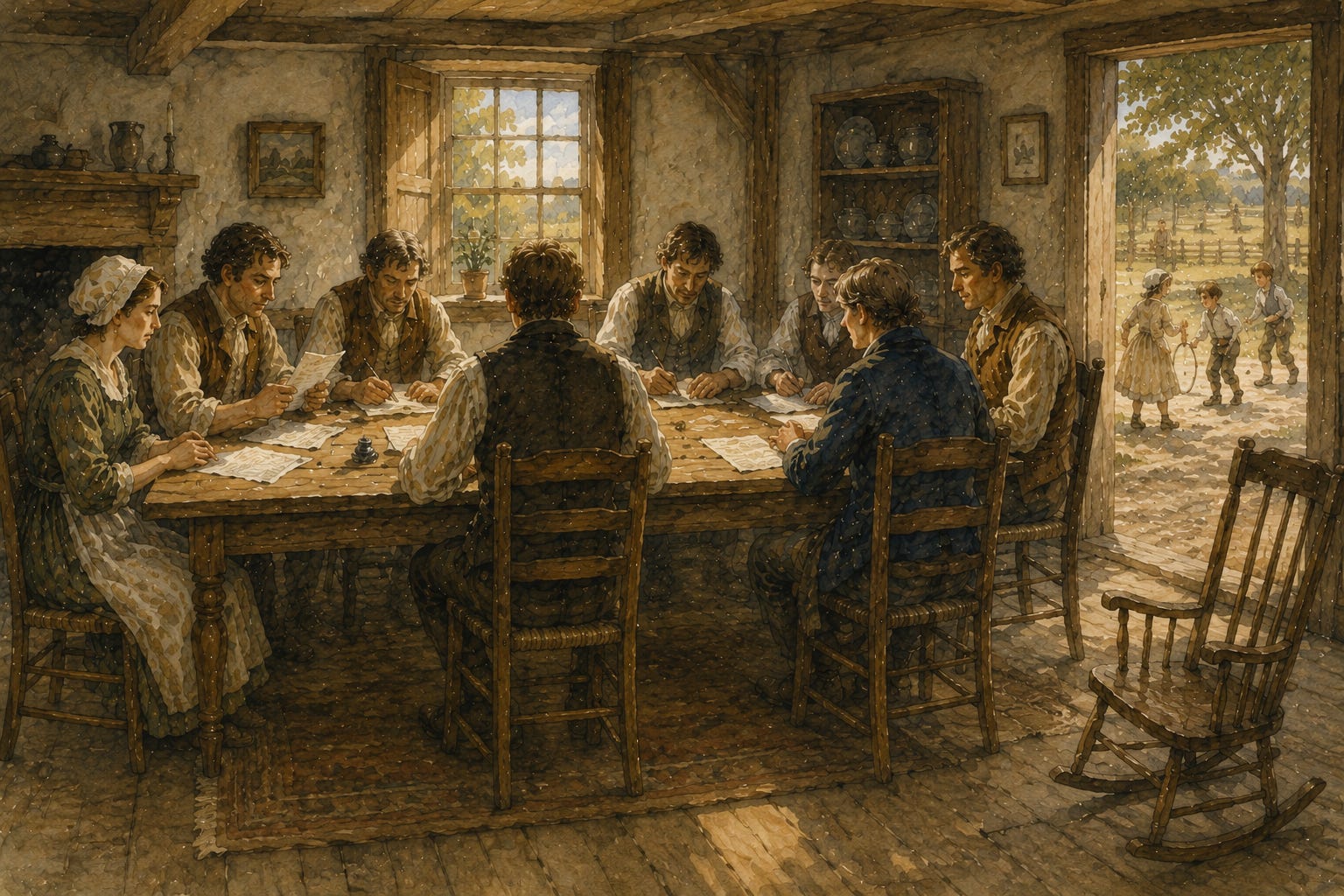
John’s death did not appear to end Catherine’s stewardship of the family farm. Court records show her actively managing her dower rights for several years afterward before transferring them to their son John. Even in widowhood, she remained at the center of the family’s affairs.
The Hess children largely remained rooted in the valleys where they had grown up. Several daughters had married nearby: the Middours, the Whitmers, the Snowbergers, the Shoaffes, the Goyers. They weren’t scattered across America. They were still neighbors—suggesting a tightly knit Pennsylvania farming community (although some did leave, like Jacob mentioned in the final section below).
Catherine, for her part, lived until 1846, dying at age 76—another 27 years. After John’s death, she appears to have spent her later years in the household of her daughter Barbara and son-in-law Jacob Middour—the very farm that remains in Middour family hands today.
During those years, Catherine no doubt raised younger children, watched grandchildren arrive, and saw America transformed. By the time she died, she had seen a generation of Hess children raise families of their own.
Catherine appears never to have remarried. Whether by circumstance or choice, she remained John Hess’s widow for another twenty-seven years.
During that time, she watched grandchildren fill the farmyard where her own children had once played. Roads improved, canals linked distant states, railroads began crossing Pennsylvania, and the young republic she had watched being born grew into a confident nation.
The America Catherine left in 1846 would have been almost unrecognizable to the little girl born a British subject in 1769.
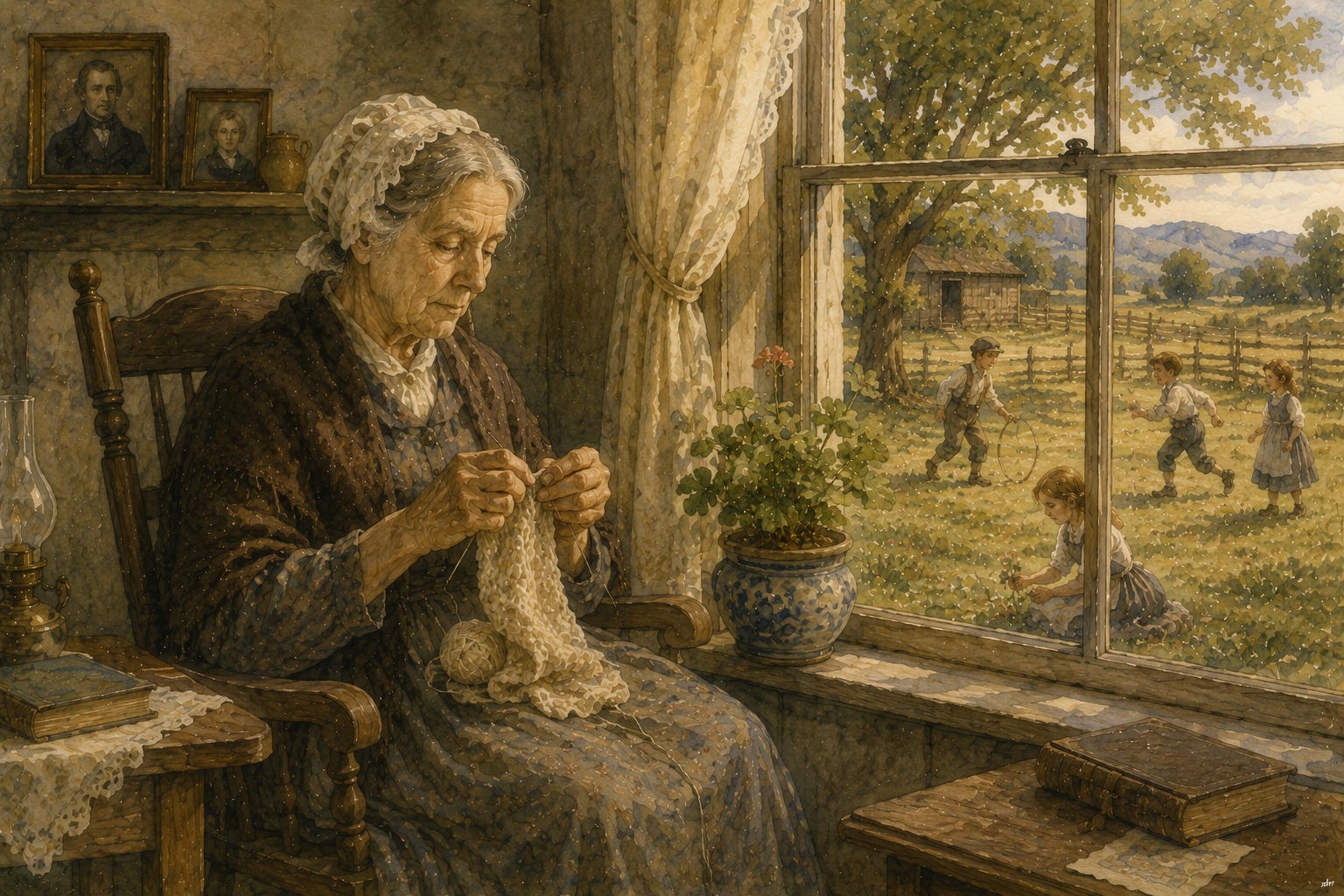
Catherine and John’s descendants become Latter-day Saints
During this same remarkable period, Joseph Smith had helped restore the Church of Jesus Christ—and was murdered 2 years before Catherine died.
John and Catherine’s son, Jacob, became one of the early converts to The Church of Jesus Christ of Latter-day Saints in 1834, along with his wife and young children after moving to Ohio.
Catherine would have been about 64 years old. We don’t know what she thought. Did she rejoice? Did she worry? Did she understand?
History is silent. But she almost certainly knew.
Less than a quarter century after Catherine’s death and nearly a century after Frederick Hess crossed the Atlantic seeking the freedom to worship according to his conscience, John and Catherine’s grandson, John W. Hess, returned as a missionary freely preaching the restored gospel to the same Pennsylvania valleys where John and Catherine had built their home.
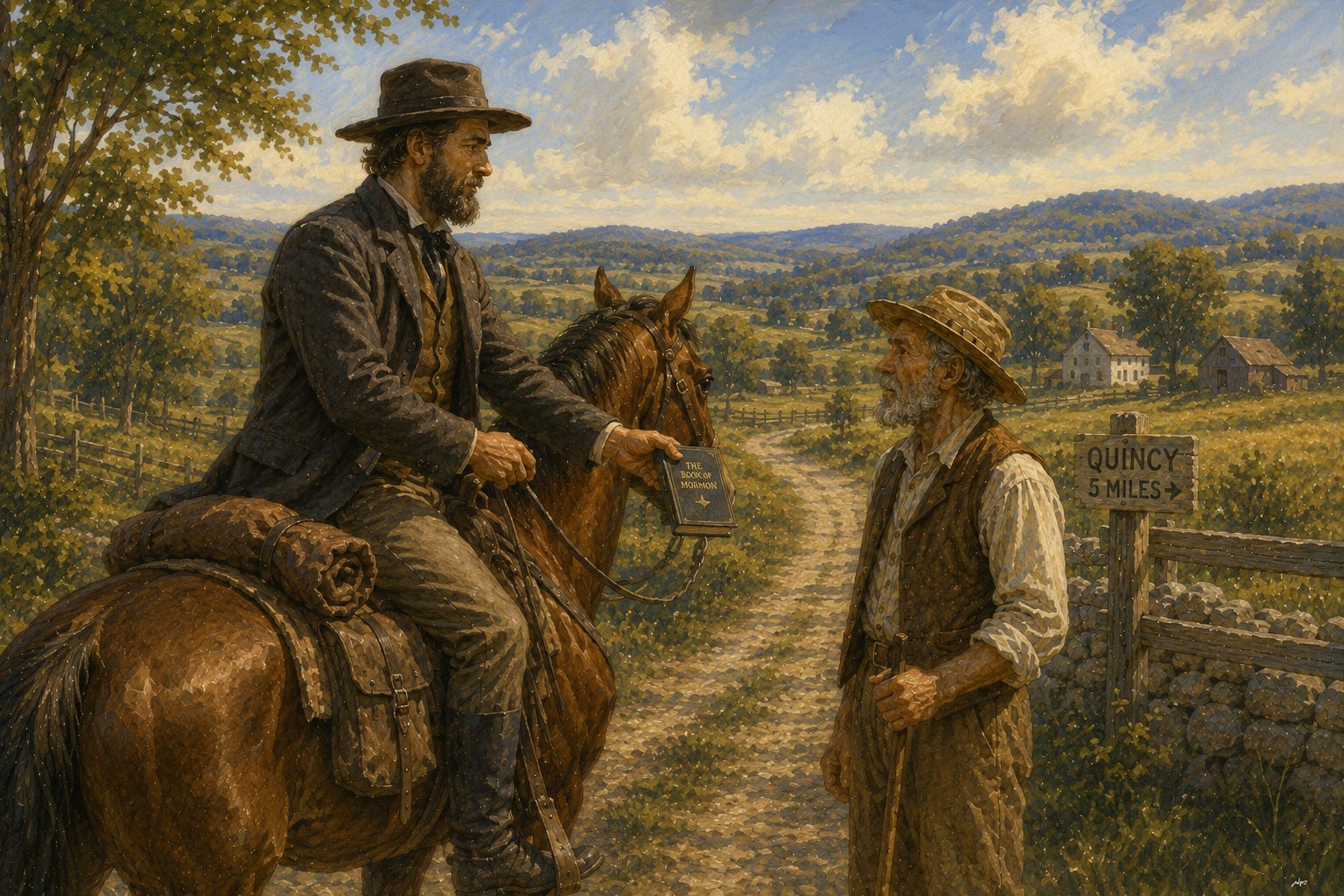
Carrying an expanded gospel message from the one his grandparents had cherished, John walked roads they had traveled, visited communities they would have recognized, and preached within sight of the farms where the Hess family had first taken root nearly a century earlier.3
It was a remarkable homecoming. The grandson returned not simply to his ancestors’ land, but to the place where their story in America had begun.
These names are listed as birthplaces in FamilySearch, but Ann Hess Clark points out that “we don’t know for certain if John Hess was born in Derry Township” - adding that we also “don’t know where Catherine was born.” Because of that, these descriptions of locations are speculative, based on tentative entries in current family trees.
Either this, or John’s parents were children of immigrants. The history isn’t entirely clear.
According to Ann Hess Clark, John W. Hess was not well-received in these missionary efforts except by a relative of his mother, Elizabeth Foutz Hess, with a surname of Reilly.