


Sharlee Mullins Glenn is weary from hearing stereotypes about “repressed” Latter-day Saint women — perceptions she has encountered over the years as a nonprofit leader with Mormon Women for Ethical Government.
It’s much less common for people to be aware of the church’s “actual doctrine regarding gender and leadership,” Glenn said at a recent Faith Matters Restore conference, emphasizing how the Church of Jesus Christ “clearly teaches that there is full equality between man and woman.”
She cited Elder Ulisses Soares of the Quorum of the Twelve Apostles as teaching, “The restored gospel of Jesus Christ proclaims the principle of full partnership between woman and man, both in mortal life and in the eternities.” And Glenn spoke of how this “divine pattern of collaboration” between men and women is reflected in many different aspects of the gospel and church teachings, including the faith’s emphasis on councils, acknowledgment of Heavenly Parents, the creation of Adam and Eve and the ministry of Jesus Christ, Paul and Joseph Smith.
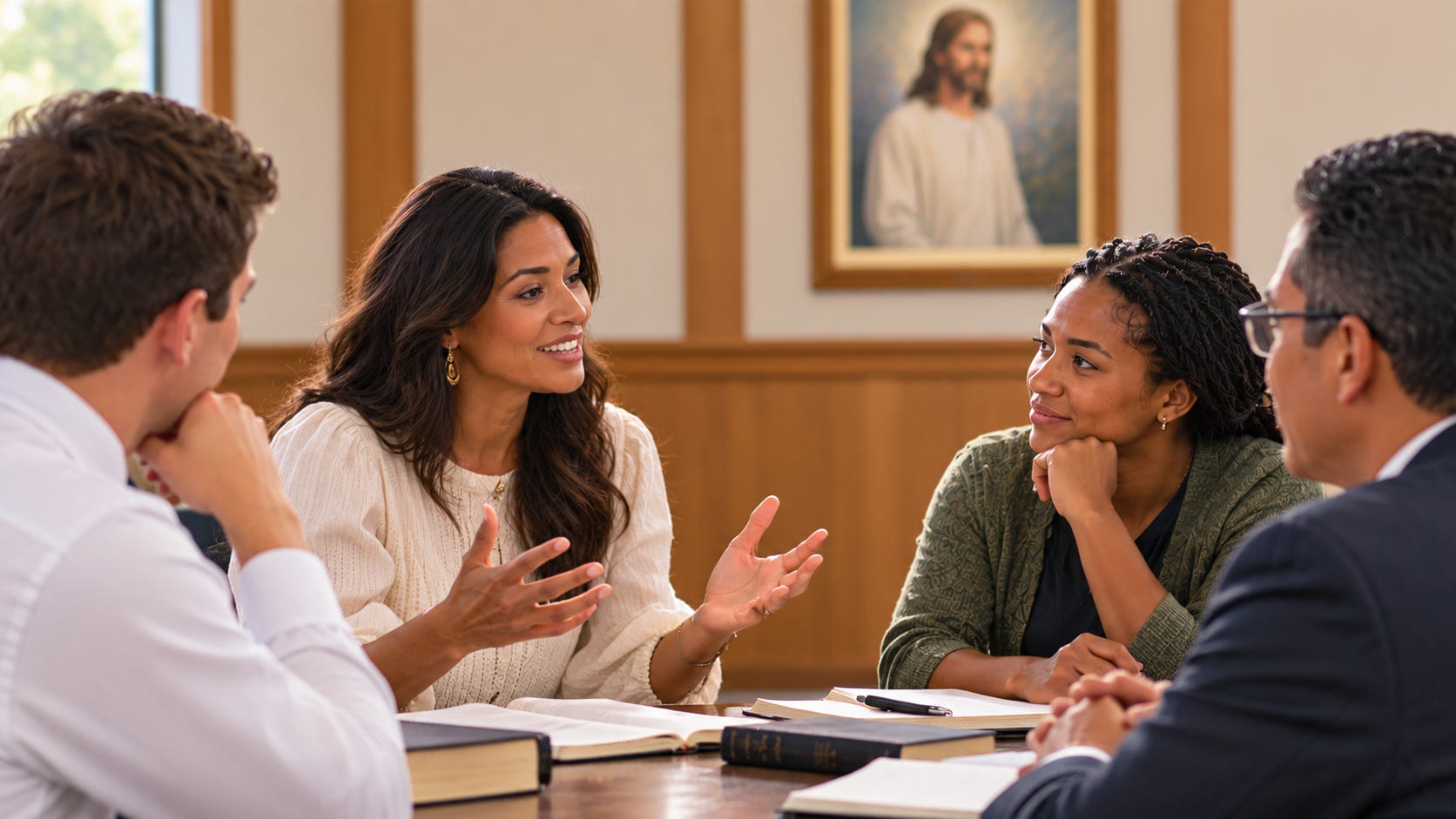
A new initiative developed by Latter-day Saint women and men in close collaboration, “Serving Together,” celebrates these teachings — while brainstorming practical ways to live them out in day-to-day ministry as lay leaders and members of The Church of Jesus Christ of Latter-day Saints.
Living out a theology of collaboration
“(When) we bring both perspectives together, we get a better perspective,” President D. Todd Christofferson said in 2025, referencing women and men working together. “We get closer to the divine perspective.”
In the same interview, President Dallin H. Oaks emphasized the need to keep improving: “We have not always been wise in using the great qualifications and powers of the daughters of God. … We have work left to do.”
“We have a beautiful theology,” conference co-presenter Amy Watkins Jensen underscored. “We love our church and our community. The Church of Jesus Christ of Latter-day Saints can be a light on the hill in modeling collaborative partnership and united leadership for the world.”
“We have a lot going for us already,” she said. “But we have challenges to overcome to get there.”
Practicing the ‘divine pattern of collaboration’
Glenn paused at the conference and expressed her gratitude for the Church’s bishops, stake presidents, elders quorum presidents and other male lay leaders, who she said “serve so selflessly and often at great personal sacrifice. And their wives, who are often the unsung heroes in this whole scenario.”
“No one asks to be a bishop. No one lobbies or campaigns for the position. It requires countless hours of unpaid and often unheralded labor. And most serve with tremendous humility, inspiration and genuine love for their congregations. We thank you,” she said.
“I think that most church leaders, both male and female, would like to experience full partnership in their callings, but many don’t know where to begin,” Ben Behunin, a stake president in Salt Lake City, told me. Since being called, he’s been exploring additional ways to help male and female leaders serve together well.
He’s learned from this new initiative additional ideas that have helped him recognize there are still many ways in which men and women can be better partners in the church.
“As a leader, I can be more sensitive to not only hearing women’s voices but (also) making sure that we’re implementing their ideas,” Behunin said.
Other ways to improve
Tarisai Mchuchu-MacMillan admitted feeling nervous putting her perspective forward as a newly called stake Relief Society president in Cape Town, South Africa.
When she shared concern about one way sisters may potentially be overlooked, her feedback was received positively by other local leaders — which she said “affirmed collaboration” and reminded her the Lord is involved in his work.
“How do I prepare sisters as they serve with the brothers who they co-serve with, who are their co-members in the Lord’s kingdom?” Mchuchu-MacMillan reflected.
The tool kit includes reminders of prophetic teaching, such as earlier clarification by then-Elder Oaks of the Quorum of the Twelve Apostles that “Men are not ‘the priesthood’” and discouragement of abbreviated expressions sometimes used, such as “the women and the priesthood,” or “we’d like to thank the priesthood for administering the sacrament.”
“The blessings of the priesthood, such as baptism, receiving the Holy Ghost, the temple endowment, and eternal marriage, are available to men and women alike,” he explained.
There are also references in the tool kit to handbook updates: “You could help ward members better understand the expanded stewardship of Relief Society presidents and Elders Quorum presidents since the 2019 policy changes and encourage sisters to counsel with their Relief Society president rather than their bishop when appropriate.”
Other reminders focus on areas people may not think about. For instance:
“Encourage members to acknowledge, thank and pray for all ward leaders and not just the bishopric.”
“Encourage both Elders Quorum and Relief Society to select talks given by women as the basis for Sunday lessons.”
And there is encouragement for women to participate more fully in council and class opportunities by sharing inspired feelings:
“Practice being in tune with the Spirit so you can show up as a full partner in moments of counseling and decision making.”
“When you are prompted by the Spirit to contribute in Sunday School or another meeting, raise your hand. Trust that others can benefit from what the Spirit is communicating through you.”

Drawing on the full strength of a ward
Bethany Brady Spalding, who contributed to the project, described a practical side of deepening male and female collaboration. “Everything that we do at church is as volunteers. And when we have stronger partnership, things just go better.”
Rachel Bates serves in Behunin’s stake as stake Young Women leader. She described the impact of “being a trusted and valued member of a team” in seeking revelation, sharing ideas and “showing up to support each other.”
“More information helps inspiration, and we also all really become friends as we serve together,” Bates said.
This new tool kit also includes questions to spark reflection for male leaders, such as:
Do my assumptions, habits and leadership practices reflect a genuine belief that women are essential, inspired, and authoritative participants in the Lord’s work?”
“Am I actively encouraging the sisters in my ward or stake to bring their strength, their conviction, their ability to lead and their wisdom to their participation in the Church?”
And women are likewise asked:
“Am I bringing my whole self — including my strengths, my conviction, my ability to lead, and my wisdom — to my participation in the Church?”
Doing even more good together
Far from a “nicety,” Jensen said that greater involvement of women is about increasing “mutual flourishing.”
“My connection to God, my love of Jesus got stronger as I practiced deeper collaboration in our ward,” she added. “Partnership is not a courtesy — it’s a revelation strategy.”
Glenn cited one recent study from Northwestern University, which found that teams made up of both men and women consistently produce more “innovative, impactful” results.
Mchuchu-MacMillan hopes that by practicing these collaborative skills in her stewardship, the sisters in her stake will “be able to find enjoyment and belonging in His Church, in becoming His beloved daughters in their full identity, fit for His kingdom.”
“There’s so much to gain and really nothing to lose,” Behunin said, “by enabling the women to do what they feel inspired to do.”
These other creative and specific ideas about collaboration have sparked “more harmony, partnership and mutual satisfaction” in his stake, he said. “It has already proven to be a great unifying blessing in our stake.”