


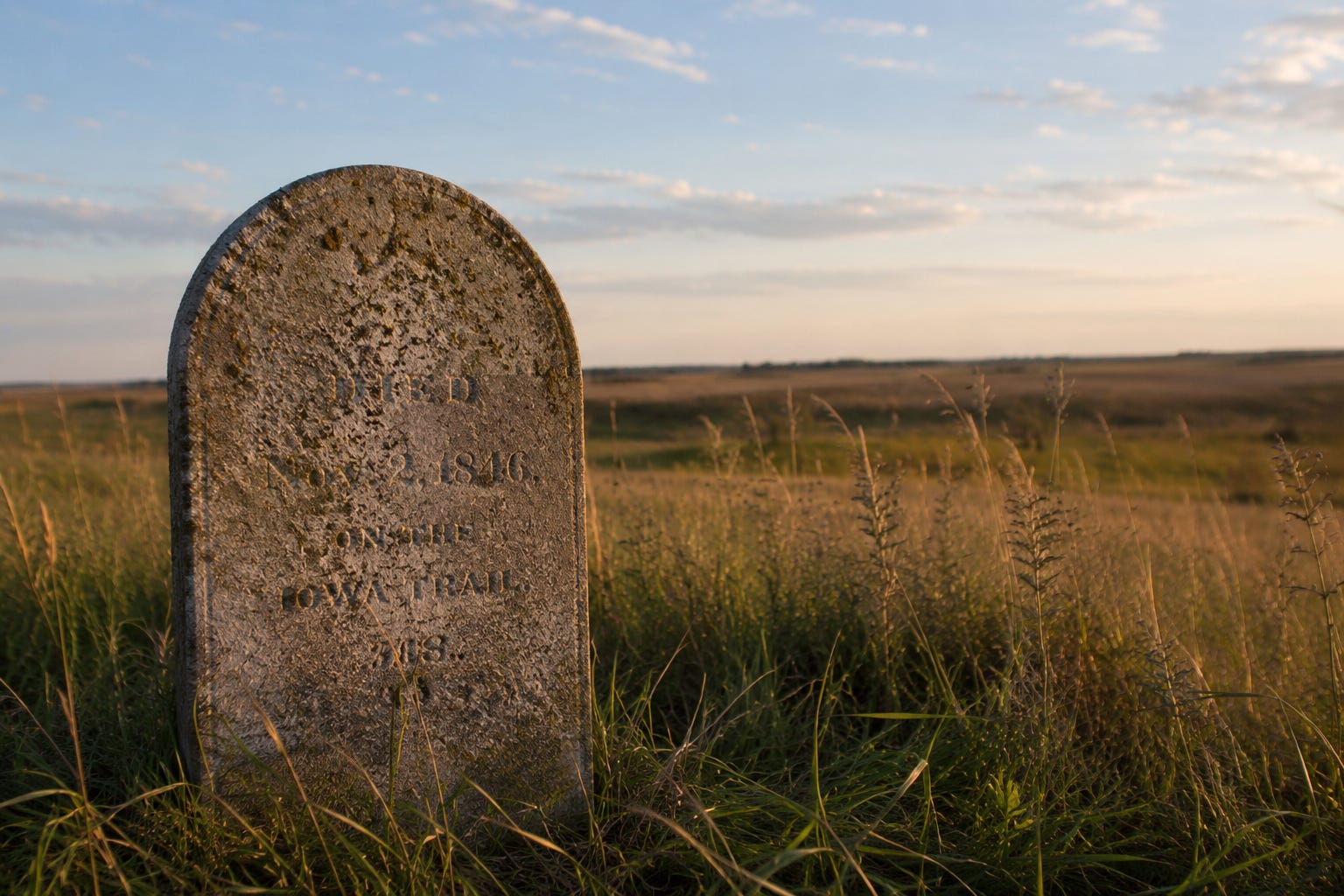
I just returned from a family trip to Nauvoo, Illinois, where 180 years ago, the man I’m named after was physically paralyzed and driven into poverty with his young family after they were forced to move a 3rd time due to the hatred of their neighbors. Before they could gather all their crops and farming supplies, their farm was burned by people who eventually drove all Latter-day Saints from the state of Illinois and country as a whole.
Buried in 1846 in a mass grave on the Iowa trail, Jacob Hess was one of millions of believers who accepted aching sacrifices for the truth they followed – demonstrating a courage that is rare today, even among the many who like to use those words “truth” and “courage.”
Monique has read to our boys Mark Twain’s history of Joan of Arc and I’ve been amazed in the strength of people I read about in Foxe’s Book of Martyrs. As Hugh Latimer nd Nicholas Ridley were about to be burned at the stake in 1555, Latimer was overheard saying: “Be of good comfort, Master Ridley, and play the man.”
He then makes the well-known prediction that they would, by God’s grace, light a candle in England that would not be put out.
We reverence these people’s lives for a reason – Hus, Tyndale, Bradford, Rogers – passing down their lives and teachings as a treasure for the generations. Twain highlights the “miracle” of Joan’s life during a time he calls “the brutalest, the wickedest, the rottenest in history since the darkest ages”:
She was truthful when lying was the common speech of men; she was honest when honesty was become a lost virtue; she was a keeper of promises when the keeping of a promise was expected of no one; she gave her great mind to great thoughts and great purposes when other great minds wasted themselves upon pretty fancies or upon poor ambitions … she was unfailingly true to an age that was false to the core….she was of a dauntless courage when hope and courage had perished in the hearts of her nation.
At the same time we’ve been discussing these incredible stories as a family, I’ve been noticing how often words like “integrity” and “courage” are being used by people disparaging and condemning faith online, who say things like:
“People are stepping away because of their integrity and honesty to the real truth they’ve found about that horrible religion.”
“Rejecting family and tradition may be the epitome of courage.”
“Leaving the church is about following conscience enough to move forward with integrity.”
Based on language alone, one could be forgiven for believing you were reading the words of someone making soul-level sacrifices for higher truths while embodying stirring integrity. But you don’t even have to look that close to realize you’re dealing with something very different.
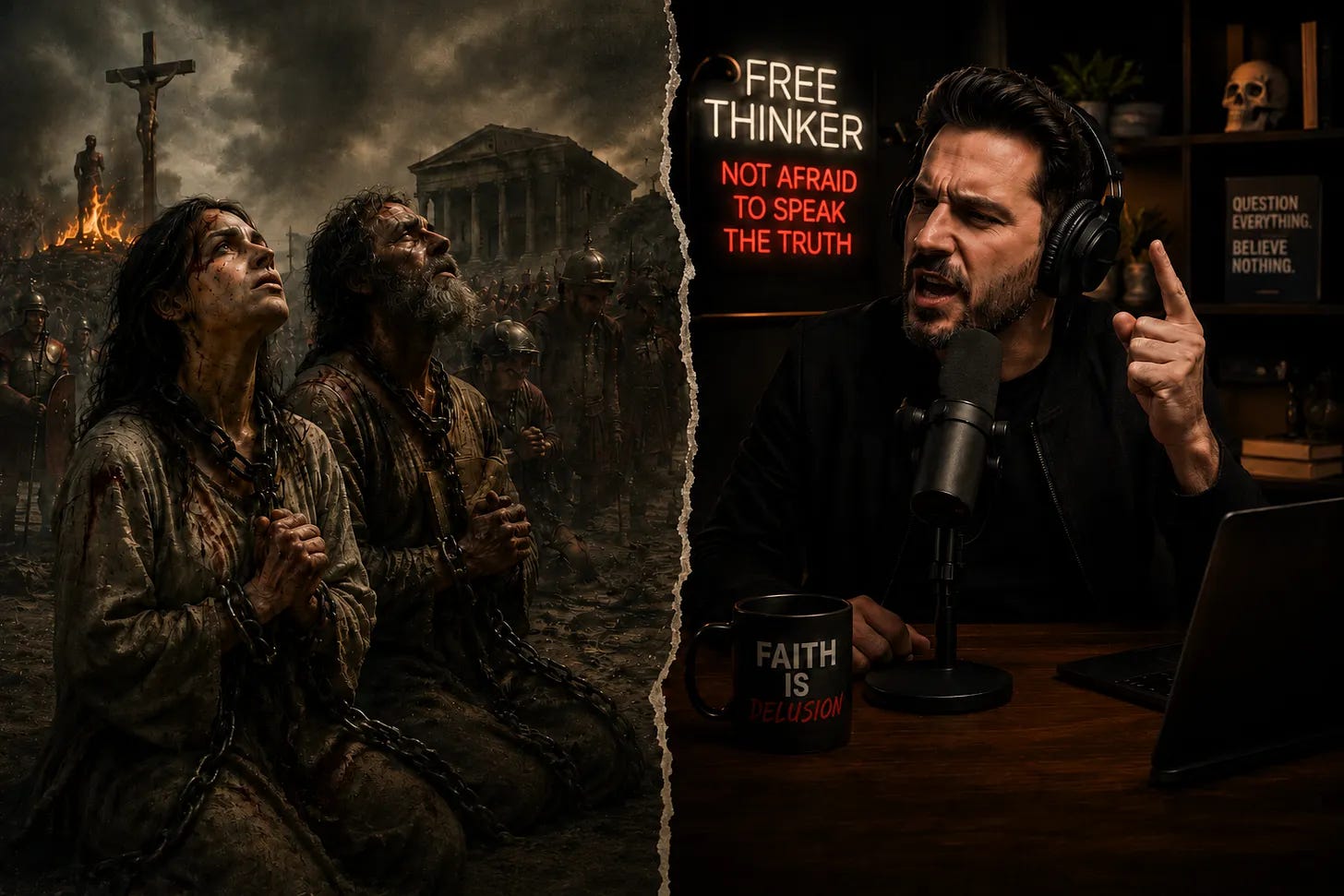
This comes across in at least three ways.
1. Embracing truth, or undermining it?
Although some of these prominent influencers are also fond of representing themselves as enlightened – having “both eyes opened” – in many cases, they’re actively attacking and undermining truths generations of Christian witnesses suffered and died to defend.
This denial and discrediting isn’t so easy to see when they are so often publicly using a language of seeking truth. But for many prominent influencers, it’s clear they are actively undermining faith in a pattern that is predatory more than anything else.
This is functionally the opposite of the martyr tradition – which centered around bringing sacred truth to light, strengthening others’ faith and sharing it with the world.
2. Standing apart from popular norms, or going along with them?
The martyrs were brutalized in their day precisely because they stood against the moral and intellectual currents of their own age. By comparison, modern narratives promoted about faith transition often encourage not greater estrangement from prevailing culture but greater harmony with it.
Even though plenty about integrity and courage may still be woven into this rhetoric, the practical endpoint often end up being embracing philosophies and lifestyles that are widely popular with the world, rather than standing up for truth “not of this world” that many cultural elites predictably hate.
In a day and age when wearing a costume from another culture can raise questions about misappropriation all this seems to me a legitimately wrongful appropriation of the historic and sacred tradition of courageous truth-tellers as a cloak or masquerade around what’s actually going on.
3. Accruing enormous personal costs, or attractive temporal benefits?
The personal cost of early believers was enormous – even to giving up their own lives. It’s true that for many who step away from faith, there can be significant, aching personal costs, as my friend Betsy VanDenBerghe wrote about for Deseret News.
But when it comes to the loudest voices who actively disparage faith while representing themselves as advancing truth, something very different is taking place.
Indeed, some of the most influential voices have built organizations with substantial audiences, conferences, books, podcasts, and donor support – along with plenty of revenue. As one commentator noted, “the more faith they shake, the more money they make.”
What courage is – and isn’t
Is courage shown in a willingness to be authentic or in remaining true when that becomes costly?
While modern authenticity culture often points inward, true sacrifice and courage point away from self. As G. K. Chesterton taught, “a martyr is a man who cares so much for something outside himself that he forgets his own personal safety.”
Earliest Christians were admired because they showed a willingness to hold firm to truth at a tremendous personal cost – reflected in the word martyr, which means “witness” in the Greek (μάρτυς, martys).
These martyrs weren’t courageous because they changed their minds. They were courageous because they remained faithful despite extraordinary cost.
Integrity quietly lived
Walking the streets of Nauvoo, I was lifted by the quiet faith behind the lives of those who gave up so much – among people who didn’t often speak out about integrity. Like many other pioneers, Jacob and Elizabeth didn’t leave any journals.
These people instead demonstrated courage – burying children, walking away from homes, crossing frozen rivers.
Even giving up their lives.
There are many who step away from faith, of course, who do feel in their own minds and hearts that they are doing so out of a sense of personal integrity, along with a willingness to make hard sacrifices. I’m not denying the reality of those feelings, or the goodness of the people experiencing them.
There is clearly an inner forcefulness people must have to be willing to sacrifice all they once experienced within a faith tradition like our own – and reject all they once knew and believed within it. Some would go so far as to call that a kind of bravery and courage – or integrity.
But are we too quick to use those words? The overarching narrative making sense of faith disaffection comes from somewhere. Rather than simply descriptive of faith dissolution, personal narratives are adopted and taken from available rhetoric.
And the most active proponents of questioning faith are keen to recast disaffection as an inevitably noble act that embodies courage, sacrifice and integrity.
If it’s true courage you want to hear about – or sacrifice and integrity – go back to the stories of people who embody it most.
After refusing to recant, Jan Hus was burned at the stake in 15th century Germany. But he first wrote urging believers, “Seek the truth, hear the truth, learn the truth, love the truth, speak the truth, hold the truth, defend the truth until death.”
Words like integrity, sacrifice, and courage belong first to these stories – people who endured ridicule, loss, imprisonment, exile, and even death rather than betray what they knew to be true.
History has already made that clear. And we should be careful before borrowing that language for something altogether different.